

When you're on warfarin, your body is walking a tightrope. Too much vitamin K, and your blood clots too easily. Too little, and you risk dangerous bleeding. It’s not about avoiding green vegetables - it’s about keeping your intake steady. Millions of people take warfarin for conditions like atrial fibrillation, deep vein thrombosis, or mechanical heart valves. And for many, the biggest challenge isn’t the pill itself - it’s figuring out what to eat.
Why Vitamin K Matters With Warfarin
Warfarin works by blocking vitamin K’s role in making clotting factors. Without vitamin K, your blood can’t clot properly - which is exactly what doctors want when you’re at risk for dangerous clots. But here’s the catch: vitamin K doesn’t just disappear after one meal. It builds up in your liver and keeps working for days. So if you eat a big plate of kale on Monday and nothing green all week, your INR (the measure of how long your blood takes to clot) will swing like a pendulum.Research from the NIH shows that every extra 100 micrograms of vitamin K you consume daily can drop your INR by 0.2 to 0.4. That might sound small, but if your target INR is 2.5, a drop of 0.5 could mean your blood is clotting too fast. On the flip side, skipping vitamin K for a few days can push your INR too high - increasing your risk of internal bleeding.
The Real Food List: Vitamin K-Rich Vegetables
You don’t need to give up greens. You just need to know what’s high in vitamin K and stick to consistent portions. The USDA FoodData Central database (2023) gives us the clearest picture. Here’s what you’re really dealing with:- Kale: 547 mcg per ½ cup cooked
- Spinach: 444 mcg per ½ cup cooked
- Collard greens: 418 mcg per ½ cup cooked
- Swiss chard: 299 mcg per ½ cup cooked
- Turnip greens: 265 mcg per ½ cup cooked
- Parsley: 246 mcg per ¼ cup fresh
- Mustard greens: 210 mcg per ½ cup cooked
- Brussels sprouts: 109 mcg per ½ cup cooked
- Broccoli: 102 mcg per ½ cup cooked
- Green cabbage: 82 mcg per ½ cup cooked
- Asparagus: 70 mcg per ½ cup cooked
- Romaine lettuce: 48 mcg per cup shredded
These aren’t outliers - they’re the norm. A single serving of cooked kale has more vitamin K than most people get in a full day from other foods. And if you’re eating salads, don’t assume lettuce is safe. Romaine is a solid source, and a big bowl of mixed greens can easily push you over your daily limit if you’re not tracking.
It’s Not Just Vegetables
Many people think only leafy greens matter. They’re wrong. Other foods pack a punch too:- Beef liver: 106 mcg per 3 oz
- Egg yolks: 25 mcg per large egg
- Seaweed: 45-100 mcg per 10g dried
- Boost or Ensure drinks: 25 mcg per 8 oz
- Viactiv Calcium Chews: 25 mcg per tablet
These aren’t hidden dangers - they’re common. If you take a daily protein shake or chew calcium supplements, you’re getting vitamin K without realizing it. Read labels. If you’re on warfarin, you need to know what’s in every bite.
What You Can Eat - And How Much
The biggest myth? That you have to avoid vitamin K entirely. That’s not just unnecessary - it’s dangerous. A 2022 study from the University of Iowa found that patients who cut out all greens had more INR swings than those who ate them consistently. Why? Because their bodies had no baseline. When they finally ate spinach again, their INR crashed.Experts now agree: eat 1-2 servings of vitamin K-rich foods daily, and keep it the same every day. That means if you normally eat ½ cup of cooked spinach on Tuesday and Thursday, stick to that. Don’t swap it for kale on Wednesday. Don’t skip it when you’re sick. Don’t go on a salad binge in summer.
The safe range? ±25 mcg from day to day. So if your usual intake is 100 mcg, aim for 75-125 mcg. That’s a buffer that keeps your INR stable. For most people, that’s one serving of spinach or a small side of broccoli. Not a giant bowl. Not a smoothie with three cups of kale.
What to Avoid Completely
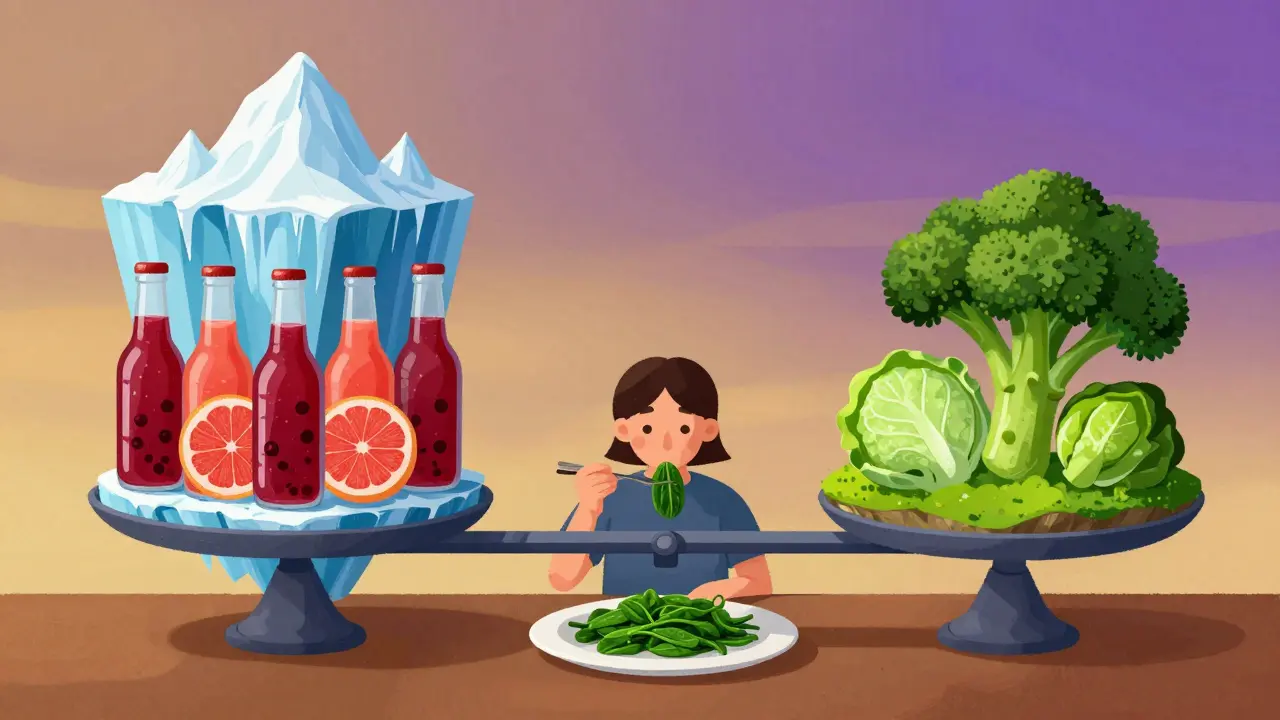
Some things aren’t about quantity - they’re about risk. These are absolute no-go zones:- Cranberry juice: Can spike INR by 0.8-1.2 units in 72 hours. One glass is enough to cause trouble.
- Grapefruit juice: Blocks the enzyme that breaks down warfarin, making the drug stronger. A 2021 study showed it can increase warfarin levels by 15-30%.
- Large amounts of alcohol: More than one drink a day can interfere with liver function and warfarin metabolism. Stick to moderation - and keep it consistent.
These aren’t “maybe” risks. They’re proven, documented dangers. Even if you’ve had cranberry juice for years, stop now. Your INR doesn’t care about tradition.
Common Mistakes (And How to Fix Them)
A 2023 University of Michigan report looked at 312 warfarin-related ER visits. Here’s what went wrong:- Stopping greens when sick (28.7% of cases): When you’re nauseous, you skip meals. But skipping vitamin K for a few days can make your INR shoot up. Keep eating your usual amount - even if it’s just half a cup of broth with chopped spinach.
- Starting new supplements (24.3%): Vitamin K supplements, fish oil, green tea extract - all can interfere. Never start one without talking to your doctor.
- Seasonal eating changes (19.1%): Summer means more salads. Fall means less. That swing is exactly what destabilizes INR.
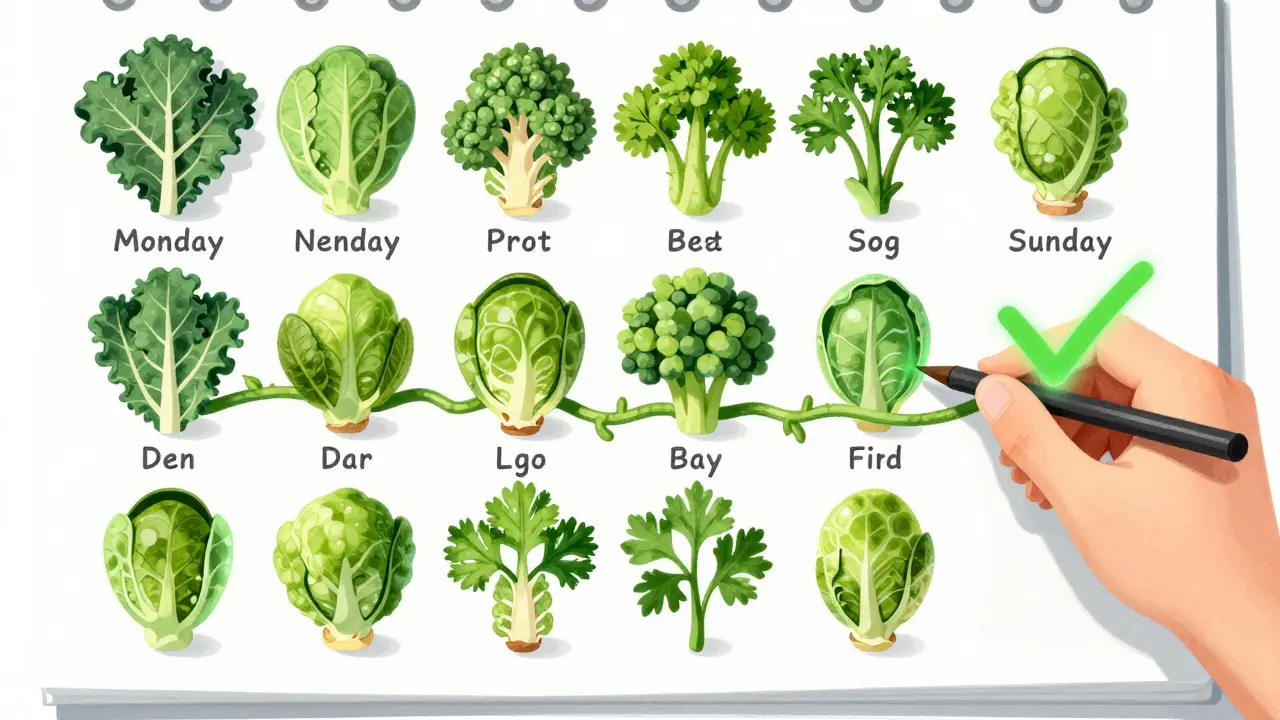
The fix? Treat your diet like your medication schedule. Same time. Same amount. Same foods. Write it down. Use a food diary. Take a photo of your plate. Apps like the National Blood Clot Alliance’s Warfarin Food Guide (used by over 42,000 people) make it easy.
How to Build a Stable Routine
Getting this right takes time - usually 3 to 6 months. Here’s how to do it:- Track your current intake for 7 days. Use a food diary or app. Don’t guess - measure.
- Find your baseline. What’s your average daily vitamin K? If you’re eating 120 mcg, that’s your new target.
- Choose 1-2 foods you’ll eat daily. Spinach, broccoli, or cabbage. Pick what you like.
- Stick to the same portion. Always ½ cup cooked. Always 1 cup raw.
- Time it right. Eat vitamin K-rich foods in the evening, after your morning INR test. This reduces daily variation.
- Check labels. Processed foods, meal replacements, and even some multivitamins contain vitamin K.
Patients who followed this plan saw their time in therapeutic INR range increase by over 12%. That’s fewer blood tests, fewer hospital visits, and less stress.
When to Call Your Doctor
You don’t need to panic over every small change. But call if:- Your INR jumps above 4.0 or drops below 1.5
- You’ve had a major dietary change (travel, illness, new supplement)
- You’re bleeding unusually - nosebleeds, bruising, dark stools
- You’ve missed doses or taken extra warfarin
Don’t wait. A quick call to your anticoagulation clinic can prevent a crisis.
The Bigger Picture: Warfarin Isn’t Going Away
Newer blood thinners like apixaban and rivaroxaban are popular now. But warfarin is still the go-to for mechanical heart valves, antiphospholipid syndrome, and severe kidney disease. In 2023, nearly 4.7 million Americans over 65 were on warfarin. That number is growing.And here’s the truth: the people who do best aren’t the ones who avoid greens. They’re the ones who eat them - every day, the same way. It’s not about perfection. It’s about consistency.
If you’re on warfarin, your diet isn’t a restriction. It’s your partner. Get it right, and you’re not just avoiding complications - you’re living fully.
Diana Dougan
so u just said dont eat kale but also eat it every day?? like wtf is this guide?? i ate a salad yesterday and now my INR is in the toilet and u wanna tell me it’s the ‘consistency’?? bruh.
Bobbi Van Riet
I’ve been on warfarin for 7 years and this is honestly the most practical guide I’ve ever read. I used to panic every time I ate spinach, but now I just stick to ½ cup cooked every Tuesday and Thursday-same as my blood test day. I even use the National Blood Clot Alliance app and it’s been a game-changer. No more wild INR swings. Consistency isn’t sexy, but it saves your life.
Natasha Plebani
The ontological paradox of warfarin management lies in its demand for metabolic constancy amidst dietary flux. Vitamin K, as a fat-soluble cofactor in the gamma-carboxylation of glutamate residues, functions not as a binary on/off switch but as a modulatory rheostat within the coagulation cascade. The clinical imperative, then, is not restriction but rhythmic entrainment-a circadian and culinary synchronization that stabilizes hepatic vitamin K epoxide reductase activity. The real pathology isn’t the vegetable-it’s the human tendency toward episodic, emotionally driven nutritional rebellion.
Eliana Botelho
Wait, so you’re telling me I can’t have a green smoothie with kale, spinach, and parsley every morning? That’s literally my entire breakfast. And now you’re saying I need to eat the same amount every day? What if I’m on vacation? What if I hate broccoli on Tuesdays but love it on Thursdays? This is fascism disguised as medical advice. Also, who even measures cooked spinach in cups? I just dump it in and hope for the best.
Darren Gormley
lol this is why people die on warfarin 🤡
"eat the same amount every day"
bro i ate a salad on monday, a burger on tuesday, and a kale smoothie on wednesday
my INR was 6.2
now i just take apixaban and drink grapefruit juice like a boss 🍊
Mike Rose
all this talk about vitamin k and cups of cooked spinach… i just dont eat green stuff. i eat chicken, rice, bread. done. why make it hard? also i think this whole warfarin thing is just a big pharma scam anyway.
Sheila Garfield
I really appreciate how this guide doesn’t just say "avoid greens" but instead gives a realistic path forward. I used to feel guilty every time I craved a salad, but now I know it’s not about deprivation-it’s about rhythm. I even started meal prepping a small portion of steamed broccoli on Sundays. It’s not perfect, but it’s sustainable. Thank you for writing this with compassion.
Holly Robin
THEY KNOW. THEY ALL KNOW. The FDA, the doctors, the food companies-they all push this "consistent vitamin K" lie so you stay dependent on warfarin and don’t switch to the REAL solution: vitamin K antagonists like nattokinase. They don’t want you to know that seaweed and fermented soy can regulate your clotting naturally. They’re hiding the truth behind "INR ranges" and "cooked portions." I’ve been off warfarin for 14 months and my INR is 2.1 without a pill. They’re terrified of this information.
Lily Steele
Just started warfarin last month and this helped more than my doctor’s 5-minute lecture. I’m eating half a cup of spinach every night with dinner and using a food tracker app. No more guessing. I feel in control for the first time. You don’t need to be perfect-just consistent. You got this.
Rob Webber
THIS IS WHY PEOPLE DIE. You tell someone to eat the same amount of kale every day like it’s a math problem? What if they’re poor? What if they can’t afford organic spinach? What if they have to eat whatever the food bank gives them? This isn’t advice-it’s privilege wrapped in a medical pamphlet. And now you want them to photograph their meals? Like they’re on Instagram? Get real.
Lisa McCluskey
I’ve been on warfarin for 12 years. I eat ½ cup cooked broccoli every day. Sometimes I swap it for cabbage. Sometimes I skip it when I’m sick. My INR stays in range because I test weekly and talk to my anticoagulation nurse. The key isn’t perfection-it’s communication. If you’re unsure, call your clinic. They’ve seen it all. And no, you don’t need to take photos of your dinner.