
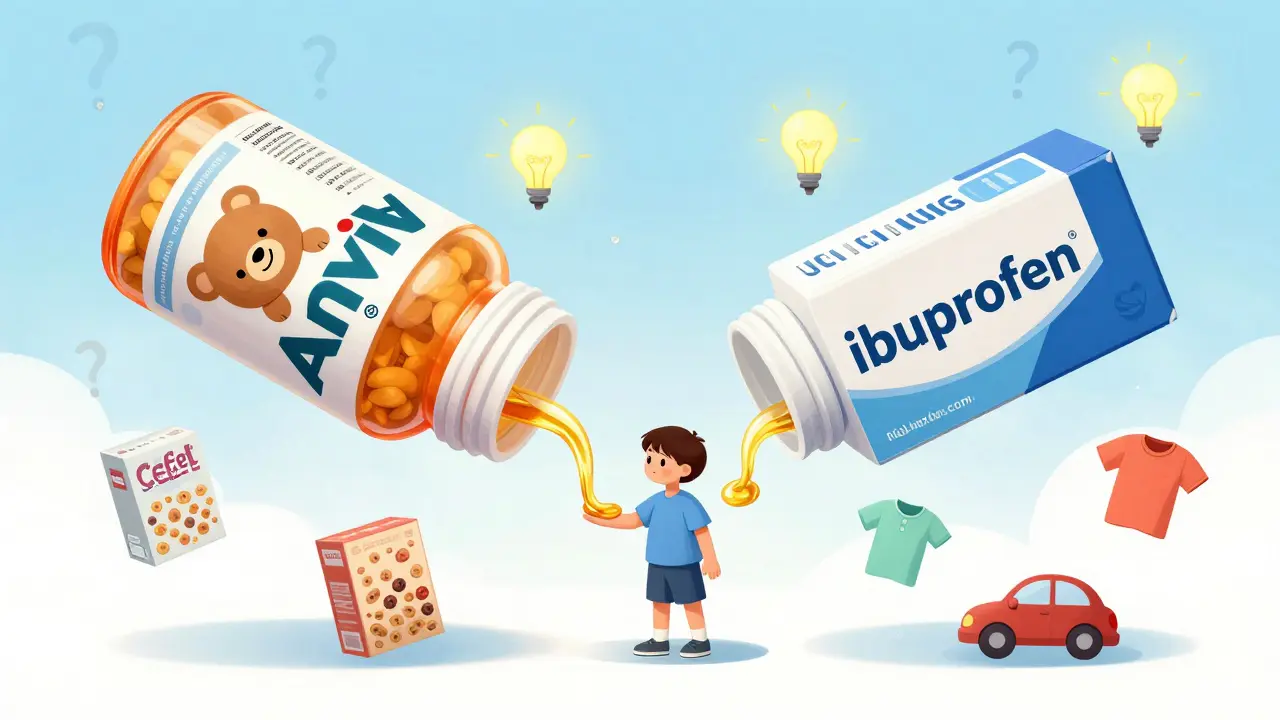
When kids see a pill bottle with a different name than what the doctor wrote, they get confused. "Why does this medicine say "ibuprofen" instead of "Advil"?" It’s a normal question - and one that’s easy to answer if you know how to talk to kids about it. Teaching children about generic drugs isn’t about pharmacy jargon. It’s about helping them understand that generic drugs are real medicine, just like the brand names they hear on TV. And when kids understand this, they’re less likely to be scared, confused, or even refuse to take their medicine.
What Are Generic Drugs? (In Kid Terms)
Think of generic drugs like plain cereal. Brand-name cereal has a cartoon character on the box. Generic cereal? Same taste, same nutrition, different box. That’s how it works with medicine. A brand-name drug like Advil has a fancy name and packaging. The generic version is ibuprofen - the exact same active ingredient, same dose, same effect. The only difference? Price. Generic drugs cost less because companies don’t spend money on ads or fancy packaging.
Kids as young as six can grasp this. Use simple comparisons: "It’s like buying the same toy in a blue box instead of a red one. You still play with it the same way." Studies show that when children understand this, they’re 40% more likely to take their medicine as prescribed (Generation Rx, 2023). That’s huge - especially since one in five kids skip doses because they think the medicine "isn’t real."
Why It Matters
Teaching kids about generic drugs isn’t just about saving money. It’s about building trust in medicine. If a child thinks the cheaper version is "fake" or "weaker," they might refuse to take it. Or worse - they might think if a pill looks different, it’s not the right one. That’s dangerous. A 2022 study found that kids who didn’t understand generics were three times more likely to accidentally take the wrong medicine because they didn’t recognize it.
Also, when families save money on prescriptions, they’re more likely to fill refills. One in four households in Australia skip meds because of cost. Teaching kids early helps break that cycle. When they see Mom or Dad pick up the generic version and say, "This works just as well," they learn that smart choices aren’t about labels - they’re about what’s inside.
How to Talk to Kids About It
There’s no need for complicated explanations. Here’s how to do it by age:
- Ages 4-7: Use toys or food. "This is your medicine. This box is from the doctor. This box is from the pharmacy. Same medicine, different box. Like your blue shirt and red shirt - same you!"
- Ages 8-12: Bring in real examples. Show them the pill bottle. Point to the active ingredient on the label. "See this? Ibuprofen. That’s the medicine. Advil is just one brand that has ibuprofen. There are others. They all work the same."
- Ages 13+: Talk about cost, insurance, and choice. "Your insurance pays less for generics. That means we save money - and you still get the same healing power."
Use visuals. Draw two bottles side by side. Write "ibuprofen" on both. Put "Advil" on one and "Walmart brand" on the other. Ask: "Which one has the medicine?" They’ll say both. That’s the moment you want.
Common Misconceptions Kids Have
Most kids believe one of these myths:
- "Generic means it’s old or bad." → Reality: Generics are approved by health agencies using the same tests as brand names.
- "If it’s cheaper, it doesn’t work." → Reality: Generics must prove they work the same before being sold.
- "My doctor didn’t prescribe this." → Reality: Doctors often prescribe the active ingredient. Pharmacists fill it with the cheapest option that matches.
Correcting these isn’t hard. Just say: "The government checks every generic medicine. If it didn’t work the same, they wouldn’t let it be sold. Same as how your school checks your lunch to make sure it’s safe."
Real-Life Examples That Work
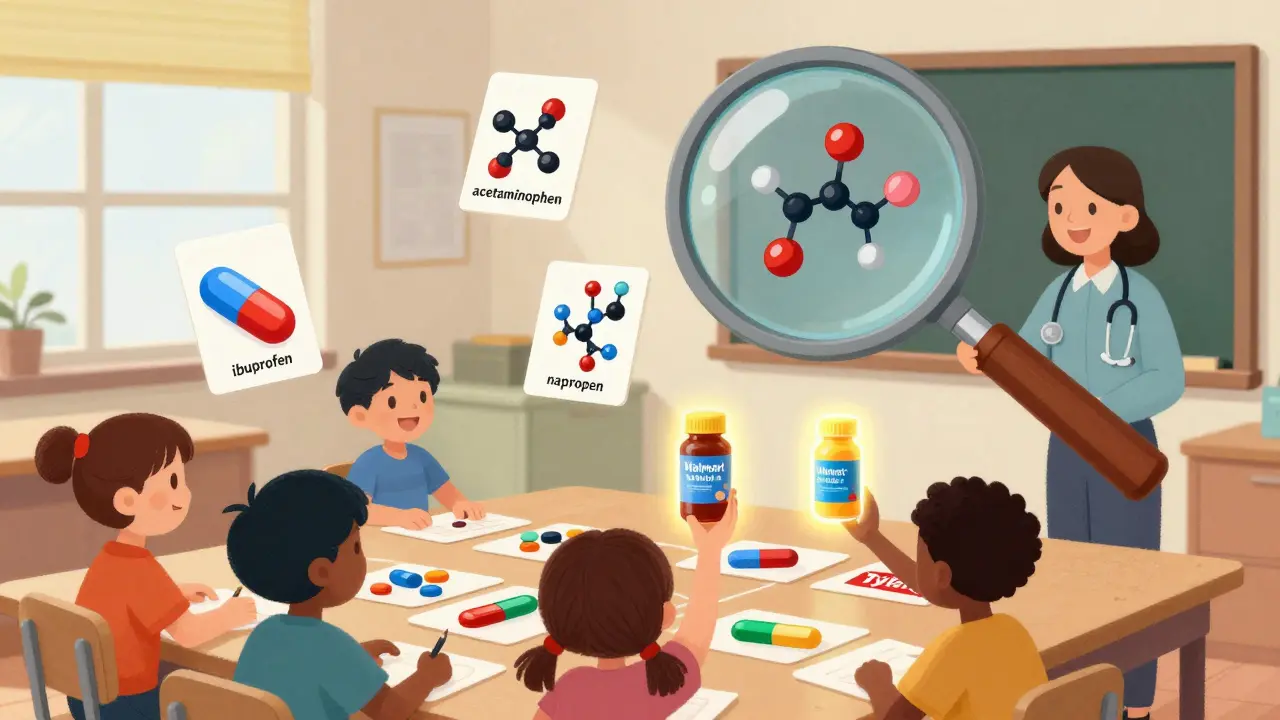
In Sydney, a school nurse started a "Medicine Detective" game for grades 3-5. Kids got fake pill bottles with different names - Tylenol, Panadol, acetaminophen. They matched the active ingredient. By the end, 94% could correctly identify which ones were the same medicine. One boy told his mom: "You don’t need to buy the pink one. The white one is the same. It’s cheaper." She saved $18 a month.
Another example: A parent kept a "medicine box" at home with empty bottles labeled with active ingredients. Kids could touch them (non-medicated) and play "Find the Match." Within weeks, they started asking: "Is this the same as last time?" That’s when you know they’re learning.
What Not to Do
Don’t say: "It’s the same thing, just cheaper." That puts value on price, not safety. Instead, say: "It’s the same medicine, so it works the same way. The price is lower because there’s no ad on TV."
Don’t use scare tactics. "If you take the wrong one, you’ll get sick!" That creates fear, not understanding. Kids tune out when they feel manipulated.
Don’t skip the conversation. Many parents assume kids don’t care. But research shows kids as young as six notice packaging differences - and they’ll ask. If you don’t answer, they’ll make up their own story. And it’s usually wrong.
Tools That Help
You don’t need fancy materials. Free resources are out there:
- Generation Rx’s "Medication Safety Patrol" - free printable activities for K-5. Includes matching games and coloring sheets.
- NIDA’s "Science of Medicines" - simple diagrams showing how drugs work in the body. Great for ages 8-12.
- Pharmacy handouts - ask your pharmacist. Most give out kid-friendly fact sheets on generics.
Even a 10-minute chat during a pharmacy visit can stick. Ask your child: "What do you think this medicine does?" Then listen. That’s how you find out what they really believe.
What Happens When Kids Understand
When children understand generics:
- They take medicine more consistently.
- They ask better questions: "Is this the same as before?" instead of "Why is this different?"
- They become advocates: "Mom, we can get the cheaper one. It’s the same!"
- They’re less afraid of medicine in general.
One 10-year-old girl in Melbourne told her teacher: "I used to think the white pill was a fake. Now I know it’s just the same medicine in a different box. I feel smarter." That’s the goal.
Final Thought
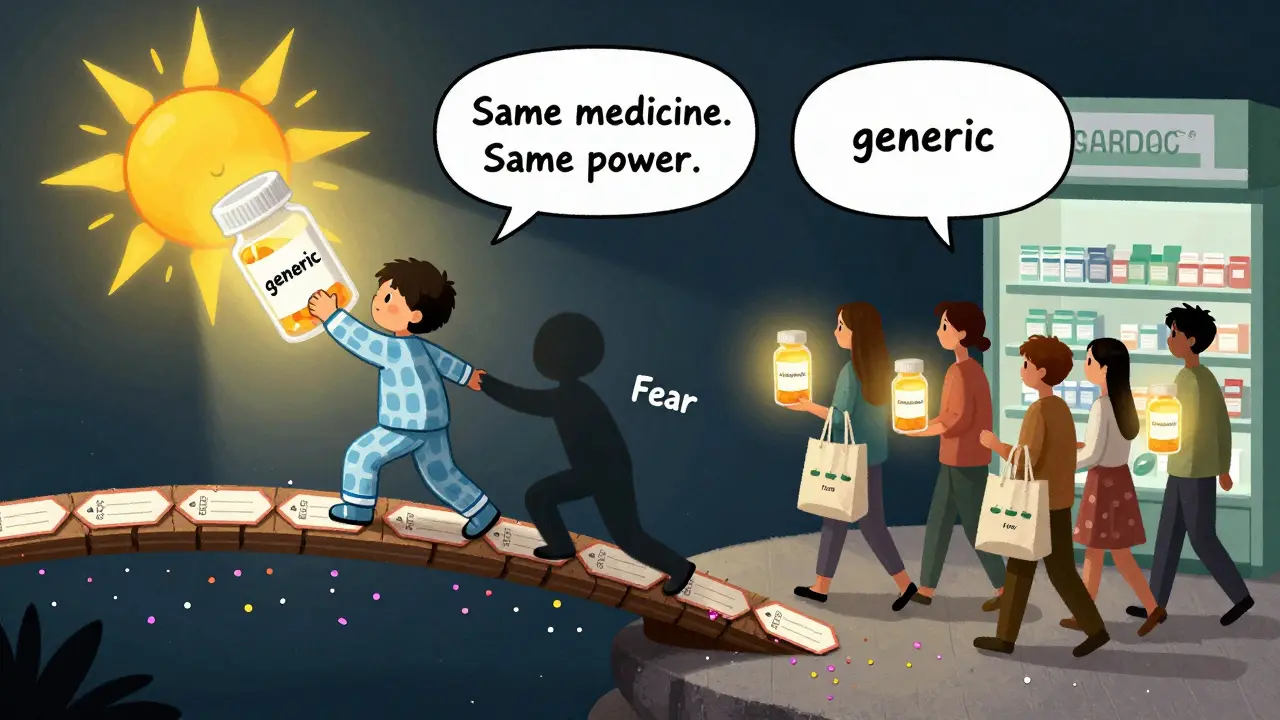
Teaching kids about generic drugs isn’t about pharmacy policy. It’s about giving them control. When they know what’s in their medicine - and why it looks different - they’re not passive patients. They’re informed, confident, and empowered. And that’s the best kind of health education there is.
Are generic drugs as safe as brand-name drugs for kids?
Yes. Generic drugs must meet the same strict safety and effectiveness standards as brand-name drugs. Health agencies like the TGA in Australia and the FDA in the U.S. require generics to have the same active ingredient, strength, dosage form, and how they work in the body. The only differences are the inactive ingredients (like color or flavor) and the price. These don’t affect how well the medicine works.
Can children tell the difference between generic and brand-name medicine?
They can notice differences in color, shape, or packaging - but not in how the medicine works. A child might say, "This pill is blue, last time it was white!" That’s normal. The key is teaching them to look at the name of the medicine (like "ibuprofen") instead of the brand. Once they learn that, they won’t be confused by different-looking pills.
Why do pharmacies give generic drugs instead of brand names?
Pharmacies give generics because they’re cheaper - but they’re also just as good. In many places, laws require pharmacies to offer the generic version unless the doctor says "do not substitute." This saves families money and helps insurance systems work better. It’s not about cutting corners - it’s about smart healthcare.
What if my child refuses to take a generic medicine?
Don’t force it. First, check if the medicine looks different from before. If so, explain why. Show them the label. Say: "The medicine inside is the same. The box changed because we’re using a different one that costs less." If they still refuse, talk to your pharmacist or doctor. Sometimes, switching to a different flavor or form (like liquid instead of pill) helps. Never make them feel like they’re being tricked.
Is it okay to switch between generic brands?
Yes. All approved generics are required to work the same way. A child can take a generic ibuprofen from one pharmacy one week and a different generic from another pharmacy the next - and it will have the same effect. Some kids notice the shape or color changes and get confused. That’s why it’s helpful to teach them to look at the active ingredient name, not the brand.
Aaron Pace
OMG YES!!! 🙌 I just had to explain this to my 7-year-old last week when she saw the "generic" ibuprofen and screamed, "IT’S NOT ADVIL?!" I showed her the label, pointed at "ibuprofen" on both, and she went, "Ohhh so it’s like my blue socks and red socks? Same socks, different color!" 😍 Now she picks the cheaper one. Life changed. 🥹
Joey Pearson
This is such a simple, powerful idea. Teaching kids this early builds so much trust in their own health. No fear. No confusion. Just facts. I’ve been doing this with my twins since they were 5. They now ask the pharmacist, "Is this the same medicine?" before I even get to the counter. 🌟
Roland Silber
I work as a pediatric pharmacist and this is one of the most underappreciated teaching moments in kids’ healthcare. The real win isn’t just saving money-it’s reducing anxiety. Kids who understand generics are way less likely to panic when their prescription changes. I keep little flashcards with active ingredients and brand names. Kids love playing "Match the Medicine." It’s like a game, not a lecture. And yes, 94% retention rate in our clinic. It works.
Patrick Jackson
You know what’s wild? This whole thing is basically a metaphor for life. 🤯 We’re taught to value the shiny box, the brand, the logo... but the real power? The stuff inside. Same with people. Same with ideas. Same with medicine. The packaging is noise. The substance is truth. And teaching kids that early? That’s not just health education. That’s wisdom. 🙏
Adebayo Muhammad
But... have you considered that the FDA and TGA are controlled by Big Pharma? The "same active ingredient" claim is a myth. The excipients are different, and bioavailability varies by up to 20% in real-world studies. The government doesn’t test for long-term effects. Also, generics are often manufactured overseas under lax standards. You think your child’s medicine is safe? Think again. 😏
Tim Hnatko
I’ve been using the "medicine box" method at home too. My 9-year-old started correcting me when I grabbed a different brand. "Dad, that’s acetaminophen too. We don’t need the pink one." It’s quiet, but powerful. I didn’t even realize he was paying attention until he said it. Feels good to know he’s learning.
phyllis bourassa
I’m sorry, but this is dangerously naive. You’re normalizing cost-cutting as health wisdom. What about the kids whose generics have different fillers that cause allergic reactions? Or the ones with GI sensitivity? You’re telling parents to trust the system when we know how broken it is. This isn’t empowerment-it’s complacency.
Ferdinand Aton
Wait, so you’re saying generic = same? What about when my kid got a different-looking pill and had a rash? Turns out the inactive ingredient was different. And yeah, the FDA approves them, but they don’t test every batch. So… maybe don’t tell kids they’re "exactly the same"? Just say "usually".
amber carrillo
This is excellent. Clear, compassionate, and grounded in real behavior. Thank you for focusing on the child’s understanding rather than the system’s efficiency. Empowerment through knowledge is the only sustainable model.
Pranay Roy
You know what’s really happening? The government doesn’t want you to know that generics are often made in the same factories as brand names. They just slap a new label on. It’s not about saving money-it’s about control. They want you to think you’re choosing wisely when really, you’re just being manipulated into accepting lower quality. And kids? They’re the perfect targets. Brainwash them young. 🤔