
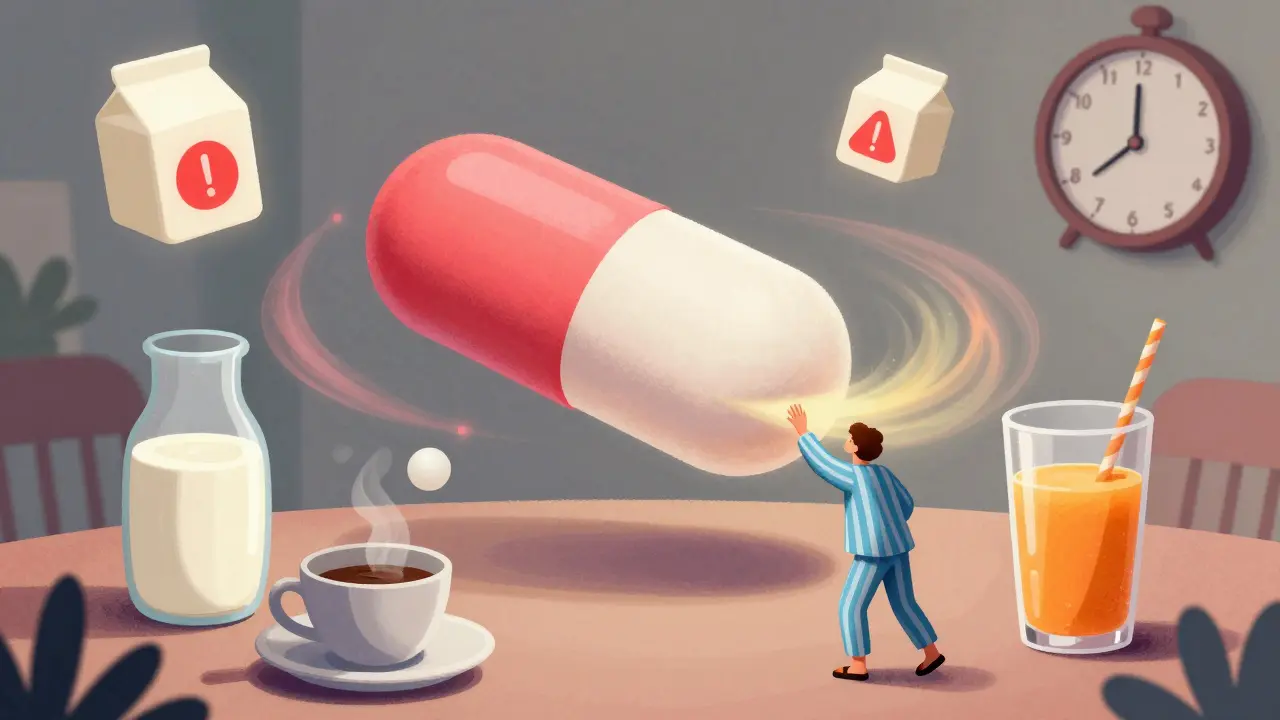
Ever taken a pill and wondered if it really mattered whether you did it with breakfast or on an empty stomach? It’s not just a suggestion-it’s science. For many prescription medications, what you eat-or don’t eat-around the time you take your pill can mean the difference between the drug working as it should or doing nothing at all. In some cases, it can even make you sick.
Why Food Changes How Your Medicine Works
Your digestive system isn’t just a pipe for food. It’s a complex environment that affects how drugs get into your bloodstream. When you eat, your stomach produces acid, your gallbladder releases bile, and your gut starts moving. All of this can change how quickly and how much of a drug your body absorbs.
Take antibiotics like tetracycline or doxycycline. These drugs bind to calcium, magnesium, and iron found in dairy, supplements, and even some leafy greens. If you take them with milk or a calcium-fortified orange juice, you could block up to 50% of the dose. That’s not just less effective-it can lead to antibiotic resistance if the bacteria aren’t fully wiped out.
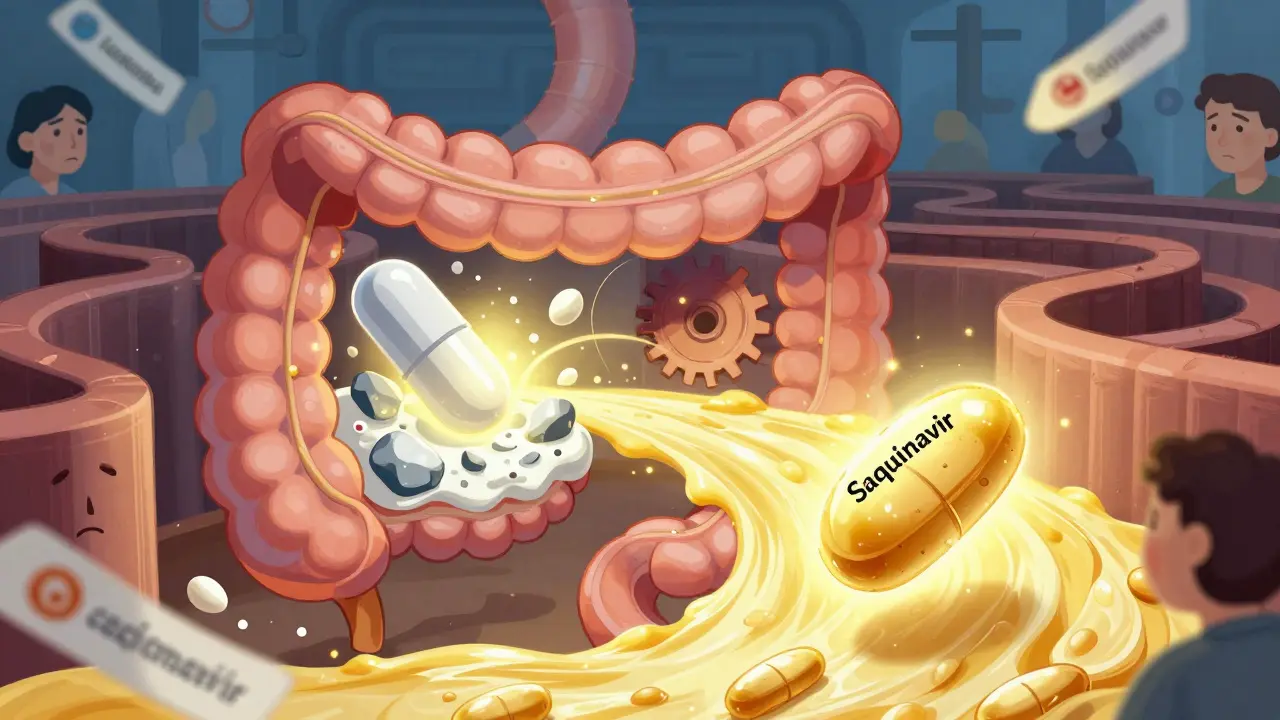
On the flip side, some drugs need food to work. The HIV medication saquinavir, for example, absorbs up to 40% better with a high-fat meal. Why? Fat slows down digestion and helps the drug dissolve properly. Grapefruit juice can do the same thing-sometimes too well. It blocks an enzyme in your gut that normally breaks down certain drugs, causing levels to spike dangerously high.
Medications That Must Be Taken with Food
Many common prescriptions are designed to be taken with meals-not because it’s nice to eat, but because it’s safer.
- NSAIDs like ibuprofen, naproxen, and aspirin: These can irritate your stomach lining. Taking them with food reduces the risk of ulcers and bleeding. Studies show taking NSAIDs with food cuts nausea by 20% or more. Some patients even report better tolerance when they take them with a banana-a simple trick shared by users on Reddit’s r/Pharmacy.
- Augmentin (amoxicillin/clavulanate): This antibiotic causes stomach upset in nearly half of people who take it on an empty stomach. With food, that drops to under 25%. The same goes for nitrofurantoin and rifabutin.
- HIV medications like ritonavir and zidovudine: Food helps reduce nausea and vomiting. One small survey of 127 HIV patients found that taking ritonavir with a small high-fat snack like peanut butter or cheese cut nausea from 45% to just 18%.
For these drugs, it’s not about timing-it’s about presence. A light snack counts. You don’t need a full meal. Just enough to coat your stomach and slow digestion.
Medications That Must Be Taken on an Empty Stomach
Some drugs are fragile. They break down in acid, get blocked by minerals, or absorb too slowly if food is around.
- Levothyroxine (for hypothyroidism): This is one of the most common prescriptions in Australia. Food can reduce its absorption by 20% to 55%. That’s why doctors tell you to take it 30 to 60 minutes before breakfast. Even coffee, calcium, or iron supplements taken within hours can interfere. A 2023 study in Endocrine Practice confirmed that consistency matters more than perfection-take it the same way every day.
- Didanosine (an older HIV drug): Stomach acid destroys it. That’s why you must take it on an empty stomach-no food, no drinks (except water) for at least 30 minutes before and after.
- Tetracycline and doxycycline: As mentioned earlier, avoid dairy, antacids, and iron pills for at least two hours before and after.
- Bisphosphonates like alendronate (Fosamax): These osteoporosis drugs need to be taken with a full glass of water, 30 to 60 minutes before eating. Lying down after taking them can cause esophageal damage. Standing or sitting upright is part of the rule.
The Mayo Clinic recommends a simple rule for empty-stomach meds: take them either one hour before a meal or two hours after. If you’re unsure, check the label or ask your pharmacist.
Confusing Guidelines? You’re Not Alone
Here’s where it gets messy. Some experts disagree-even on common drugs. A 2015 review in Inflammopharmacology argued that NSAIDs might work faster on an empty stomach and that food doesn’t actually reduce stomach damage. But other studies, including those from the UK’s NHS and German medical societies, still recommend food for safety, especially in older adults.
Dr. Alissa Keillor, a pharmacist in Indiana, puts it plainly: "Food can change how your body responds to certain medications." The key isn’t guessing. It’s following the label.
The FDA now requires food-effect studies for about 40% of new drugs. In 2018, only 62% of new medications had these instructions. By 2023, it jumped to 78%. That means more labels will soon say things like "take with a high-fat meal" or "avoid grapefruit juice." The days of vague instructions like "take with food" are ending.
Real-World Challenges and How to Beat Them
Imagine you take five medications. Three need food. Two need an empty stomach. One requires a 30-minute wait before breakfast. One says avoid dairy for two hours. This isn’t rare-it’s common for people with chronic conditions.
A 2023 GoodRx survey of 5,000 patients found that 42% admitted to taking their meds incorrectly regarding food. The highest errors? People on five or more drugs.
But there’s hope. A 2023 pilot study by Express Scripts showed that color-coded labels improved adherence by 31%:
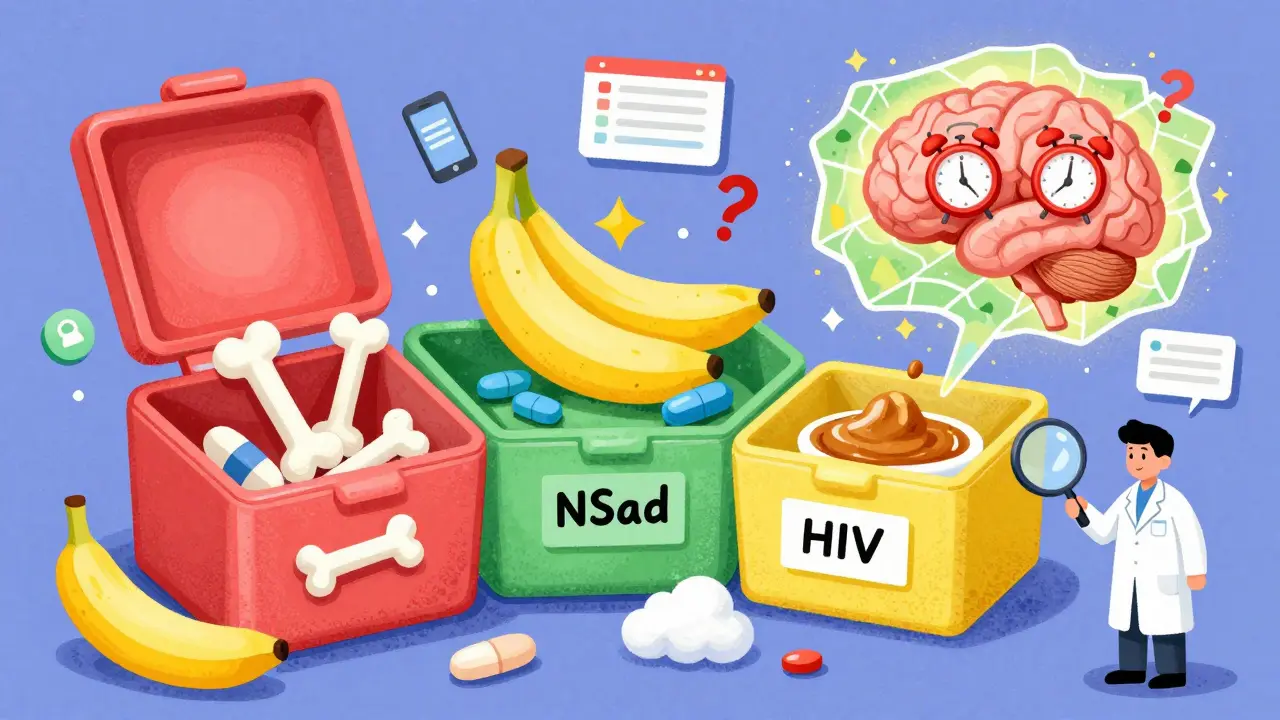
- Red: Take on empty stomach
- Green: Take with food
- Yellow: Take with high-fat meal
Pharmacists also found that explaining why matters. When patients understood that food blocks absorption or helps prevent nausea, adherence jumped 44%. Visual aids-like a simple chart showing when to take each pill-helped elderly patients the most.
Smartphone reminders work, too. A Reddit thread from March 2024 reported a 68% success rate when users set alarms for "take with breakfast" or "wait 2 hours after lunch."
What You Should Do Today
You don’t need to memorize every interaction. But you do need to be proactive.
- Check every prescription label. Look for "take with food," "take on empty stomach," or "avoid dairy."
- Ask your pharmacist. They see hundreds of patients a week. They know what works.
- Use a pill organizer with notes. Write "take 1 hour before breakfast" next to levothyroxine. Write "with dinner" next to your NSAID.
- Set phone alarms. One for "take med now," one for "eat in 1 hour."
- Keep a food-med log. If you feel worse after taking a pill with yogurt, write it down. Bring it to your next appointment.
There’s no one-size-fits-all. But there is a right way for your meds. And that way is written on the label-for a reason.
What’s Coming Next
Researchers at UCSF are now using gut microbiome tests to predict how a person’s body will respond to food and medicine. Early results show 87% accuracy. In the future, your doctor might say: "Based on your gut bacteria, take this with a small amount of olive oil."
The European Medicines Agency will require food-effect studies for all new cancer drugs starting in 2025. The NIH has funded $15.7 million to study how individual diets affect drug metabolism. This isn’t just about pills anymore-it’s about personalizing medicine to your plate.
For now, stick to the basics. Read the label. Ask questions. Don’t assume. Your body-and your medicine-deserve that much.
Nancy Maneely
Yall really out here taking antibiotics with milk like it's cereal? I had a cousin end up in the ER because she thought yogurt "helped the stomach" with doxycycline. Spoiler: it didn't. Bacteria laughed all the way to resistance town. Stop guessing. Read the damn label.
divya shetty
It is imperative that patients adhere strictly to pharmaceutical guidelines, as deviation may lead to subtherapeutic concentrations and potential public health consequences. The scientific literature is unequivocal on this matter, and casual disregard reflects a troubling erosion of medical literacy in modern society.
Phoebe Norman
Levothyroxine and coffee is a silent killer
People don't realize how much their gut flora is just... collapsing under the weight of poor timing
It's not just absorption it's the whole endocrine cascade
And no one talks about the cortisol spike from inconsistent dosing
It's systemic
Johanna Pan
I love that this post included the color-coded label idea. My grandma started using red/green stickers on her pill bottles and now she takes everything right. She even made a little chart with crayons. It’s beautiful when simple solutions work. We need more of this in healthcare.
Jenna Elliott
NSAIDs with food is a myth pushed by pharma to sell more stomach meds
Real science says empty stomach = faster relief
Stop being scared of a little acid
lance black
Set alarms. Use a pill box. Write it down. Do it. Your life depends on it.
Pamela Power
Of course the FDA only started requiring food-effect studies when Big Pharma realized they could charge more for "specialized dosing instructions"
Let me guess-your "high-fat meal" is actually just a McDonald’s cheeseburger wrapped in a patent
Real science doesn’t need fancy labels
It needs honesty
Albert Lua
As someone who grew up in rural India where pills were taken with chai and roti no matter what, I didn’t realize how much I was sabotaging my own meds until I moved to the US. Now I have a whole system: color-coded bottles, phone alarms, and a little notebook. It’s not glamorous, but it saved me from a hospital trip. If you’re struggling-you’re not alone. Just start small.
Elliot Alejo
My pharmacist gave me a laminated card with all my meds and their food rules. I keep it in my wallet. I’ve had people ask me about it at the grocery store. Now I’m basically the neighborhood med coach. Knowledge is power, but sharing it? That’s the real win.