
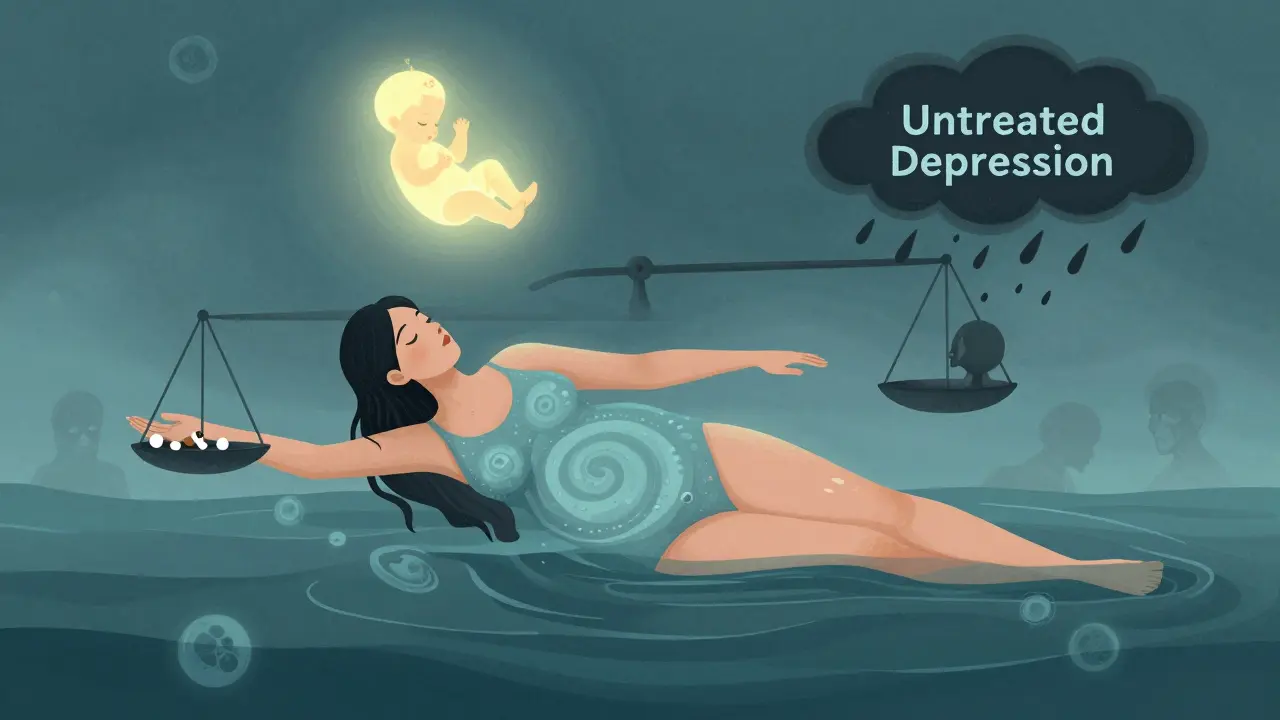
When a woman is pregnant and struggling with depression or anxiety, the question isn’t just whether to take medication-it’s whether the risks of not taking it are worse than the risks of taking it. This isn’t a simple yes or no. It’s a balancing act, and the data tells us something surprising: for many women, continuing an SSRI during pregnancy is safer than stopping it.
Why This Matters More Than You Think
About 1 in 7 pregnant women experience depression or anxiety serious enough to need treatment. Left untreated, these conditions don’t just affect how you feel-they affect your baby’s health. Untreated depression during pregnancy increases the risk of preterm birth by more than double. It raises the chance of low birth weight. It makes postpartum depression far more likely. And tragically, suicide is the leading cause of death among pregnant women in the U.S., accounting for 20% of pregnancy-related deaths. SSRIs-medications like sertraline (Zoloft), citalopram (Celexa), escitalopram (Lexapro), and fluoxetine (Prozac)-have been used for decades to treat these conditions. They work by increasing serotonin, a brain chemical that helps regulate mood. But because they cross the placenta, questions about fetal safety have lingered. The truth? The risks are real-but often smaller than people assume.What the Data Says About Birth Defects
One of the biggest fears is that SSRIs cause birth defects. The most commonly cited concern is heart defects, especially with paroxetine (Paxil). Studies show paroxetine may raise the risk of certain heart problems from about 0.5% to 0.7-1.0%. That’s a small increase, but enough that doctors avoid it during the first trimester. For the other common SSRIs-sertraline, citalopram, escitalopram, and fluoxetine-the data is far more reassuring. A 2020 analysis of 1.8 million births across Nordic countries found no meaningful increase in major birth defects among babies exposed to these SSRIs. The absolute risk of any major congenital malformation was 2.8% in SSRI-exposed babies versus 2.5% in unexposed babies. That’s not a significant difference. The FDA removed its old pregnancy risk categories in 2015 and now requires detailed summaries based on real-world data. Most SSRIs now carry a label that says: “No substantial evidence of increased risk of major birth defects.”The Real Risk: PPHN and Preterm Birth
The two most studied risks are persistent pulmonary hypertension of the newborn (PPHN) and preterm birth. PPHN is a rare but serious condition where a newborn’s lungs don’t adapt properly after birth. In the general population, it affects 1-2 out of every 1,000 babies. With SSRI exposure in the third trimester, that number rises to 3-6 per 1,000. That’s a doubling of risk-but remember, even at its highest, it’s still rare. Most babies exposed to SSRIs have perfectly healthy lungs. Preterm birth (before 37 weeks) is more common in women with depression, regardless of medication. Studies show about 12.5% of women taking SSRIs deliver early, compared to 9.5% of depressed women not on medication. But here’s the key: when researchers control for how severe the depression was, the difference disappears. In other words, it’s not the SSRI causing the preterm birth-it’s the untreated depression.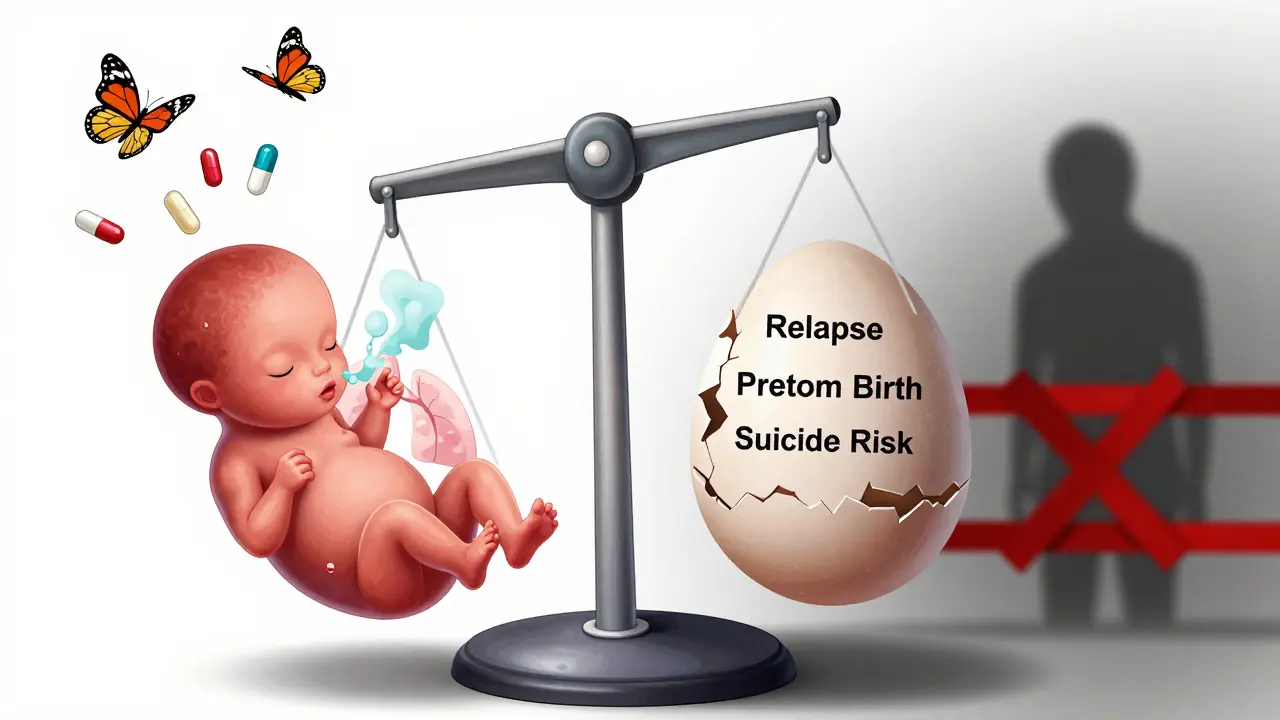
What Happens When You Stop Taking SSRIs?
This is where the data gets startling. A 2022 JAMA Psychiatry study followed women who stopped their SSRIs during pregnancy. Of those who discontinued, 92% had a depressive relapse. Of those who kept taking their medication, only 21% did. Stopping SSRIs isn’t just risky for your mood-it’s risky for your baby. Women who stop treatment are 2.2 times more likely to have a preterm birth than those who continue. They’re also 3 times more likely to develop postpartum depression. And here’s something rarely discussed: abruptly stopping SSRIs causes withdrawal symptoms in 73% of women. Dizziness, nausea, brain zaps-these aren’t just uncomfortable. They can make it harder to care for yourself or your baby.Which SSRI Is Safest?
Not all SSRIs are the same. Sertraline is the most studied and recommended first-line choice. It has the lowest placental transfer rate among SSRIs, meaning less medication reaches the baby. It’s also linked to the lowest risk of PPHN. Fluoxetine stays in the body longer, which can be helpful for women who miss doses, but it also builds up over time. It’s often used as a second-line option. Citalopram and escitalopram are also safe and effective. Paroxetine? Avoid it. The cardiac risk, even if small, isn’t worth it when better options exist.What About Long-Term Effects on the Child?
This is the most debated area. Some studies suggest children exposed to SSRIs in utero may have slightly higher rates of anxiety or depression later in life. A 2023 study from Columbia University found that by age 15, 28% of children exposed to SSRIs in pregnancy had depression, compared to 12% in children whose mothers had depression but didn’t take SSRIs. But here’s the catch: those same children’s mothers had more severe depression. Other studies, including a 2021 Lancet study that controlled for family history and environment, found no increased risk of autism or depression. The difference? The Columbia study didn’t fully account for genetic and environmental factors that influence mental health. The NIH’s 2023 review concluded: “The available data do not support a causal link between SSRI exposure and long-term neurodevelopmental harm.”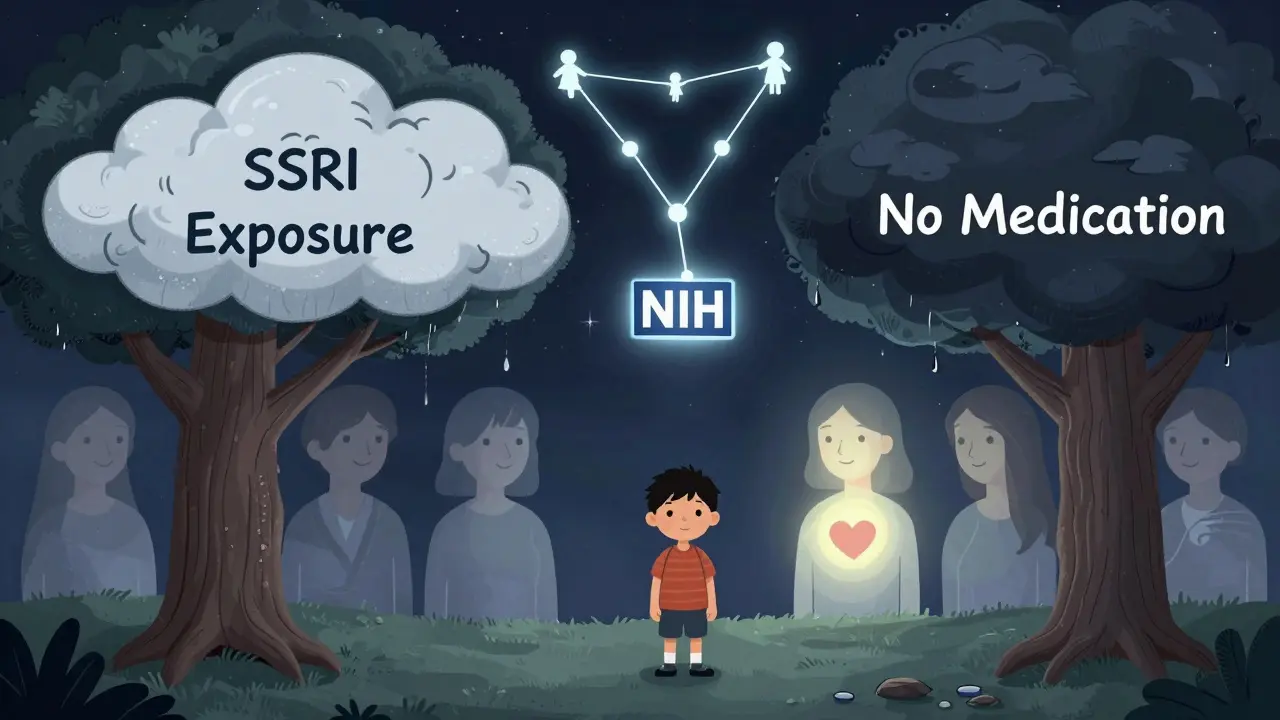
What Should You Do?
If you’re pregnant and taking an SSRI:- Do not stop suddenly. Talk to your doctor about tapering if needed.
- Sertraline is usually the best choice if you’re starting or switching.
- Avoid paroxetine.
- Keep taking your medication if it’s working. The risks of untreated depression are greater.
- Monitor for signs of neonatal adaptation syndrome-jitteriness, feeding trouble, mild breathing issues. These happen in about 30% of exposed newborns and usually resolve within 1-2 weeks.
- Don’t wait. Talk to your OB-GYN or a psychiatrist.
- SSRIs are not a last resort-they’re a valid, evidence-based option.
- Therapy, exercise, and support groups help-but for moderate to severe depression, they’re often not enough on their own.
tynece roberts
i just took zoloft thru my whole preg and my kid is 5 now and literally the most chill, smart, happy kid uve seen. like, no issues. people freak out over 0.7% risk but ignore the 200% risk of u collapsing on the floor crying and not feeding urself. wtf.
Lorna Brown
The data is clear but the emotional weight isn't. We're not just talking about statistics-we're talking about women who are terrified to take meds because they've been told they're 'poisoning' their babies. The real tragedy isn't the SSRIs. It's the stigma that makes women choose suffering over safety. We need better messaging, not more fear.
rakesh sabharwal
The entire discourse is fundamentally misaligned. SSRIs are not 'safe'-they are pharmacologically active compounds with documented transplacental penetration. To assert that 'the risks are smaller than assumed' is a semantic sleight of hand. The absence of statistical significance does not equate to biological irrelevance. One must interrogate effect size, not just p-values. The NIH's 2023 review is methodologically compromised due to residual confounding from maternal genotype-environment covariance.
Jimmy V
Sertraline. Low transfer. Low PPHN risk. Proven. Done. Stop overthinking. If you're on meds and pregnant, don't panic. Don't quit. Talk to your doc. Simple. No drama.
Hugh Breen
THIS. 🙌 I was on Lexapro during both pregnancies. My kids are 8 and 6. One's a violinist. The other's building a robot. I didn't 'hurt' them-I saved myself so I could be there. To anyone scared: you're not weak for needing help. You're a hero for choosing your child's future over fear. 🤍
Rex Regum
Oh please. SSRIs are just Big Pharma’s way of drugging women into compliance. You think depression is a medical condition? Nah. It’s a spiritual crisis. My cousin didn’t take meds, meditated, ate turmeric, and now her kid’s in Harvard. Stop pathologizing normal human emotion.
Aaron Leib
Thank you for laying this out so clearly. The numbers don't lie. Untreated depression is the real danger. If you're reading this and thinking about stopping your meds-please talk to someone first. You're not alone.
Kelsey Vonk
I stopped my SSRI because I was scared. I relapsed hard. Had a panic attack during labor. My baby was fine, but I wasn't. I didn't realize how much I needed it until I lost it. Now I'm back on sertraline. And honestly? I feel like a person again. Not a 'risk.' Just me.
Emma Nicolls
omg this post saved me. i was about to quit my meds bc my mom said they make babies 'weird'. but now i see its the depression that's the real threat. i cried reading this. thank u. im keeping my zoloft. 🥹
Byron Boror
America's obsession with medicating everything is disgusting. In my day, women just sucked it up. You think your baby needs a chemical crutch? Raise your kid right. Stop outsourcing parenting to Big Pharma. This isn't healthcare-it's corporate control.