
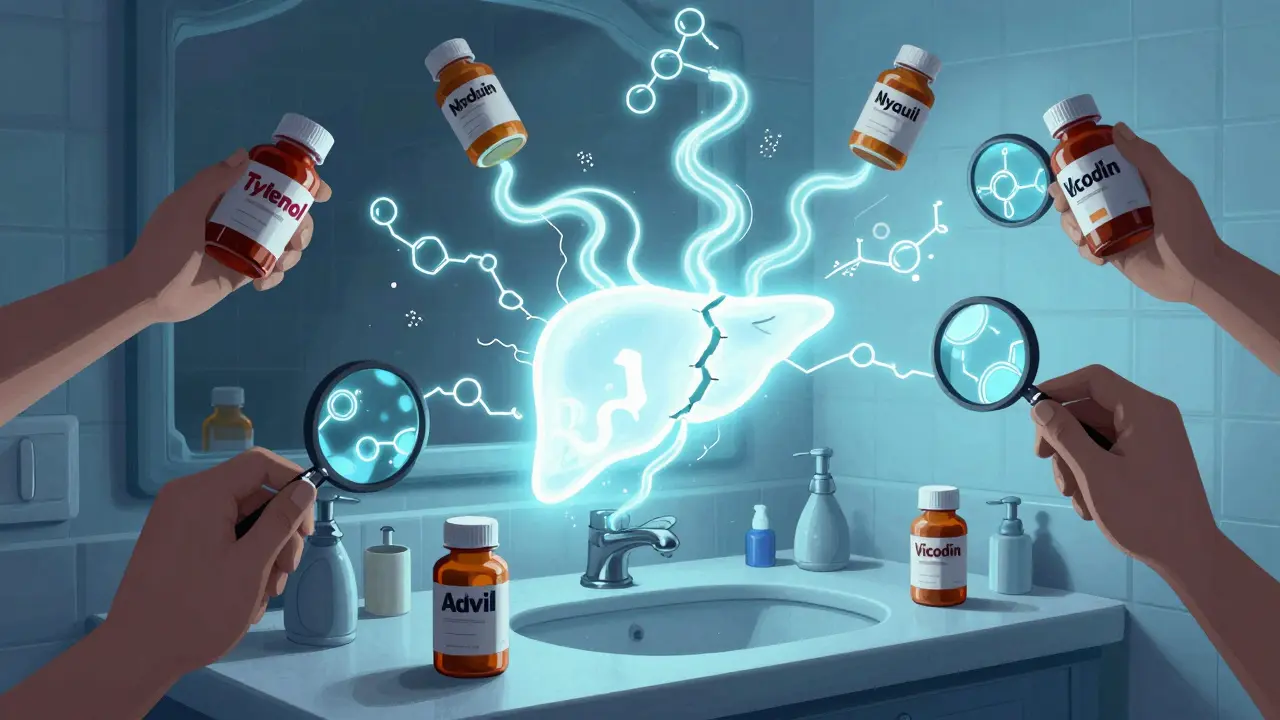
Every year, tens of thousands of people end up in the emergency room not because of a fall, infection, or heart problem-but because they took two different pills with the same active ingredient. It sounds impossible, right? But it happens more often than you think. You’re taking a prescription painkiller. You grab a cold medicine off the shelf. You don’t realize both contain acetaminophen. By the time you feel sick, your liver is already under stress. This isn’t rare. It’s a silent, preventable crisis.
Why Double Ingredients Are a Silent Killer
Double ingredients happen when you take more than one medicine that contains the same active chemical. It’s not about drug interactions-it’s about duplication. You’re not getting double the benefit. You’re getting double the risk. The most common culprit? Acetaminophen. It’s in over 600 prescription and over-the-counter (OTC) products: pain relievers, cold medicines, sleep aids, even some allergy meds. The National Institutes of Health reports that acetaminophen causes more than 56,000 emergency room visits every year in the U.S. alone. Most of those are accidental.It’s not just acetaminophen. Diphenhydramine (found in Benadryl and many sleep aids) can cause dangerous drowsiness when mixed with prescription sedatives. Pseudoephedrine (in decongestants) can spike your blood pressure if you’re already on a blood pressure medication. NSAIDs like ibuprofen or naproxen pile up when you take a prescription anti-inflammatory and a store-brand pain reliever. These aren’t edge cases. They’re routine mistakes.
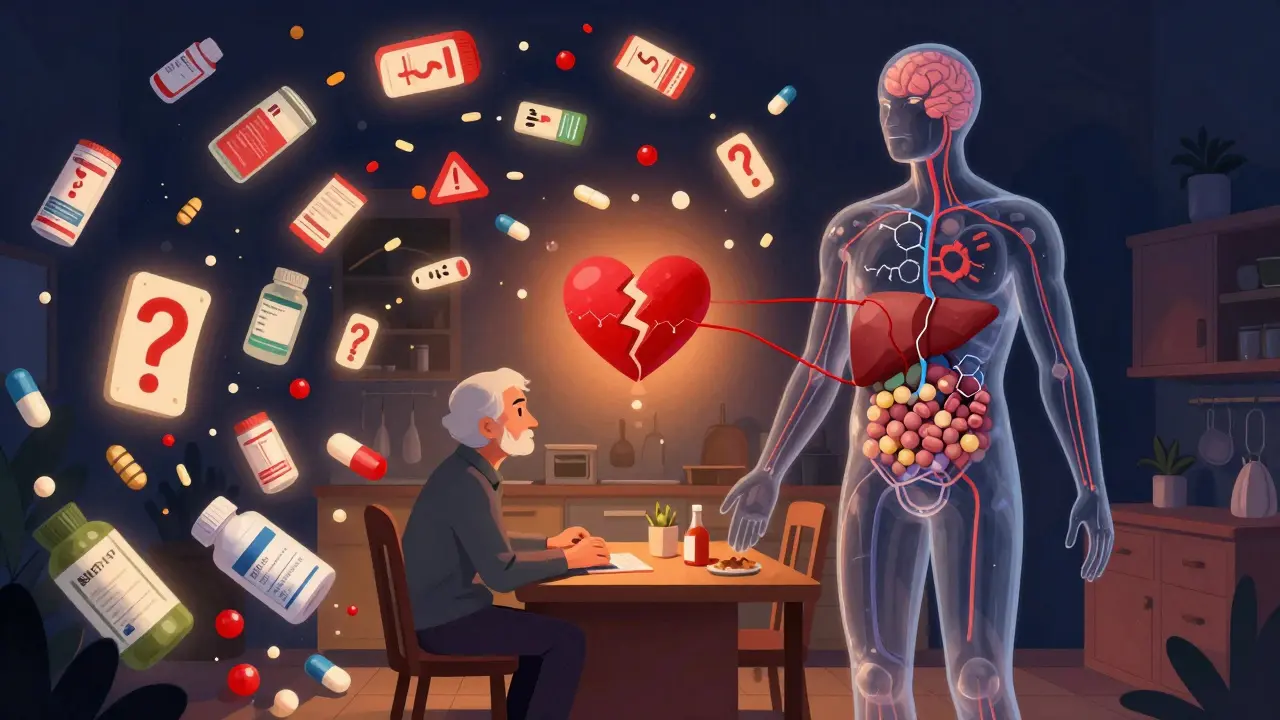
Older adults are at the highest risk. About 40% of people over 65 take five or more medications regularly. That’s called polypharmacy. And when you’re seeing multiple doctors, filling prescriptions at different pharmacies, and grabbing OTC meds off the shelf without telling anyone, the chances of overlap skyrocket. The CDC says adults 65+ make up 65% of all hospitalizations from double ingredient errors. And here’s the kicker: 67% of them say no one ever asked them what OTC meds they were taking.
How It Happens: The Hidden Traps
Most people don’t set out to overdose. They’re trying to feel better. Maybe they’re still achy after taking their prescribed pain pill, so they reach for a cold medicine that says "relieves pain." Or they’re having trouble sleeping, so they take a nighttime cold tablet-without realizing it contains the same sedative as their prescription sleep aid.The problem isn’t just confusion. It’s design. Many OTC labels don’t make it easy to spot duplicates. Even after the FDA updated Drug Facts labels in 2020 to standardize formatting, a 2023 Government Accountability Office report found that 41% of patients still couldn’t identify shared ingredients. Brand names hide the truth. Tylenol. Panadol. Excedrin. NyQuil. All contain acetaminophen. But if you don’t know to look for "acetaminophen" on the label, you won’t see it.
And then there are the hidden players: herbal supplements, traditional medicines, and vitamins. A 2019 WHO report found that 68% of patients don’t tell their doctors about these. Someone might take turmeric for inflammation, but not mention it-only to later add an NSAID. Or take melatonin for sleep, unaware that many cold medicines already contain it. These aren’t "natural" or "safe" just because they’re not prescription. They’re chemicals too.
What You Can Do Right Now
The good news? Almost 90% of double ingredient errors are preventable. You don’t need a PhD in pharmacology. You just need a system.- Make a full medication list-every pill, patch, liquid, capsule, and supplement. Include brand names, generic names, doses, and how often you take them. Write it down. Don’t rely on memory.
- Keep it with you. Store a copy in your wallet, phone, and at home. Update it every time you start or stop something-even if it’s just a one-time dose of ibuprofen.
- Take it to every appointment. Every doctor. Every pharmacist. Every specialist. Say: "Here’s everything I’m taking. Please check for overlaps." Don’t wait for them to ask.
- Use one pharmacy. If you fill all your prescriptions at the same place, their system will flag duplicates. Studies show this cuts double ingredient errors by 63%. If you’re using multiple pharmacies, you’re flying blind.
- Ask your pharmacist. When you pick up a new prescription, ask: "Could this interact with anything else I’m taking?" Pharmacists are trained to catch this. In 87% of medication therapy consultations, they identify hidden duplicates.
Red Flags to Watch For
You don’t have to wait for an emergency to know something’s wrong. These symptoms could signal a double ingredient problem:- Dizziness or extreme drowsiness (common with sedatives or antihistamines)
- Nausea, vomiting, or loss of appetite (signs of acetaminophen overload)
- Unexplained bruising or dark stools (possible NSAID-induced bleeding)
- Rapid heartbeat or high blood pressure (from too much pseudoephedrine)
- Confusion or trouble urinating (signs of anticholinergic buildup)
If you experience any of these after starting a new medicine-even if it’s OTC-stop taking everything and call your doctor or pharmacist. Don’t wait. Liver damage from acetaminophen can happen silently. You might not feel pain until it’s too late.
What’s Changing to Help
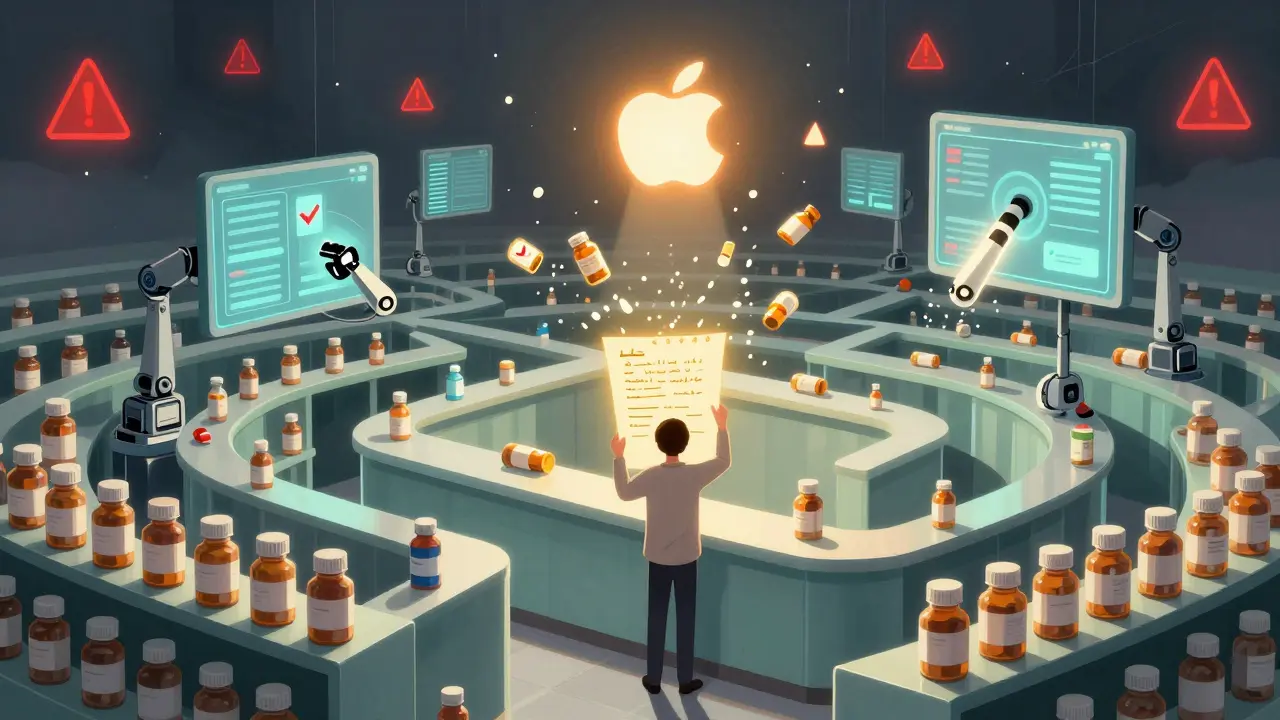
The system is catching up. In 2023, the American Geriatrics Society updated its Beers Criteria to list 15 high-risk double ingredient combinations involving anticholinergics, sedatives, and NSAIDs. Electronic health records from Epic and Cerner now include automated double ingredient checks that alert providers in 92% of cases. Apple Health on iOS 17 can scan your medication list and warn you about duplicates. The FDA’s new OTC label rules, required by 2025, will make active ingredients impossible to miss.But technology alone won’t fix this. Only you can be the final gatekeeper. A computer can’t know you took that extra Advil because your knee hurt. It can’t know you’re using a traditional remedy from your culture. Only you can speak up.
Real Stories, Real Risks
One Reddit user, "MedSafety101," shared how they took three different cold medicines-all with pseudoephedrine-because they didn’t realize they were all the same. Their blood pressure spiked to dangerous levels. They ended up in the ER. Another patient at UCLA Health took Vicodin for back pain and a store-brand cold tablet for a cough. Both had acetaminophen. Within days, her liver enzymes soared. She needed a transplant.These aren’t outliers. They’re examples of what happens when we assume our meds are safe because they’re "prescribed" or "available over the counter."
Final Checklist: Your Action Plan
Do this today:- Write down every medication you take, including vitamins and supplements.
- Look at the label of each one. Circle the active ingredient.
- Compare them. Are any the same?
- Call your pharmacist. Read them your list. Ask: "Any duplicates?"
- Set a calendar reminder to review your list every 3 months.
You don’t need to be a doctor. You just need to be informed. Medications save lives-but they can also harm you if you don’t know what you’re taking. Double ingredients aren’t a mystery. They’re a mistake. And mistakes like this are meant to be caught before they become emergencies.
What is the most common double ingredient that causes overdoses?
Acetaminophen is the most common. It’s found in over 600 products, including prescription painkillers like Vicodin and OTC cold and sleep medicines like Tylenol, NyQuil, and Excedrin. Taking even one extra dose can push you over the safe daily limit of 4,000 mg. Liver damage can happen without symptoms until it’s too late.
Can I trust OTC labels to tell me if I’m doubling up?
Not always. Even though the FDA updated OTC Drug Facts labels in 2020 to be clearer, a 2023 government report found 41% of people still can’t identify shared ingredients. Brand names like "DayQuil" or "Advil Cold & Sinus" hide the active ingredient. Always look for the chemical name-like "acetaminophen" or "diphenhydramine"-not the brand.
Should I only use one pharmacy?
Yes. Pharmacies use software that flags dangerous combinations. If you fill prescriptions at multiple places, those systems can’t see everything you’re taking. One study showed using a single pharmacy reduces double ingredient errors by 63%. It’s one of the simplest, most effective safety steps you can take.
What if I see multiple doctors? Who should I tell about my meds?
Everyone. Every specialist, every GP, every dentist, every physical therapist. Bring your written list to every visit. Say: "I’m taking these. Please check for overlaps." Studies show that 67% of patients who had double ingredient errors were never asked about OTC meds. Don’t assume they know. You’re the only one who knows your full list.
Are herbal supplements safe to mix with prescription meds?
No. Many people don’t realize supplements can contain active ingredients that duplicate or interact with prescriptions. For example, St. John’s Wort can interfere with blood thinners and antidepressants. Turmeric can increase bleeding risk when taken with NSAIDs. A 2019 WHO report found that 68% of patients don’t tell their doctors about herbal or traditional medicines. Always disclose everything.
Marlon Mentolaroc
Man I used to do this all the time - took Tylenol for headaches, then grabbed NyQuil when I got a cold and wonder why I felt like a zombie. Turns out both had acetaminophen. My liver thanked me after I started reading labels. Now I keep a sticky note on my pill bottle with all the active ingredients. Simple fix, huge difference.
Gina Beard
Medication is not a buffet. You don’t get to sample everything because it’s labeled ‘for relief.’ The body isn’t a machine that upgrades with extra input - it’s a fragile ecosystem. We treat pills like snacks. That’s the real tragedy.
Don Foster
People think reading a Drug Facts label is hard? Bro it’s literally in bold and capitalized. Acetaminophen. Not Tylenol. Not Lortab. The chemical. If you can’t tell the difference between a brand and an ingredient you shouldn’t be allowed to own a phone let alone a medicine cabinet. The FDA did their part. You didn’t.
siva lingam
So the solution is to read labels? Wow. Groundbreaking. Next you’ll tell us water is wet and gravity exists. My grandma took 12 pills a day and still thought ‘natural’ meant safe. We’re not fixing the problem. We’re just making people feel guilty for being alive.
Shelby Marcel
i never realized how many things had diphenhydramine until i took a cold med and then my sleep pill and woke up feeling like my brain was wrapped in cotton. also why is it called Benadryl and not just… diphenhydramine? like come on
asa MNG
OMG I JUST REALIZED I’VE BEEN TAKING ADVIL AND A PRESCRIPTION PAIN MED WITH IBUPROFEN FOR MONTHS 😭 I’M SO STUPID WHY DID NO ONE TELL ME??!! 😭 I’M SCARED TO GO TO THE DOCTOR NOW BUT I JUST TEXTED MY PHARMACIST AND THEY SAID ‘YEP THAT’S A PROBLEM’ AND I FEEL SO BAD AND ALSO LIKE I’M GOING TO DIE?? 🥲💊🩺
Sushrita Chakraborty
While the American approach emphasizes individual responsibility, in many South Asian households, polypharmacy is managed through intergenerational knowledge - elders often guide medication use, and herbal remedies are disclosed within the family. However, the lack of formal integration with Western medical systems remains a critical gap. Perhaps a hybrid model, culturally sensitive yet scientifically grounded, could reduce these errors more effectively than label redesign alone.
Heather McCubbin
Of course this is a crisis - because we live in a world where Big Pharma wants you to buy three different things to fix one problem. And then they sell you the antidote for the problem they created. Wake up. This isn’t an accident. It’s a business model. And you’re the product.
Shanta Blank
Acetaminophen is the quiet assassin of the medicine cabinet - no fanfare, no dramatic crash, just your liver slowly whispering ‘I’m done’ while you scroll TikTok. And then? Boom. Transplant list. Meanwhile, the guy who sold you the ‘natural sleep aid’ with melatonin is chilling on a beach in Bali, sipping coconut water. I hate this system.
Tiffany Wagner
Just started keeping my meds list on my phone notes. Updated it after my last cold medicine. Feels weird to write down something so basic but also… kind of empowering? Like I’m finally taking control. Small steps.
Chloe Hadland
My mom’s 72 and takes 8 different things. I made her a little color-coded chart with the active ingredients circled. She cried. Said no one’s ever helped her like that before. We’re not just saving lives - we’re showing people they’re not alone in this mess.
Amelia Williams
Y’all - I made a printable medication tracker with emoji icons for each type (pain = 💊, sleep = 😴, cold = 🤒). I gave one to my aunt, my uncle, and my neighbor. We all check each other’s lists every Sunday. It’s become our little ritual. And no one’s ended up in the ER. Small wins, people.
Viola Li
Wow what a shocker - people don’t read labels. Maybe if we didn’t live in a culture that treats medicine like candy, this wouldn’t be an issue. But nope, let’s just blame the patient. The real problem is that we’re medicating everything and calling it healthcare.
Jenna Allison
Acetaminophen is metabolized by the liver via CYP450 enzymes - overdose saturates those pathways, leading to NAPQI accumulation and hepatocyte necrosis. The 4g/day limit isn’t arbitrary. It’s pharmacokinetics. Same with NSAIDs - COX-1 inhibition = gastric mucosal damage. You don’t need to be a doctor to understand this. You just need to stop assuming ‘natural’ or ‘OTC’ means ‘safe.’
Vatsal Patel
So the answer is to read labels? And use one pharmacy? And write everything down? Wow. What a revolution. Meanwhile, in India, people take 10 pills a day from 5 different shops and live to 90. Maybe the real problem is overmedication, not lack of reading. Just saying.