
Antibiotic Phototoxicity Risk Calculator
Assess Your Risk
Your Personalized Protection Plan
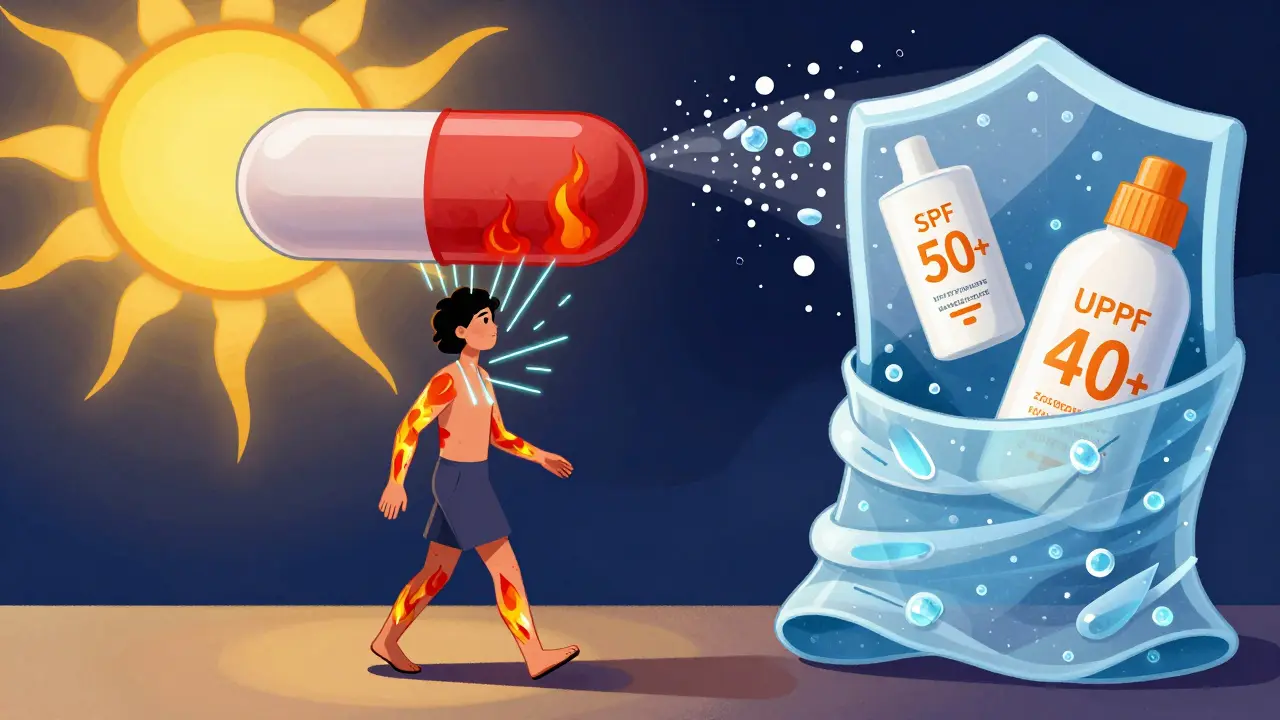
When you're on antibiotics like doxycycline or ciprofloxacin, your skin isn't just fighting an infection-it's also fighting the sun. Phototoxicity isn't a rare side effect. It's a common, painful reaction that can turn a simple walk outside into a sunburn within hours. The good news? You can prevent it. And it doesn't require drastic changes-just smart, specific steps based on real science.
What Is Antibiotic Phototoxicity?
Phototoxicity happens when certain antibiotics absorb UV light and trigger a chemical reaction in your skin. This isn't an allergy. It's a direct chemical burn, similar to a bad sunburn but faster and more intense. Symptoms include redness, blistering, swelling, and dark spots that can last for months. It usually shows up on exposed skin: face, neck, arms, hands. The worst part? It can happen even on cloudy days or through windows. UVA rays (315-400 nm) are the main culprits, and they penetrate deeper than UVB.Not all antibiotics do this. Some are high-risk. Others barely cause a reaction. Knowing which ones are dangerous helps you take the right precautions.
Which Antibiotics Carry the Highest Risk?
Tetracyclines are the biggest offenders. Doxycycline tops the list-with a phototoxicity rate of 5.7% per 1,000 patient-months. That means if 1,000 people take it for a month, about 57 will get a reaction. Minocycline? Only 0.9%. Tetracycline itself is in the middle at 3.2%. The difference? Chemical structure. Doxycycline absorbs more UVA light.Fluoroquinolones vary too. Ciprofloxacin causes reactions in 2.1% of users. Levofloxacin? Half that. Moxifloxacin and gatifloxacin? Almost none. Why? A methoxy group at the C-8 position blocks the reaction. That’s why some doctors switch patients from ciprofloxacin to moxifloxacin when sun exposure is unavoidable.
Sulfonamides? Negligible risk. Third-gen cephalosporins like cefotaxime? Rare, but can cause long-term skin changes like telangiectasia. If you're on one of these, you still need to be cautious.
Why SPF 30 Isn't Enough
Most people think SPF 30 is solid. It’s not. Clinical studies show SPF 30 blocks only 55% of phototoxic reactions. SPF 50+ blocks 92%. That’s not a small difference-it’s the difference between a mild redness and a blistering, days-long reaction.Here’s the catch: sunscreen degrades faster under antibiotic-induced photosensitivity. A 2022 study found SPF 30 sunscreens lose 65% of their protection within an hour when paired with doxycycline. Reapplying every hour isn’t optional-it’s essential. And don’t forget UVA protection. Look for labels that say "broad-spectrum" and check for ingredients like zinc oxide, avobenzone, or ecamsule.

Clothing Matters More Than You Think
A white cotton T-shirt? It only blocks 60-80% of UV radiation. That’s UPF 5-10. Not enough. You need UPF 40+, which blocks 97.5% of UV rays. UPF 50+ blocks 98%. Look for tightly woven fabrics-polyester blends, dark colors, or labeled UPF clothing. A regular cotton shirt worn for 10 minutes in direct sun can still let through enough radiation to trigger a reaction.Wide-brimmed hats? They block 95% of UV from the face. Baseball caps? Just 45%. If you're outside for more than 20 minutes, a hat isn’t optional-it’s your first line of defense.
Timing Your Dose: The Evening Strategy
This one’s simple and powerful. Take your antibiotic at night. For fluoroquinolones like ciprofloxacin or levofloxacin, dosing 2-3 hours before bedtime reduces phototoxic reactions by 37%. Why? Serum levels peak 1-2 hours after ingestion. If you take it at 8 p.m., levels are lowest during the day when UV exposure is highest.It doesn’t work for all antibiotics. Doxycycline is often taken with food, and some forms can cause stomach upset at night. But if your doctor allows it, shifting the dose is one of the most effective, zero-cost prevention methods.
Real-World Challenges: Why People Still Get Reactions
Studies show only 38.7% of patients stick to sun protection during antibiotic therapy. Why? Confusion. People think sunscreen lasts all day. They forget reapplication. They wear thin clothes. They assume clouds protect them.One survey found 68% of patients didn’t know they needed to reapply sunscreen within an hour. Another found most people don’t realize their regular clothing offers almost no UV protection. Even dermatologists admit: patient education is inconsistent.
Technology helps. Apps like UV Lens give real-time UV index alerts and medication-specific reminders. In a 2023 trial, users who got app notifications improved adherence by 52%. If your phone can remind you to take your pill, why not remind you to put on sunscreen?
When to Consider Alternatives
If you’re an outdoor worker, lifeguard, or athlete, and you’re prescribed doxycycline for Lyme disease, you’re in a tough spot. Doxycycline is the best treatment-but the phototoxicity risk is high. In these cases, some doctors consider alternatives like amoxicillin or azithromycin, depending on the infection.A 2021 study of 347 dermatologists found 28% changed antibiotics for patients with heavy sun exposure. It’s not about avoiding treatment-it’s about avoiding harm. If you’re on long-term antibiotics for acne, phototoxicity risk jumps to 62% even with perfect protection. That’s why newer, non-phototoxic options like gepotidacin (currently in Phase III trials) are so promising.
New Frontiers: What’s Coming Next
In 2023, the FDA approved a new adjunctive therapy: a capsule containing β-carotene and soybean trypsin inhibitor. In trials, it reduced phototoxic reactions by 63%. It doesn’t replace sunscreen-it supports it. Think of it as an internal antioxidant shield.Future protocols will be personalized. People with Fitzpatrick skin types I-II (fair skin, burns easily) need 37% more protection than those with types IV-VI. Melanin helps. If you’ve always burned, your risk is higher. Your prevention plan should reflect that.
Summary: Your Action Plan
- Know your antibiotic. Is it doxycycline? Ciprofloxacin? High risk. Moxifloxacin? Low risk.
- Use SPF 50+ broad-spectrum sunscreen. Apply 15-30 minutes before going out. Reapply every hour.
- Wear UPF 40+ clothing. Dark, tightly woven fabrics. Wide-brimmed hats. Sunglasses with UV protection.
- Take fluoroquinolones at night. Reduces peak serum levels during daylight.
- Use a UV app. Get alerts when UV levels are high.
- Ask your doctor. Is there a lower-risk alternative? Especially if you’re outdoors often.
Phototoxicity isn’t inevitable. It’s preventable. You don’t need to stop living your life-you just need to adjust how you protect yourself. The science is clear. The tools are available. The choice is yours.
Can I still go outside if I’m on antibiotics that cause phototoxicity?
Yes, but you need to be extra careful. Avoid direct sunlight between 10 a.m. and 4 p.m. Wear UPF 40+ clothing, a wide-brimmed hat, and reapply SPF 50+ sunscreen every hour. Use UV index apps to plan outdoor time for early morning or late afternoon. Even short exposures can trigger a reaction if protection is inadequate.
Does sunscreen alone prevent phototoxicity?
No. Sunscreen is critical, but not enough on its own. Studies show that even with SPF 50+, people still get reactions if they wear thin clothing or skip hats. UPF clothing blocks 98% of UV rays without reapplication. Combining sunscreen, clothing, and timing reduces risk by over 75%. Relying only on sunscreen is like wearing a raincoat in a storm and forgetting the umbrella.
Why is doxycycline riskier than minocycline?
Doxycycline’s chemical structure absorbs more UVA light, triggering a stronger reaction. Minocycline has a modified ring structure that reduces light absorption. Clinical data shows doxycycline causes phototoxicity in 5.7% of users per 1,000 patient-months, while minocycline causes it in only 0.9%. If you’re on long-term doxycycline and get repeated sunburns, ask your doctor about switching.
Can I use tanning beds while on antibiotics?
Absolutely not. Tanning beds emit concentrated UVA radiation-up to 12 times stronger than midday sun. If you’re on doxycycline or ciprofloxacin, tanning beds can cause severe blistering, permanent dark spots, or even second-degree burns within minutes. No exceptions. This isn’t just risky-it’s dangerous.
How long does phototoxicity last after stopping the antibiotic?
The antibiotic clears from your system in 1-3 days, but skin damage can linger. Redness and swelling usually fade in 3-7 days. Hyperpigmentation (dark spots) can last weeks to months. In rare cases, it can be permanent. Protecting your skin for at least 7 days after stopping the drug is crucial, especially if you’ve had a reaction before.
APRIL HARRINGTON
I took doxycycline last summer and thought I was being careful but still ended up looking like a boiled lobster
Turns out my SPF 50 was useless because I didn’t reapply every hour
Now I wear a hat like it’s my job and I don’t even step outside without long sleeves
Worth it
Leon Hallal
This post is accurate but everyone still ignores it because they think theyre invincible until they get burned
Janelle Pearl
I used to think sunscreen was enough until I got phototoxicity from just walking to my car. Now I have UPF shirts, a wide-brimmed hat, and a UV app on my lock screen. It’s not glamorous but I’d rather look silly than spend weeks with dark spots on my neck. If you’re on antibiotics and you’re outside at all, treat your skin like it’s made of glass.
Judith Manzano
I’m so glad someone finally broke this down without jargon. I’ve been on doxycycline for acne and didn’t realize how dangerous even a cloudy day could be. My dermatologist never mentioned UPF clothing. I’m switching to moxifloxacin next round and I’m already feeling smarter.
rafeq khlo
The medical establishment is failing patients by not mandating phototoxicity warnings on prescriptions. This is not a side effect it is a failure of systemic oversight. People are being poisoned by sunlight because pharmaceutical companies prioritize profit over safety. You think sunscreen works? You are naive
Morgan Dodgen
The real issue is that the FDA approves drugs with known phototoxic potential and then tells us to "just use sunscreen" like its our fault. They know UVA penetrates glass. They know SPF degrades. They know clothing matters. But they dont want to admit that doxycycline should be off the market for outdoor workers. This is corporate negligence wrapped in a patient education pamphlet
Philip Mattawashish
You people are so naive. You think sunscreen is the answer? You think hats matter? You think timing your dose helps? Youre all just sheep following trends. Real protection is staying inside. No sun. No risk. Simple. If you cant handle that then maybe you shouldnt be taking antibiotics at all. Your lifestyle is the problem not the drug
Tom Sanders
I read this whole thing and honestly I just wanna know if I can still go to the beach. Like can I? Or do I need to cancel my vacation? I dont wanna be the guy who gets burned because he was lazy
Jazminn Jones
The assertion that SPF 50+ blocks 92% of phototoxic reactions is statistically misleading without citing the confidence intervals or sample size. Moreover, the 65% degradation rate under doxycycline was observed in vitro under artificial UV exposure. Real-world applicability remains unvalidated. This post reads like marketing copy disguised as clinical guidance.
George Vou
i dont get why everyone is making such a big deal about sunscreen. i mean its just a lotion. if you dont like it dont use it. also tanning beds are not that bad if you dont stay in too long. i did it once while on cipro and i was fine
Scott Easterling
Wait... wait... so you're telling me... that the sun... is dangerous... when you're on antibiotics...? And that... you need to... reapply sunscreen... every hour...? And wear... hats? And... UPF clothing? Oh my god. I'm going to die. I'm going to die. I'm going to die. I'm going to die. I'm going to die.
Mantooth Lehto
I had a reaction so bad I had to go to urgent care. They gave me a steroid shot and said "just be more careful next time". Well guess what? I’m done with doxycycline. I switched to azithromycin and now I’m actually living again. If you’re on antibiotics and you’re outside, protect yourself like your skin depends on it. Because it does. 💪🌞
Melba Miller
I don't care what science says. In America, we don't let big pharma scare us away from the sun. I'm on doxycycline and I'm still hiking. I wear a tank top. I use SPF 30. I don't need your overpriced UPF shirts. This is America. We don't hide from the sun. We conquer it.