

When you're nursing and dealing with nausea, vomiting, or slow stomach emptying, your doctor might suggest metoclopramide. It’s a medication that helps your stomach move food along faster. But if you're breastfeeding, you’re probably wondering: is metoclopramide safe for my baby? And more importantly-will it help or hurt my milk supply?
How metoclopramide works in the body
Metoclopramide is a dopamine blocker. It stops dopamine from slowing down your stomach and intestines, which helps food move through faster. That’s why it’s often used for gastroparesis, acid reflux, and severe nausea. But here’s the part most people don’t know: dopamine also suppresses prolactin, the hormone your body needs to make breast milk. By blocking dopamine, metoclopramide can actually boost prolactin levels. That’s why some doctors prescribe it off-label to increase milk supply.
Studies show that metoclopramide can raise prolactin by 20% to 50% in nursing mothers. In one 2018 trial published in the Journal of Human Lactation, women taking 10 mg three times daily for 7 days saw an average 40% increase in milk volume. That’s not magic-it’s science. But it doesn’t work for everyone.
Is metoclopramide safe for your baby?
Yes, it’s generally considered safe when used short-term. Less than 1% of the maternal dose passes into breast milk. That’s a tiny amount-far below what’s considered harmful. The American Academy of Pediatrics lists metoclopramide as compatible with breastfeeding. The LactMed database from the National Library of Medicine confirms no reported adverse effects in breastfed infants at typical doses.
Still, you should watch for signs your baby might be reacting. Some infants have shown mild drowsiness, irritability, or fussiness. In rare cases, there have been reports of tremors or abnormal movements, but these happened only with very high doses or long-term use. If your baby seems unusually sleepy, cries more than usual, or has jerky movements, talk to your doctor right away.
Can metoclopramide really increase milk supply?
It can-but only if low milk supply is caused by low prolactin. If your supply is low because your baby isn’t latching well, you’re not feeding often enough, or you’re stressed, metoclopramide won’t fix that. It only works if your body isn’t making enough prolactin. That’s why it’s not a first-line treatment for low supply.
Most lactation consultants recommend starting with the basics: frequent feeding (8-12 times a day), proper latch, skin-to-skin contact, and avoiding bottles or pacifiers in the early weeks. If those don’t help and your prolactin levels are low, then metoclopramide might be worth trying.
One mother in Sydney, Emma, started metoclopramide after 3 weeks of pumping 2 ounces at a time. Her baby was losing weight. She took 10 mg three times a day for 10 days. Her milk output jumped to 4 ounces per session. She didn’t need formula anymore. But she stopped after 2 weeks because she felt anxious and her hands shook. That’s a red flag.
Side effects you shouldn’t ignore
Metoclopramide isn’t risk-free. Common side effects include drowsiness, dry mouth, headaches, and diarrhea. But there’s one serious risk: tardive dyskinesia. It’s a movement disorder that causes involuntary facial tics, lip-smacking, or tongue protrusion. It’s rare with short-term use (under 12 weeks), but it can be permanent. That’s why most doctors won’t prescribe it for longer than 12 weeks.
Other red flags: depression, anxiety, or feeling like you’re losing touch with reality. Metoclopramide can affect mood, especially in people with a history of depression. If you feel worse emotionally after starting it, stop and call your doctor. Don’t wait.
Who should avoid metoclopramide?
Not everyone should take it. Avoid metoclopramide if you have:
- A history of tardive dyskinesia or other movement disorders
- Parkinson’s disease
- Seizure disorders
- Stomach blockage or bleeding
- Depression or bipolar disorder
- Allergy to metoclopramide or similar drugs
If you’ve had bad reactions to anti-nausea drugs like prochlorperazine or promethazine, you might react badly to metoclopramide too. Tell your doctor your full medication history.
What’s the right dose for breastfeeding?
The standard dose for increasing milk supply is 10 mg three times a day-before meals and at bedtime. That’s 30 mg total per day. Some doctors start lower, at 5 mg three times a day, especially if you’re sensitive to medications.
Don’t go higher than 30 mg a day unless your doctor specifically tells you to. Higher doses don’t help more-they just raise your risk of side effects. Most women see results in 3 to 7 days. If you don’t notice any change in milk volume after 10 days, it’s unlikely to work for you.
Take it 30 minutes before meals so it works when your body is preparing to digest food. That’s when it’s most effective.
Alternatives to metoclopramide for increasing milk supply
There are other options if metoclopramide isn’t right for you.
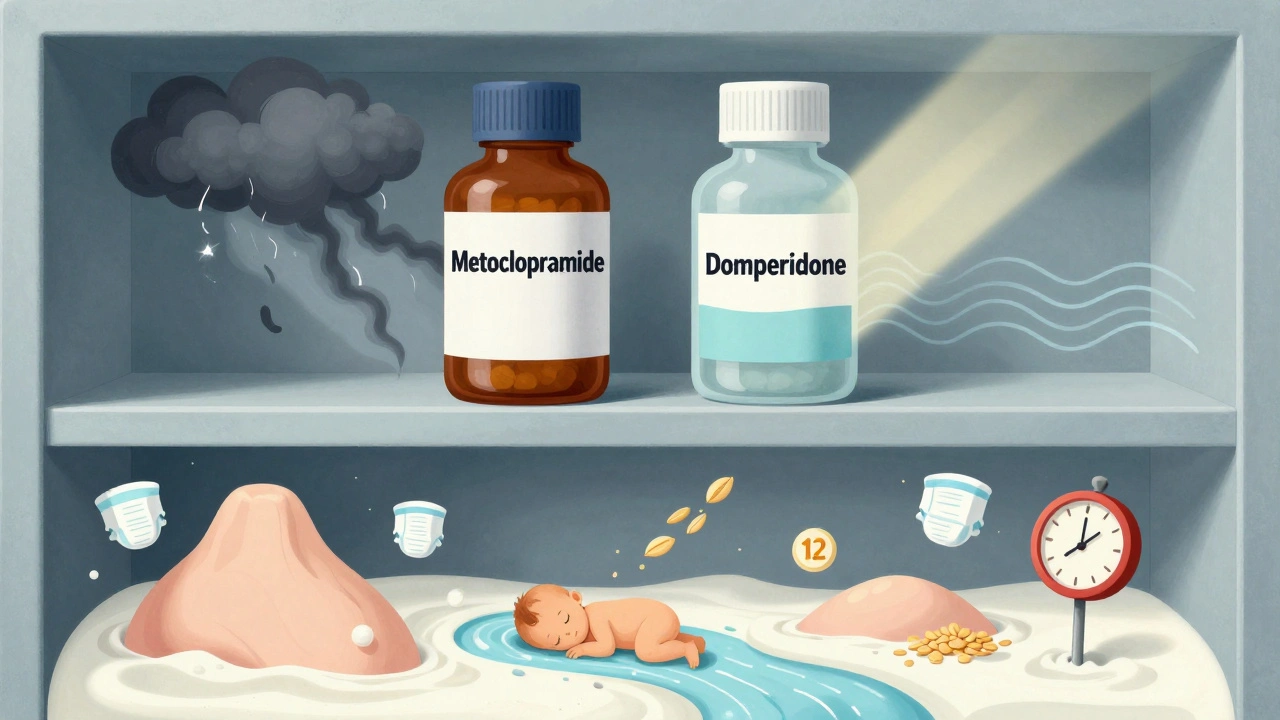
- Domperidone: This drug works like metoclopramide but doesn’t cross the blood-brain barrier as easily, so it’s less likely to affect mood or cause movement problems. It’s not approved in the U.S., but it’s commonly used in Australia, Canada, and Europe for lactation. You need a prescription.
- Herbal galactagogues: Fenugreek, blessed thistle, and milk thistle are popular. They’re not as strong as medication, but some moms find them helpful. They’re safe for most people, but can cause gas or allergic reactions.
- Galactogogues via diet: Oats, brewer’s yeast, flaxseed, and leafy greens are often recommended. While evidence is weak, they’re harmless and might help if you’re eating poorly.
- More frequent feeding: This is still the #1 most effective method. Even one extra feeding a day can boost supply.
Domperidone is often preferred over metoclopramide for lactation because it’s less likely to cause depression or movement issues. But it’s harder to get in some countries. In Australia, it’s available by prescription, and many lactation consultants recommend it as a first choice.

How to know if it’s working
Don’t rely on how your breasts feel. They can feel full even if your supply is low. Instead, track:
- Number of wet diapers per day (should be 6-8 after day 5)
- Number of poops per day (yellow, seedy stools-3 or more after day 4)
- Your baby’s weight gain (should be at least 150-200 grams per week after the first week)
- How often your baby is feeding (8-12 times a day is normal)
If your baby is gaining weight steadily and having enough wet and dirty diapers, your supply is likely fine-even if you’re not pumping much. Pumping output doesn’t tell the whole story.
When to stop metoclopramide
Once your milk supply is stable and your baby is gaining well, talk to your doctor about tapering off. Don’t quit cold turkey. Sudden stoppage can cause nausea, dizziness, or even a drop in milk supply.
Try reducing by one dose every 3-5 days. For example, go from three times a day to twice a day for a week, then once a day for a few days, then stop. Keep feeding often during this time. Your body needs time to adjust.
Some moms stay on it for 6-8 weeks if they’re still struggling. But longer than 12 weeks isn’t recommended. The risk of side effects goes up with time.
What to do if you’re still unsure
Don’t guess. Talk to a lactation consultant. They can check your baby’s latch, assess your milk transfer, and help you decide if medication is even needed. Many hospitals and community health centers offer free lactation support.
If you’re prescribed metoclopramide, ask your doctor to monitor you. A quick check-in after 1 week can catch problems early. And if you’re feeling anxious, down, or off-say something. Your mental health matters just as much as your milk supply.
Metoclopramide can be a helpful tool-but it’s not a cure-all. It works best when paired with good feeding habits, support, and patience. You’re not failing if your supply is low. You’re just figuring out what your body needs right now.
Can metoclopramide cause depression in nursing mothers?
Yes. Metoclopramide can affect mood, especially in people with a history of depression or anxiety. Some nursing mothers report feeling more sad, anxious, or emotionally numb after starting the drug. If you notice changes in your mood-especially if it’s sudden or severe-stop taking it and contact your doctor immediately. It’s not common, but it’s serious enough that many doctors avoid prescribing it to mothers with mental health histories.
How long does it take for metoclopramide to increase milk supply?
Most women see an increase in milk volume within 3 to 7 days of starting the medication. Some notice changes as early as 24-48 hours. But if there’s no improvement after 10 days, it’s unlikely to work for you. Don’t keep taking it longer without checking in with your doctor or lactation consultant.
Is domperidone better than metoclopramide for breastfeeding?
For many mothers, yes. Domperidone works the same way as metoclopramide to boost prolactin but doesn’t cross into the brain as easily, so it’s less likely to cause mood changes or movement problems. It’s widely used in Australia, Canada, and Europe for lactation support. While it’s not FDA-approved in the U.S., it’s available by prescription in many other countries and is often recommended as a safer first choice for nursing mothers.
Can I take metoclopramide while pregnant and then continue while breastfeeding?
Metoclopramide is considered safe during pregnancy and is sometimes used for severe morning sickness. If you took it during pregnancy and then started breastfeeding, you can usually continue it. But you should still be monitored for side effects, especially if you’re taking it for longer than 12 weeks. Always check with your doctor before continuing any medication through pregnancy and lactation.
What should I do if my baby has side effects from metoclopramide?
If your baby seems unusually sleepy, fussy, jittery, or has uncontrolled movements like head bobbing or lip smacking, stop the medication and contact your pediatrician right away. These are rare but possible side effects. Your doctor may recommend switching to domperidone or stopping the drug entirely. Never ignore signs your baby isn’t reacting well.
Can metoclopramide affect my baby’s development?
There’s no evidence that short-term use of metoclopramide affects a baby’s long-term development. Studies tracking children exposed to metoclopramide through breast milk show normal growth, motor skills, and cognitive development. The small amount that passes into milk is not enough to interfere with brain development. But long-term use (over 12 weeks) is not recommended, and any concerns should be discussed with your doctor.
Bonnie Youn
Just wanted to say this post saved my sanity. I was pumping 2 oz and my baby was losing weight so I started metoclopramide and within 4 days I was up to 5 oz. No formula needed. Yes I got anxious and my hands shook but I tapered off slow and now I'm at 8 weeks and my supply is stable. You can do this. You're not broken you're just figuring it out. Keep going.
Charlotte Collins
The data here is statistically significant but the real issue is the pharmaceutical industry's tendency to repurpose neuroactive drugs for lactation without long term neurodevelopmental studies on infants. Metoclopramide is a dopamine antagonist with known psychiatric side effects in mothers and yet it's pushed as a first line solution for supply issues that are often behavioral or systemic. This isn't medicine it's bandaid pharmacology.
Margaret Stearns
Thank you for writing this. I took metoclopramide for 10 days and my supply doubled. I had mild drowsiness but no tremors. I didn't know about the dopamine-prolactin link until now. I'm sharing this with my friend who's struggling. You're right about tracking diapers and weight gain. Pumping numbers lie.
amit kuamr
India has no access to domperidone so we rely on metoclopramide. My cousin took it for 6 weeks and her milk increased from 60ml to 150ml per feed. No side effects. But she stopped because her husband said it made her too emotional. This is not science this is cultural pressure. If you need help take the medicine. Your baby needs you.
Scotia Corley
While the anecdotal evidence presented is compelling, one must acknowledge the absence of large-scale randomized controlled trials evaluating the long-term neurobehavioral outcomes of infants exposed to metoclopramide via breast milk. The FDA's non-approval of metoclopramide for lactation augmentation is not arbitrary but rooted in precautionary pharmacovigilance principles. Clinical judgment must be tempered with epidemiological caution.
elizabeth muzichuk
How can you even recommend this? This drug can cause permanent movement disorders. You're basically telling moms to risk their child's future for a few extra ounces of milk. What kind of mother would do that? My sister took it and she became a different person. Depressed. Angry. Like a zombie. And her baby was jittery for weeks. This is dangerous. You should be ashamed.
Kelly Essenpreis
Domperidone is better? Yeah right. That's just the EU being soft. We have FDA standards for a reason. If it's not approved here it's because they know what they're doing. Stop pushing foreign meds on American moms. Stick to the basics. Feed more. Sleep more. Stop crying over 2 extra ounces.
Alexander Williams
The pharmacokinetic profile of metoclopramide demonstrates a low milk-to-plasma ratio of 0.01-0.03, which aligns with the LactMed classification of L2. However, the dopaminergic antagonism in the central nervous system introduces a significant risk-benefit imbalance in the context of postpartum neuroendocrine vulnerability. The off-label use for galactogogue purposes is not supported by robust phase III data.
Suzanne Mollaneda Padin
I'm a lactation consultant in Oregon and I've seen this over and over. Metoclopramide works for about 40% of women. But the real hero is skin-to-skin and feeding on demand. One mom I worked with had a baby with tongue tie. Once we fixed that, her supply doubled without any meds. Medication is a tool, not a solution. Always start with support, not pills.
Erin Nemo
I took it for 7 days and my supply went from 3 oz to 6 oz. No side effects. My baby is thriving. I'm not a doctor but I'm a mom who got this and I'm telling you - if you're struggling, talk to your doc. Don't suffer in silence. You're not failing.
Amber-Lynn Quinata
💔 I took metoclopramide and it made me feel like I was losing my mind. I cried all day. I couldn't hold my baby. I thought I was a terrible mom. I stopped. My supply dropped. But I'm okay now. I'm not okay with being told this is safe. I'm not okay with being guilted into taking a drug that stole my joy. 🚫💊