

What Metformin Does for Women with PCOS
Polycystic Ovary Syndrome (PCOS) affects about 1 in 10 women of childbearing age. One of its biggest problems is that many women don’t ovulate regularly-or at all. That makes getting pregnant harder. But there’s a simple, old, and surprisingly effective drug that’s helping change that: metformin.
Metformin isn’t a fertility drug. It doesn’t directly trigger ovulation like clomiphene or letrozole. Instead, it fixes the root problem many women with PCOS have: insulin resistance. When your body doesn’t respond well to insulin, your pancreas pumps out more of it. That extra insulin pushes your ovaries to make more testosterone, which shuts down ovulation and causes acne, hair growth, and weight gain. Metformin breaks that cycle.
How Metformin Improves Insulin Sensitivity
Metformin works in three main ways. First, it slows down how much sugar your gut absorbs after meals. Second, it tells your liver to stop making so much glucose-especially at night when it shouldn’t be producing any. Third, and most importantly, it helps your muscles and fat cells respond better to insulin. That means your body needs less insulin to do the same job.
This isn’t just theory. In clinical studies, women with PCOS who took metformin saw their fasting insulin levels drop by 20-40% within 3 months. Their HOMA-IR scores (a measure of insulin resistance) improved significantly. And when insulin goes down, testosterone drops too. That’s why many women notice less facial hair and clearer skin after just a few months on metformin.
Does Metformin Really Help You Ovulate?
Yes-but not for everyone. A Cochrane review of 44 studies found that metformin nearly doubles the odds of ovulating compared to no treatment. Women taking metformin ovulated in about 50-60% of cycles, versus 20-30% without it. That’s a big jump.
But here’s the catch: metformin alone isn’t the most powerful tool for getting pregnant. In a 2023 study of 72 women trying to conceive, those who took letrozole plus metformin had an 89% ovulation rate. Those on metformin alone? Only 69%. So if you’re trying to get pregnant fast, metformin works best as a team player.
Still, for women who can’t take or don’t respond to clomiphene or letrozole, metformin is a solid backup. It’s also the go-to for women who aren’t overweight. Surprisingly, research now shows that lean women with PCOS and clear insulin resistance benefit more from metformin than obese women do. That’s because their bodies are more sensitive to the drug’s effects.
Metformin vs. Other Fertility Drugs
For years, clomiphene citrate was the first-line treatment for PCOS-related infertility. But things are changing. A 2023 analysis in Annals of Translational Medicine argued that metformin should be considered first-line for non-obese women with PCOS. Why? Because it doesn’t just help with ovulation-it lowers your long-term risk of diabetes and heart disease.
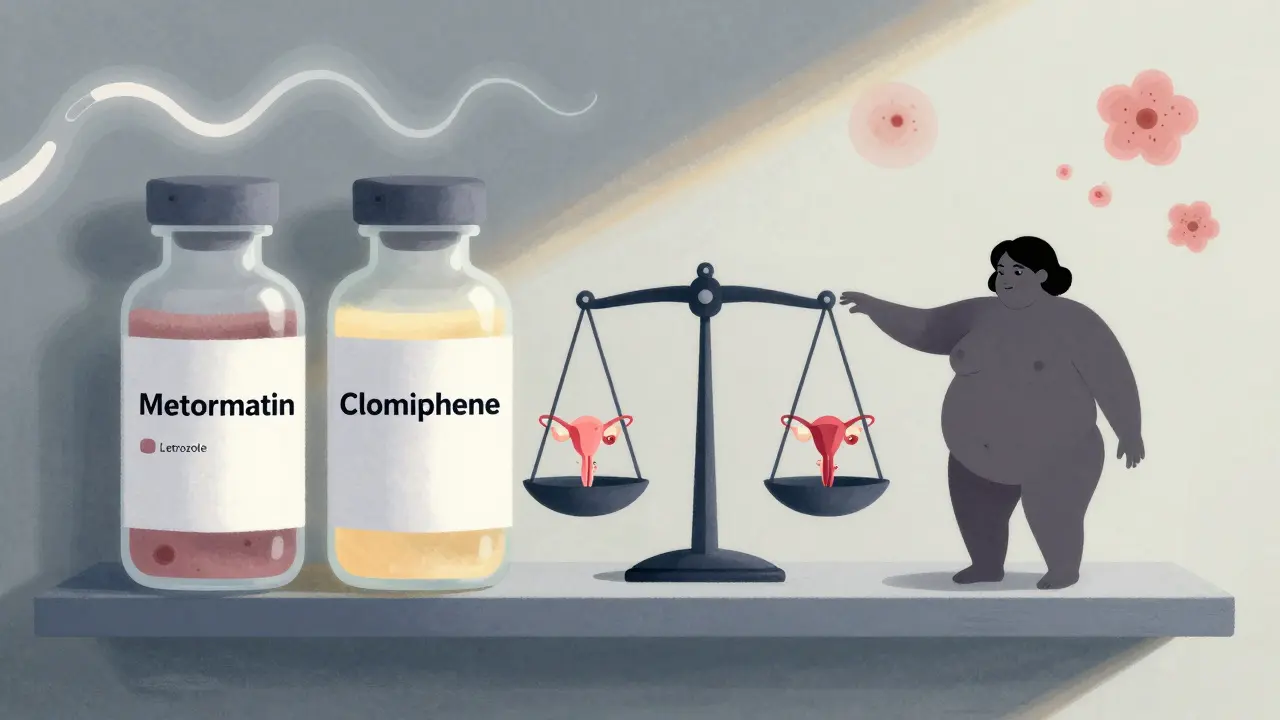
Here’s how metformin stacks up:
- Metformin alone: 50-60% ovulation rate, 19-37% live birth rate (low-quality evidence)
- Clomiphene alone: 70-80% ovulation rate, 30-40% live birth rate
- Letrozole alone: 80-85% ovulation rate, 40-50% live birth rate
- Letrozole + metformin: 89% ovulation rate, highest live birth rates in studies
So if you’re young, lean, and insulin resistant? Start with metformin. If you’re overweight or need faster results? Letrozole is still the top choice. But combining them? That’s where the magic happens.
Why Doctors Recommend Metformin During IVF
Even if you’re going straight to IVF, metformin can help. Women with PCOS are at high risk for ovarian hyperstimulation syndrome (OHSS)-a dangerous overreaction to fertility drugs. Metformin cuts that risk by more than 70%. One pooled analysis showed an odds ratio of 0.27, meaning women on metformin were far less likely to develop OHSS.
It also improves egg quality and embryo development. In IVF cycles, women taking metformin had higher numbers of mature eggs and better-quality embryos. That’s why many fertility clinics now start metformin 2-3 months before IVF even begins.
How to Take Metformin for PCOS
Most doctors start low and go slow. You’ll likely begin with 500 mg once a day with dinner. After a week or two, you’ll increase to 500 mg twice daily. By week 4-6, you’ll probably be on 1,500-2,000 mg per day, split into two or three doses.
The extended-release version (metformin XR) causes far fewer stomach issues. If you get nausea, diarrhea, or bloating-which happens in 20-30% of people-switching to XR often fixes it. Most side effects fade after 2-4 weeks. If they don’t, talk to your doctor about lowering the dose or trying a different timing (like taking it with food).
You need to be off birth control and have a negative pregnancy test before starting. And if you’re trying to conceive, have sex every 2-3 days throughout your cycle. You won’t know exactly when you’re ovulating at first, so frequency matters.
When and How to Check If It’s Working
After 2-3 months, your doctor will likely check your hormone levels. You’ll want to see:
- Lower fasting insulin
- Lower testosterone
- More regular periods
To confirm ovulation, they might order a blood test for progesterone around day 21 of your cycle. If it’s above 3 ng/mL, you ovulated. Some women get their period back within 60 days. Others take 4-6 months.
Don’t get discouraged if it takes time. Metformin doesn’t work like a switch. It’s a slow reset of your metabolism.
Can You Stay on Metformin During Pregnancy?
This is a hot topic. Some doctors stop metformin as soon as you get a positive pregnancy test. Others keep it going through the first trimester. Why? Because a 2023 meta-analysis of 12 trials found higher pregnancy rates when women kept taking it.
Metformin is classified as Category B-meaning animal studies show no risk, and human data hasn’t shown harm. It doesn’t cross the placenta in large amounts. And it may reduce miscarriage risk in women with PCOS and insulin resistance.
Still, decisions vary. Talk to your OB or fertility specialist. If you’re at high risk for gestational diabetes, staying on metformin might be the smartest move.

The Bigger Picture: More Than Just Fertility
Metformin isn’t just about getting pregnant. It’s about staying healthy. Women with PCOS have a 3-7 times higher risk of developing type 2 diabetes by age 40. Metformin cuts that risk by nearly 50%, according to the REPOSE trial.
It also helps with weight management. While it’s not a weight-loss drug, many women lose 2-5% of their body weight on it-enough to restore natural cycles. It lowers triglycerides, improves cholesterol, and reduces liver fat.
And for women who can’t or won’t take birth control pills for acne or hirsutism? Metformin is the only alternative that treats the cause, not just the symptoms.
Who Benefits Most-and Who Doesn’t?
Metformin works best for:
- Women with PCOS and insulin resistance (confirmed by blood tests)
- Lean or normal-weight women with PCOS
- Those who can’t tolerate clomiphene or letrozole
- Women planning IVF
- Anyone wanting long-term metabolic protection
It’s less effective for:
- Women without insulin resistance
- Those with severe obesity and no metabolic issues
- People who need immediate ovulation
Don’t assume you’re a candidate just because you have PCOS. Ask for an insulin or glucose tolerance test before starting.
Cost, Safety, and What to Expect
Generic metformin costs $4-$10 a month in the U.S. That’s a fraction of what letrozole or clomiphene cost. It’s been used for over 60 years. Side effects are mostly mild and temporary. The biggest risk? Vitamin B12 deficiency after long-term use. Get tested every 2-3 years.
And yes-some women don’t respond. That’s okay. It doesn’t mean you’re broken. It just means your body needs a different approach. Metformin is one tool in a big toolbox. Sometimes it’s the perfect fit. Other times, it’s part of a team.
Final Thoughts
Metformin isn’t a miracle cure. But for women with PCOS and insulin resistance, it’s one of the most underused, evidence-backed tools we have. It doesn’t just help you ovulate-it helps your body heal. Whether you’re trying to get pregnant now or just want to protect your long-term health, metformin deserves a serious look.
Start with the facts: Do you have insulin resistance? Are you lean? Are you looking for more than just a quick fix? If yes, talk to your doctor about giving metformin a real chance.
Can metformin help me get pregnant if I have PCOS?
Yes, metformin can help women with PCOS ovulate and conceive, especially if insulin resistance is present. Studies show it improves ovulation rates by nearly doubling them compared to no treatment. However, it’s more effective when combined with other fertility drugs like letrozole. For women who don’t respond to clomiphene, metformin often restores ovulation.
How long does it take for metformin to work for PCOS?
Most women notice more regular periods within 2-3 months. Ovulation usually resumes after 3-6 months of consistent use. For metabolic improvements like lower insulin or better skin, you may see changes in as little as 6 weeks. But full benefits-like improved fertility or weight loss-often take 6 months or longer.
Does metformin cause weight loss in PCOS?
Metformin isn’t a weight-loss drug, but many women with PCOS lose 2-5% of their body weight on it. This happens because it reduces insulin spikes that drive fat storage. The weight loss is usually modest but enough to restart natural ovulation in some women. It works best when paired with diet and movement.
Is metformin safe during pregnancy?
Yes, metformin is considered safe during pregnancy. It’s classified as Category B, meaning no harm has been shown in human studies. Some doctors continue it through the first trimester because it may lower miscarriage risk in women with PCOS and insulin resistance. Others stop it after a positive test. Always discuss this with your provider.
What are the side effects of metformin for PCOS?
The most common side effects are nausea, diarrhea, bloating, and stomach upset-especially when starting. These affect 20-30% of users but usually fade within 2-4 weeks. Switching to the extended-release version (XR) reduces side effects by half. Rarely, long-term use can lower vitamin B12 levels, so get tested every few years.
Can I take metformin without being diagnosed with insulin resistance?
It’s not recommended. While many women with PCOS have insulin resistance, not all do. Metformin works best when insulin resistance is confirmed through blood tests like fasting insulin or HOMA-IR. Taking it without a clear need offers little benefit and exposes you to unnecessary side effects. Ask your doctor for testing before starting.
Why do some doctors say metformin doesn’t work for PCOS?
Some studies show metformin alone doesn’t significantly improve live birth rates compared to placebo. But those studies often include women without insulin resistance, where metformin has little effect. The real benefit shows up in women with confirmed insulin resistance-especially lean women. The confusion comes from grouping all PCOS patients together. It’s not a one-size-fits-all drug.
Shanahan Crowell
I was skeptical at first, but after 4 months on metformin, my periods came back like clockwork-and my acne cleared up so much my dermatologist asked if I switched skincare! It’s not magic, but it’s the closest thing I’ve found to a reset button for my body. 🙌
Kerry Howarth
Metformin isn’t a fertility drug. It’s a metabolic one. That distinction matters.
Angela Fisher
Okay but have you heard about the BIG PHARMA cover-up?? They don’t want you to know that metformin was originally a goat herb that was banned in Europe because it makes you ‘too healthy’ and cuts drug sales!! My cousin’s friend’s nurse said the FDA buried 3 studies proving it cures PCOS AND makes you lose weight without dieting!! 😱💉 #WakeUpSheeple
Brittany Wallace
It’s funny how we treat insulin resistance like it’s a flaw to fix, rather than a signal that our bodies are trying to survive in a world that’s way too sugary and stressful. Metformin doesn’t ‘cure’ PCOS-it gives us space to breathe while we rebuild. 🌱 Maybe the real question isn’t ‘does it work?’ but ‘why did we need it in the first place?’
Michael Burgess
I started metformin after my endo told me I had HOMA-IR off the charts. First month: nausea so bad I cried. Second month: switched to XR and life changed. Third month: I ovulated for the first time in 3 years. Now I’m 8 weeks pregnant and still taking it. My OB said it’s probably why I didn’t get OHSS during IVF. This drug saved my sanity-and my future. 💪👶
Liam Tanner
I’ve seen patients on metformin for years. The ones who stick with it, even when side effects suck, are the ones who end up with better labs, fewer miscarriages, and way less anxiety about their health. It’s not glamorous. But it’s real.
Hank Pannell
The pharmacodynamics of metformin in PCOS are fascinating-it activates AMPK, downregulates hepatic gluconeogenesis, and modulates gut microbiota, which in turn reduces androgen synthesis via decreased LH pulsatility. But beyond the mechanisms? It’s about restoring homeostasis in a system that’s been chronically dysregulated by modern life. The fact that it reduces long-term diabetes risk by 50%? That’s not just therapeutic-it’s preventative medicine at its finest.
Ian Ring
I’ve been on metformin for 2 years now. My insulin levels are normal, I’ve lost 4kg, and my periods are regular. But I did have to get my B12 checked-turns out it was low. Took supplements and all good. Worth it. 🙏