
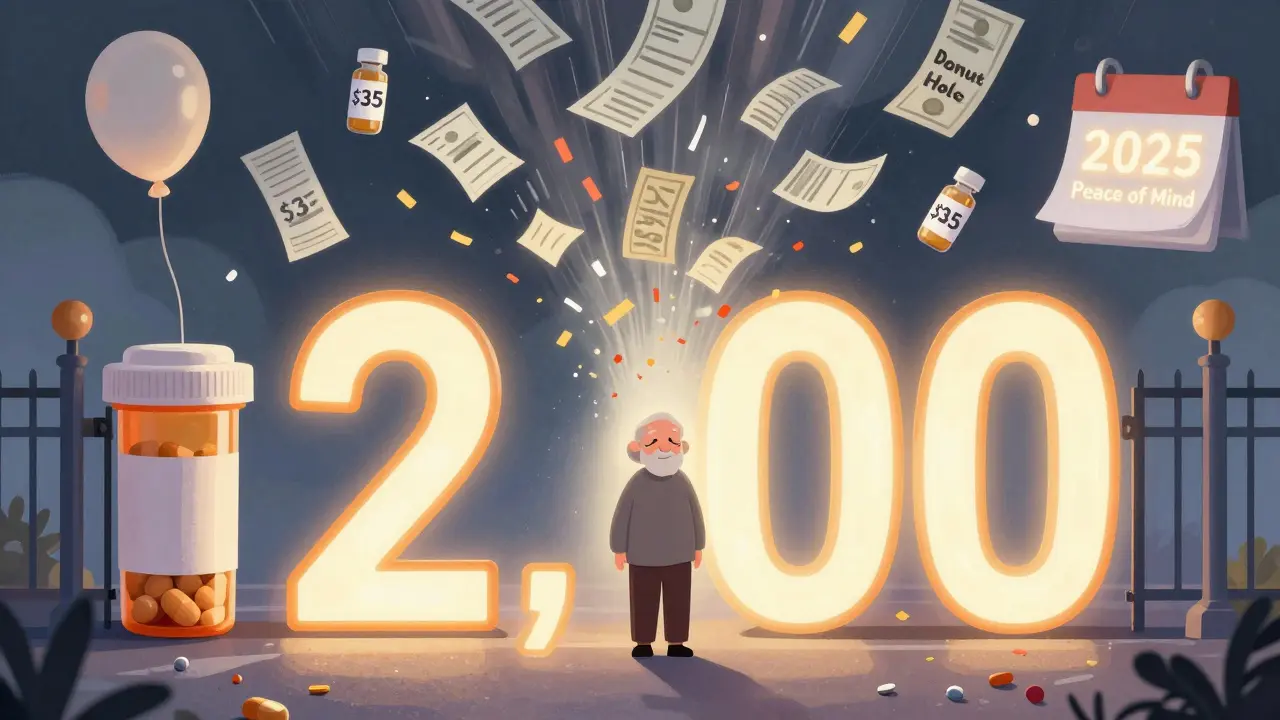
By 2025, Medicare Part D has changed more in the last two years than it has in the last 15. If you’re on Medicare and take prescription drugs, this isn’t just another annual update-it’s a complete reset. The old confusion about the "donut hole," the surprise bills in the middle of the year, the endless calculations-those are gone. Now, there’s one clear rule: you’ll never pay more than $2,000 out of pocket for your prescriptions in a calendar year. That’s it. No more guessing. No more panic when your insulin bill hits $300. This is the new reality, and it’s simpler than most people realize.
What Medicare Part D Actually Covers
Medicare Part D is prescription drug coverage. It’s not part of Original Medicare (Parts A and B). Instead, it’s offered by private insurance companies that follow rules set by Medicare. You can get it two ways: as a stand-alone plan (called a PDP), or bundled into a Medicare Advantage plan (called an MA-PD). Either way, it covers most FDA-approved prescription drugs-both brand-name and generic.
Every plan has a formulary-a list of drugs it covers. These are grouped into tiers. Lower tiers (like preferred generics) cost you less. Higher tiers (like specialty drugs) cost more. The plan decides which drugs go where. That’s why you can’t just pick a plan based on price alone. You have to check if your specific medications are covered and at what cost.
Insulin is capped at $35 per month. That hasn’t changed since 2023, and it still applies in 2025. Same goes for certain vaccines, like shingles and flu shots-those are free under Part D, no matter your plan.
The Three Phases of Coverage (2025 Simplified)
Forget the old four-phase system. In 2025, there are only three:
- Deductible Phase - You pay 100% of your drug costs until you hit the deductible. In 2025, the maximum deductible is $590. Some plans have lower deductibles-or even $0. But if your plan has a deductible, you pay full price until you reach it.
- Initial Coverage Phase - Once you hit the deductible, you pay 25% of the drug cost. Your plan pays 65%. The drug manufacturer pays 10% through a discount program. This continues until your total out-of-pocket spending (including what you paid during the deductible phase) reaches $2,000.
- Catastrophic Coverage Phase - Once you hit $2,000, you pay nothing for covered drugs for the rest of the year. Ever. Not a cent. The plan pays 60%, the manufacturer pays 20%, and Medicare pays 20%. That’s it.
That $2,000 cap includes everything you pay: deductibles, coinsurance, copays-even what you pay through the Extra Help program. It does not include your monthly premium. That’s separate.
What’s New in 2025 (And Why It Matters)
The biggest change? The elimination of the coverage gap-the "donut hole." Before 2025, after you spent a certain amount, you’d hit a phase where you paid 25% to 75% of your drug costs, depending on the year. It was confusing. People would get hit with bills they didn’t expect. Now, that phase is gone. You go straight from initial coverage to catastrophic coverage once you hit $2,000.
Another big change: the deductible went up from $505 in 2024 to $590 in 2025. That might sound bad, but it’s offset by the $2,000 cap. Before, you could spend $8,000 before hitting catastrophic coverage. Now, you’re capped at $2,000. Even if you take expensive drugs, you’re protected.
Monthly premiums vary. The average stand-alone Part D plan costs $45 a month. Medicare Advantage plans with drug coverage average $7. That’s a huge difference. But here’s the catch: the cheaper plan might have higher copays or exclude your meds. So don’t just pick the lowest premium. Run the numbers for your specific drugs.

How to Choose the Right Plan
You have options. In 2025, the average Medicare beneficiary can choose from 48 Part D plans. That includes 14 stand-alone drug plans and 34 Medicare Advantage plans with drug coverage.
Here’s how to pick:
- Make a list of your drugs - Include the name, dose, and how often you take them. Don’t forget over-the-counter meds your doctor prescribed.
- Use the Medicare Plan Finder - Go to medicare.gov/plan-compare. Enter your drugs, zip code, and pharmacy. The tool shows you total estimated costs for each plan-premiums, deductibles, copays, everything.
- Check the formulary - Make sure your drugs are covered. Look at the tier. Is it a preferred generic? Or a specialty drug? Higher tier = higher cost.
- Check your pharmacy - Is your local pharmacy in-network? Some plans have narrow networks. If you’re not in-network, you might pay full price.
- Compare total annual cost - Don’t just look at the monthly premium. Add up what you’ll pay for your meds for the whole year. The cheapest premium might cost you more in the long run.
Pro tip: If you get Extra Help (Low-Income Subsidy), you can enroll in one of 90 stand-alone Part D plans with $0 monthly premium. That’s a huge win.
What You Still Need to Watch Out For
The $2,000 cap is powerful. But it doesn’t fix everything.
- Formularies change - Plans can remove your drug from the formulary next year. Always review your plan during Open Enrollment.
- Non-preferred drugs cost more - If your drug isn’t on the preferred list, you’ll pay more. Ask your doctor if there’s a generic or preferred brand alternative.
- High list prices still exist - The cap protects you from paying too much, but drugmakers can still set high list prices. Medicare doesn’t negotiate those prices directly.
- Don’t skip enrollment if you don’t take drugs now - If you don’t enroll when you’re first eligible and you don’t have other creditable drug coverage, you’ll pay a late penalty forever. It’s 1% of the national base premium ($35.37 in 2024) for every month you delay. That adds up.
When to Enroll and How to Avoid Penalties
You have a 7-month window around your 65th birthday to sign up for Part D without penalty. If you miss it, and you don’t have other drug coverage that’s as good as Medicare’s, you’ll pay a penalty for as long as you have Part D.
Open Enrollment runs from October 15 to December 7 every year. That’s when you can switch plans. If you’re happy with your plan, you don’t have to do anything. But if your meds changed, or your pharmacy moved, or your premium went up, this is your chance to switch.
Even if you think you don’t need it, consider a low-premium plan. You can always drop it later if you never use it. But if you wait and need drugs later, you’ll pay more.
Where to Get Help
You don’t have to figure this out alone.
- Medicare & You Handbook - Free, official guide. Download it at medicare.gov.
- 1-800-MEDICARE - Call 24/7. They handled 78 million calls in 2023.
- SHIP Programs - State Health Insurance Assistance Programs offer free, one-on-one counseling. Find yours at shiptacenter.org.
- Medicare Rights Center - Offers free advice and resources. Their 2024 survey found 68% of beneficiaries didn’t know about the 2025 changes. Don’t be one of them.
Real people say it best: "I used to stress every time my insulin refill came. Now, I just pick it up. No math. No fear. That’s peace of mind."
That’s what the 2025 redesign is for. Not to save Medicare money. Not to make insurance companies happy. To make sure you can afford your meds.
Does Medicare Part D cover all prescription drugs?
No. Each Part D plan has its own formulary, or list of covered drugs. Plans must cover at least two drugs in each drug class, but they can choose which ones. Some drugs, like weight-loss pills or fertility treatments, are never covered. Always check your plan’s formulary before enrolling.
Is the $2,000 out-of-pocket cap per person or per household?
It’s per person. Each Medicare beneficiary has their own $2,000 limit. If you and your spouse both have Part D, you each have your own cap. You can’t combine them.
Do I still pay a monthly premium if I hit the $2,000 cap?
Yes. The $2,000 cap only covers what you pay for your drugs-deductibles, copays, coinsurance. Your monthly premium is separate and continues whether you’ve hit the cap or not. That’s why it’s important to factor premiums into your total cost when comparing plans.
What happens if my drug isn’t on my plan’s formulary?
You’ll pay full price out of pocket unless you get an exception. You can ask your plan for a formulary exception if your doctor says you need a drug that’s not covered. You’ll need a letter from your doctor explaining why. Plans must respond within 72 hours for urgent cases or 7 days for non-urgent ones.
Can I switch Part D plans anytime?
Only during specific times: your Initial Enrollment Period, Annual Enrollment Period (October 15-December 7), or if you qualify for a Special Enrollment Period. Examples of Special Enrollment Periods include moving out of your plan’s service area, losing other drug coverage, or qualifying for Extra Help. Outside those windows, you’re locked in.
Will the $2,000 cap go up in future years?
Yes. Starting in 2026, the out-of-pocket threshold will increase to $2,100. After that, it will be adjusted annually based on inflation. The cap isn’t frozen-it’s designed to rise with drug costs, but it will always protect you from spending more than a set amount each year.
How do I know if I qualify for Extra Help?
You qualify if your income is below $21,870 for an individual or $29,580 for a couple in 2025, and your assets are under $17,220 (or $34,360 for a couple). Extra Help pays for your premium, deductible, and copays. You can apply at SSA.gov or call 1-800-772-1213. Even if you think you don’t qualify, apply-it’s free and you might be surprised.
What to Do Next
Don’t wait until December to act. Start now.
- Gather your current prescription list, including dosages.
- Write down your pharmacy’s name and address.
- Go to medicare.gov/plan-compare and run your numbers.
- Compare at least three plans-don’t just stick with what you’ve had.
- If you’re unsure, call 1-800-MEDICARE or find your local SHIP counselor.
The system is simpler now. But it’s still easy to miss something. The goal isn’t just to get coverage-it’s to get the right coverage. With the $2,000 cap, you’re protected. But only if you choose wisely.
Jon Paramore
The $2,000 out-of-pocket cap is a game-changer for high-cost polypharmacy patients. No more navigating the donut hole’s arbitrary thresholds-now it’s linear: pay until you hit the ceiling, then zero liability. Formulary tiering still matters, though-preferred generics will always be cheaper than non-preferred brands, even under catastrophic coverage. Don’t assume all plans are equal; check your specific drugs on the Plan Finder with your pharmacy locked in.
Grace Rehman
So we’re telling seniors they can finally afford their meds but still gotta pay $45 a month just to have the privilege of not going broke? The system didn’t fix capitalism-it just put a pretty bow on the bleeding wound. I’m not grateful. I’m pissed we had to wait this long for basic human decency
Siobhan K.
That $2,000 cap is the single most important change since Part D launched. But people still don’t realize it doesn’t include premiums. I’ve seen too many elderly folks drop plans because they thought ‘no more out-of-pocket’ meant ‘no more payments.’ It doesn’t. Always check the total annual cost-not just the cap. And yes, insulin at $35 is still a miracle.
Brian Furnell
Wait-so the manufacturer discount is now mandatory? And Medicare pays 20% in catastrophic? That’s unprecedented. I’ve been tracking this since 2022, and this is the first time the federal government has directly subsidized drug manufacturers’ rebates in the coverage phase. This isn’t just reform-it’s structural re-engineering. The CBO didn’t predict this level of cost-shifting. And yes, the deductible increase to $590 is a red herring; the cap makes it irrelevant for most users.
Meina Taiwo
Check your formulary. Always.
Adrian Thompson
They’re hiding the truth. The $2,000 cap? It’s a trap. Big Pharma raised list prices so high that Medicare’s forced to pay more to keep you from going broke. The real cost is in the premiums and the hidden kickbacks. This isn’t relief-it’s a shell game. And they want you to thank them for it. Don’t fall for it.
Southern NH Pagan Pride
so the goverment says u pay 2k but pharma still jacks up the list price so the plan pays more? and we’re supposed to be happy? i mean... i guess its better than 8k but why does this feel like a scam? also why is the word 'catastrophic' still in the name? that’s not calming
Jackie Be
MY INSULIN JUST COST ME $35 AND I DIDNT HAVE TO CHOOSE BETWEEN FOOD AND MEDS THIS MONTH AND I’M CRYING IN THE PHARMACY LINE AND I’M NOT EMBARRASSED BECAUSE THIS IS WHAT WE WERE FIGHTING FOR
Swapneel Mehta
This is actually good news. I’ve been helping my uncle in India compare his U.S. Medicare plan with his local insurance. He’s amazed at how much clearer this is now. Even in countries with universal care, the drug pricing chaos is real. This model-capped out-of-pocket with manufacturer rebates-could be a blueprint. Not perfect, but miles ahead of what we had.
Dan Adkins
It is imperative to underscore that the aforementioned $2,000 out-of-pocket threshold is not a universal panacea, nor is it a statutory entitlement. Rather, it constitutes a discretionary fiscal policy adjustment enacted under the Inflation Reduction Act of 2022, subject to annual recalibration and potential legislative revision. One must remain vigilant, as the current structure is neither constitutionally guaranteed nor immune to future amendment.
Erika Putri Aldana
why is everyone acting like this is a win?? i mean sure i dont pay 8k anymore but now i pay 45 a month and my plan still doesnt cover my weird allergy med?? and why is it called catastrophic?? like i’m dying?? this feels like a scam to make people feel good while they still get gouged
Orlando Marquez Jr
The structural evolution of Medicare Part D in 2025 represents a significant milestone in U.S. public health policy. The harmonization of cost-sharing mechanisms under a single out-of-pocket threshold, coupled with mandatory manufacturer contributions and the elimination of the coverage gap, aligns the program more closely with international benchmarks for pharmaceutical affordability. This model, while imperfect, demonstrates a functional equilibrium between fiscal sustainability and patient protection. Further refinement should focus on formulary transparency and premium equity.