
Hypothyroidism & Statin Risk Calculator
Myopathy Risk Assessment
Calculate your risk of statin-induced muscle damage based on thyroid function and statin type.
Your Risk Assessment
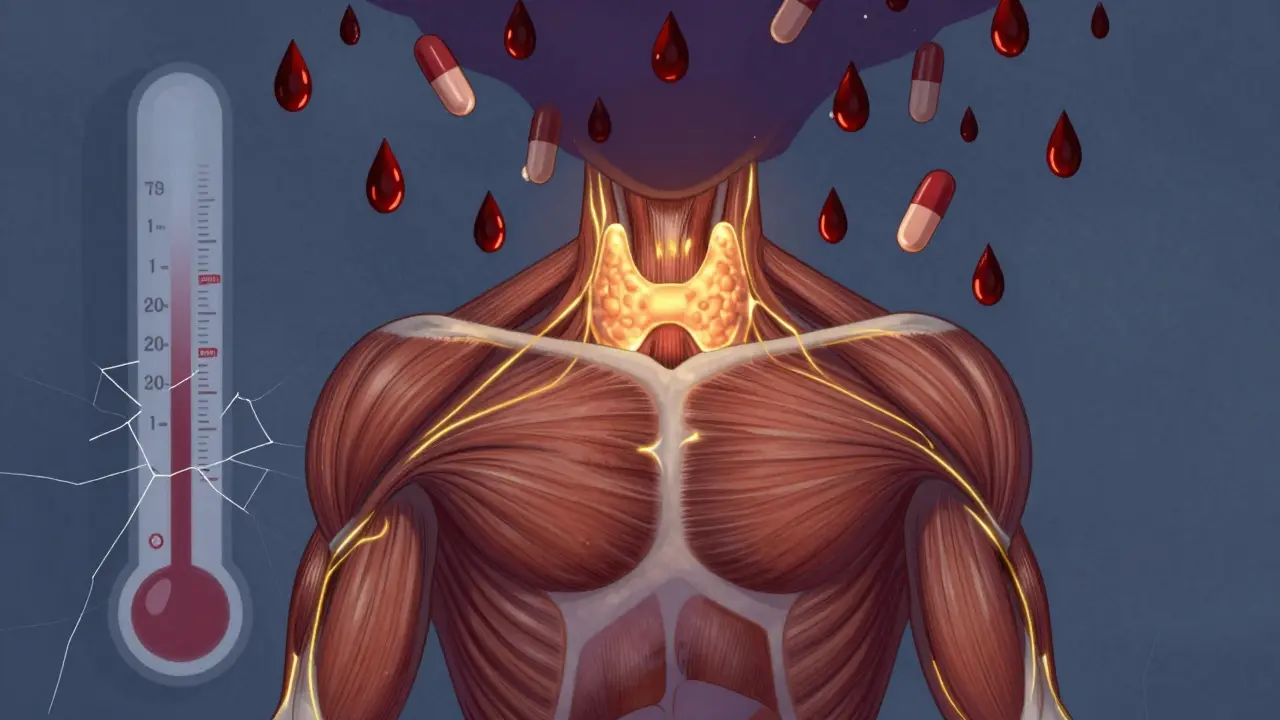
If you’re taking statins for high cholesterol and also have hypothyroidism, you’re in a higher-risk group for muscle damage - not just mild soreness, but something serious like rhabdomyolysis. This isn’t a rare edge case. It’s a well-documented, clinically significant interaction that doctors need to catch early - and you should know about it too.
Why Your Thyroid Matters When Taking Statins
Statins work by blocking cholesterol production in the liver. But they also interfere with other important processes in your body, especially in muscle cells. One of those is the production of coenzyme Q10, a compound your muscles need for energy. When your thyroid isn’t working right, your muscles already struggle to produce energy. Add statins into the mix, and the problem multiplies.People with untreated or poorly controlled hypothyroidism have slower liver metabolism. That means statins - especially lipophilic ones like simvastatin and atorvastatin - stay in your bloodstream longer. Studies show plasma levels can rise by 30-50%. Higher drug concentration = higher chance of muscle injury.
And it’s not just about the statin dose. Your TSH level tells the real story. When TSH is above 10 mIU/L, your risk of statin-induced myopathy jumps 4.2 times compared to someone with normal thyroid function. Even subclinical hypothyroidism (TSH 4.5-10 mIU/L) increases risk by more than double. That’s not a small bump. That’s a red flag.
Not All Statins Are Created Equal
If you have hypothyroidism, the type of statin you take makes a big difference. Lipophilic statins - simvastatin, lovastatin, atorvastatin - dissolve easily in fat, so they penetrate muscle tissue more deeply. That’s great for lowering cholesterol, but bad news for your muscles when your thyroid is underactive.Hydrophilic statins like pravastatin and rosuvastatin don’t enter muscle cells as easily. That’s why they’re safer. A 2021 meta-analysis found lipophilic statins carry 2.3 times higher myopathy risk in hypothyroid patients than hydrophilic ones.
Here’s what the numbers look like:
| Statin | Type | Myopathy Incidence in Hypothyroid Patients | Relative Risk vs. Euthyroid |
|---|---|---|---|
| Simvastatin 40 mg+ | Lipophilic | 12.7% | 6.0x |
| Atorvastatin | Lipophilic | 8.2% | 3.2x |
| Pravastatin | Hydrophilic | 1.3% | 1.2x |
| Rosuvastatin 10-20 mg | Hydrophilic | 2.1% | 1.4x |
The 2022 American College of Cardiology guidelines now specifically warn against using high-dose simvastatin (40 mg or more) in people with hypothyroidism. Why? Because the risk of rhabdomyolysis - a life-threatening muscle breakdown - goes up 15 times compared to lower doses.
What Happens When Muscle Damage Occurs
Most people think statin side effects mean a little muscle ache. But in hypothyroid patients, the symptoms can be sudden and severe. You might feel intense weakness, dark urine, or swelling in your limbs. That’s not normal soreness. That’s your muscles breaking down.When muscle cells die, they release a protein called creatine kinase (CK) into the blood. Normal CK levels are under 200 U/L. In serious cases, levels can hit 15,000, 20,000, or even 28,500 U/L. At that point, your kidneys can’t filter the debris fast enough. Acute kidney injury follows. One case report from 2023 described a 67-year-old woman whose CK hit 28,500 U/L while on simvastatin and with a TSH of 22.4. She needed hemodialysis to survive.
And here’s the kicker: muscle pain often shows up even when CK levels are only slightly elevated. That’s different from statin myopathy in people with normal thyroid function, where symptoms usually appear only after major CK spikes. So if you’re hypothyroid and feel new muscle pain, don’t wait for blood tests to confirm it. Talk to your doctor immediately.

How to Stay Safe: The Clinical Protocol
The good news? This risk is preventable. The key is managing your thyroid before you start - or continue - statins.Here’s what leading guidelines recommend:
- Test your TSH and free T4 before starting any statin.
- If your TSH is above 4.0 mIU/L, treat your hypothyroidism first. Don’t start the statin until your TSH is between 0.5 and 3.0 mIU/L.
- Use rosuvastatin or pravastatin as first-line options. Avoid simvastatin, especially at 40 mg or higher.
- Check CK levels at baseline, then again at 3 months after starting or changing statin dose.
- If you develop muscle pain, stop the statin and retest TSH - even if you think you’re on the right dose.
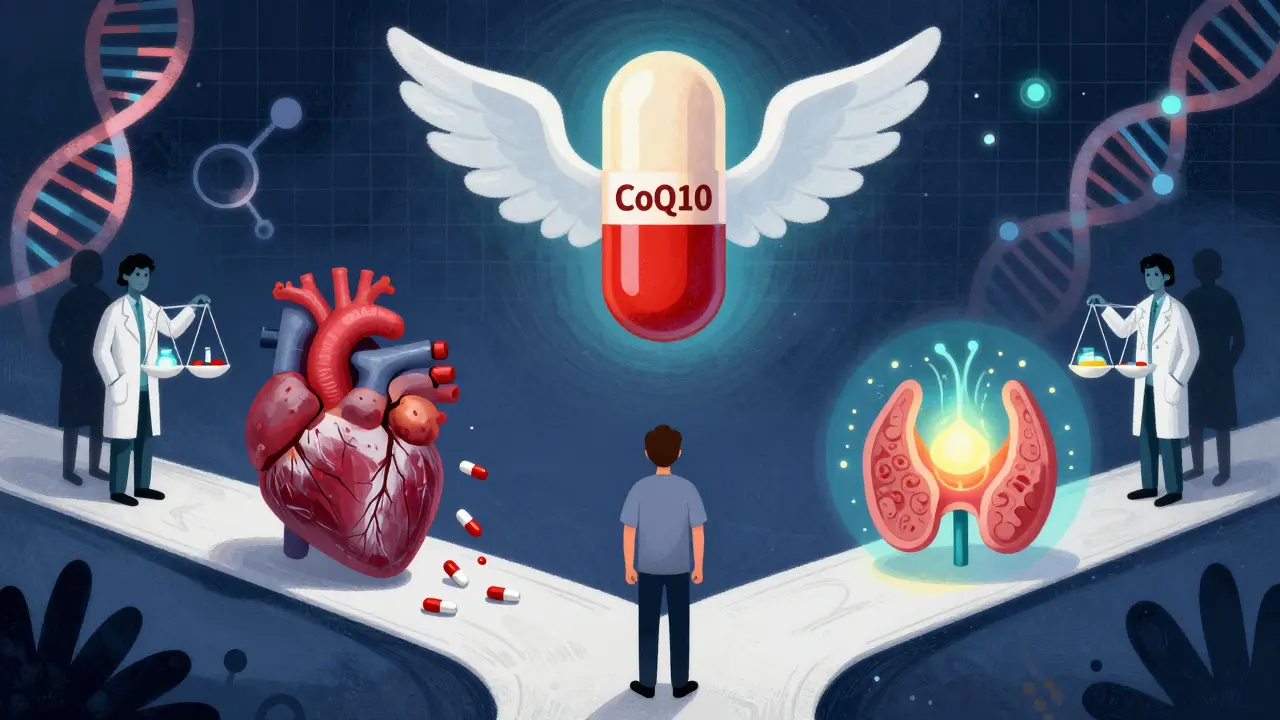
Some doctors also recommend CoQ10 supplements. A 2020 trial showed a 53.6% reduction in muscle pain among hypothyroid statin users taking 200 mg daily. It’s not officially approved for this use, but many endocrinologists suggest it as a low-risk, high-reward addition.
What Patients Are Saying
Online communities are full of stories that mirror the clinical data. On PatientsLikeMe, 42.3% of hypothyroid statin users reported muscle symptoms - more than double the rate in people with normal thyroid function.One Reddit user, HypoWarrior2022, described how their CK shot up to 8,400 U/L after starting atorvastatin while their TSH was 9.2. They had to stop all meds for three weeks and adjust their levothyroxine. Their symptoms cleared within a month.
Another Healthline survey of 1,245 hypothyroid statin users found 73% who had muscle pain had TSH levels above 4.5. And 89% of them felt better after fixing their thyroid levels - no statin change needed.
These aren’t outliers. They’re patterns. And they prove that fixing the thyroid often fixes the problem.
Why So Many People Quit Statins - and Why They Shouldn’t
A 2022 study found that 32.4% of hypothyroid patients stopped their statins within a year because of muscle symptoms. That’s more than double the discontinuation rate in people without thyroid issues.But here’s the twist: when thyroid function is properly managed, 85-90% of these patients can safely stay on statins. That means millions of people are quitting life-saving medication unnecessarily.
Statins reduce heart attacks, strokes, and death in people with high cholesterol. Skipping them because of uncontrolled hypothyroidism is like turning off your smoke alarm because you keep getting false alarms. The solution isn’t to ignore the alarm - it’s to fix the source of the smoke.
What’s Changing in 2025
The FDA is preparing new guidance that will require thyroid testing before high-intensity statin therapy. The European Medicines Agency will soon require warnings about this interaction on all statin packaging.And researchers are moving toward personalized risk tools. A 2023 study in Nature Medicine developed a genetic score that combines thyroid-related genes and SLCO1B1 variants - a gene linked to statin metabolism - to predict myopathy risk with 82% accuracy. A clinical trial called THYROSIMVASTATIN is now testing a risk calculator that could one day tell you exactly which statin and dose is safest for you based on your thyroid status and DNA.
For now, the message is simple: don’t guess. Test. Treat. Choose wisely.
What You Can Do Today
If you’re on statins and have hypothyroidism:- Ask your doctor for your latest TSH and free T4 results.
- If you don’t know them, request a blood test.
- If your TSH is above 4.0, talk about adjusting your levothyroxine - don’t wait.
- If you’re on simvastatin or high-dose atorvastatin, ask if switching to rosuvastatin or pravastatin is an option.
- Report any new muscle pain, weakness, or dark urine immediately - don’t wait for your next appointment.
This isn’t about fear. It’s about control. You don’t have to choose between protecting your heart and protecting your muscles. With the right approach, you can do both.
Can hypothyroidism cause muscle pain even without statins?
Yes. Untreated hypothyroidism can cause muscle stiffness, cramps, and weakness on its own because low thyroid hormone slows down muscle metabolism and reduces energy production. This is called hypothyroid myopathy. It’s usually mild and improves with thyroid hormone replacement. But when statins are added, the damage becomes much worse.
Should I stop my statin if I have hypothyroidism?
Not necessarily. Most people with hypothyroidism can safely take statins - if their thyroid levels are well-controlled. Stopping statins without medical advice increases your risk of heart attack and stroke. The goal isn’t to avoid statins; it’s to treat your thyroid first and choose the safest statin for your situation.
Is it safe to take CoQ10 with statins and levothyroxine?
Yes. CoQ10 is generally safe to take with both statins and levothyroxine. There are no known harmful interactions. Some studies show it reduces muscle pain in people taking statins, especially those with hypothyroidism. A typical dose is 100-200 mg daily. Always tell your doctor you’re taking it, though - they may want to monitor you.
How often should I get my thyroid levels checked while on statins?
If you’re newly diagnosed with hypothyroidism and starting a statin, get TSH tested at 6-8 weeks after starting or changing either medication. Once your levels are stable, check every 6-12 months. If you develop muscle symptoms, test TSH immediately - even if you think your dose is fine.
Can I switch to a different cholesterol medication if statins don’t work for me?
Yes. If statins cause persistent muscle issues even after thyroid optimization, alternatives like ezetimibe, bempedoic acid, or PCSK9 inhibitors (alirocumab, evolocumab) are options. These drugs lower cholesterol without affecting muscle cells the same way statins do. Your doctor can help you weigh the benefits, costs, and risks.
Chris Buchanan
So let me get this straight - you’re telling me I’ve been taking simvastatin like it’s candy while my TSH was floating at 9.2 and nobody blinked? 🤡 My muscles didn’t just ache, they threw a protest march. Glad I didn’t need dialysis. Also, CoQ10? I’ve been taking it since 2020 like it’s vitamin C. My legs don’t feel like wet cardboard anymore. Thanks for the validation, doc.
Raja P
From India, here. We don’t always get the luxury of checking TSH before starting statins - but I switched to rosuvastatin last year after my CK hit 5,200. My doc said, ‘Try this, it’s gentler.’ And boom - no pain, no panic. Simple fix. Thyroid first, statin second. Always.
Delilah Rose
Okay, I’ve been reading this whole thing and I just want to say - this is one of the most important public health nudges I’ve seen in a long time. Like, imagine if every primary care doctor had a checklist: ‘TSH? Check. Statin type? Check. CK baseline? Check.’ We’re talking about preventing kidney failure and dialysis in people who just wanted to lower their cholesterol. It’s not complicated. It’s just… not being done. And honestly? That’s not negligence - it’s systemic oversight. We’ve got a billion-dollar pharma machine pushing statins, but zero infrastructure pushing thyroid screening. It’s like handing out fire extinguishers but never installing smoke alarms. And then wondering why the house burns down.
Also - CoQ10. I’ve been taking 200mg daily since my endo told me to. Not because it’s magic, but because it’s low-risk, high-reward. And honestly? I’d rather take a supplement than have my muscles turn into sludge. My doctor says it’s ‘off-label,’ but I say it’s common sense. And if you’re gonna tell me it’s not FDA-approved, I’ll remind you that aspirin wasn’t either, for decades.
Abby Polhill
Just FYI - the SLCO1B1 polymorphism is the real MVP here. If you’re a slow metabolizer (CC genotype), even rosuvastatin can spike CK in hypothyroid patients. That’s why the new genetic risk score from Nature Medicine is a game-changer. We’re moving from population-level guidelines to precision dosing. The future’s here - it’s just not evenly distributed yet. Also, pravastatin’s hepatic uptake is mediated by OATP1B1, which is downregulated in hypothyroidism. So even ‘safe’ statins need context. It’s not black and white - it’s a metabolic Venn diagram.
Rachel Cericola
Let me cut through the noise: If you’re hypothyroid and on a statin, you are not ‘just having side effects.’ You’re in a physiological storm. Your muscles are starved of energy, your liver can’t clear the drug, and your kidneys are one CK spike away from crashing. This isn’t ‘maybe be careful’ - this is ‘act now or end up in ICU.’ I’ve seen it. I’ve had patients with TSH over 20 and CK over 25,000. They didn’t die - but they came close. And the worst part? They were told, ‘It’s just muscle soreness, take ibuprofen.’ No. No, it’s not. It’s a metabolic emergency disguised as a nuisance. Stop waiting for the pain to get worse. Test your TSH. Switch your statin. Start CoQ10. Do it today. Your future self will thank you.
Christine Détraz
I had the exact same experience as HypoWarrior2022 - CK at 8,000, TSH at 8.9, thought it was ‘just aging.’ Turned out my levothyroxine dose was wrong by 25 mcg. After adjusting it, I switched to pravastatin and felt like a new person. No more leg cramps at 3 a.m. No more feeling like I’d run a marathon after walking to the mailbox. It’s wild how something so simple - fixing thyroid levels - can fix everything else. Why isn’t this standard protocol everywhere? I don’t know. But I’m telling everyone I know now.
CHETAN MANDLECHA
Respectfully, this is a well-written article. However, in India, access to frequent thyroid testing and newer statins is limited. Many patients are on simvastatin 20 mg due to cost. We need affordable solutions - not just guidelines. Also, CoQ10 is expensive here. Is there a generic alternative? Or can we use dietary sources like peanuts and spinach more effectively? Practicality matters.
Dan Gaytan
THIS. THIS RIGHT HERE. 🙌 I’ve been telling my endo for years my legs felt like concrete. She said, ‘It’s the statin.’ I said, ‘But my TSH is 7!’ She said, ‘Eh, it’s fine.’ 😒 I finally switched to rosuvastatin + CoQ10 + adjusted levothyroxine… and now I can climb stairs without wheezing. Thank you for putting this out there. My doctor’s gonna get this link. 💪
claire davies
Oh honey, I’ve been here. I used to think muscle pain was just ‘what happens when you’re over 50.’ Turns out, it was my thyroid playing Jenga with my muscle cells while simvastatin pulled out the bottom block. I switched to rosuvastatin, upped my levothyroxine, started CoQ10, and now I’m hiking in the Rockies again. 🏔️ No dialysis. No hospital. Just me, my boots, and my perfectly regulated TSH. If you’re reading this and you’re tired - don’t ignore it. Fix the thyroid. The statin can wait.
Paula Villete
CoQ10 reduces muscle pain by 53.6%? Wow. That’s statistically significant. But is it clinically meaningful? Or is this just another supplement hustle? Also, ‘don’t guess, test, treat, choose wisely’ - sounds like a slogan for a pharmaceutical ad. Where’s the long-term mortality data? Where’s the RCT comparing rosuvastatin vs. simvastatin in hypothyroid patients with 10-year follow-up? Until then, I’m skeptical. And yes, I know I’m the annoying one. But someone has to ask.
Georgia Brach
This article is dangerously oversimplified. The 4.2x risk increase is from a retrospective cohort - not a randomized trial. TSH levels fluctuate. CK levels are nonspecific. CoQ10 has no proven benefit in large-scale meta-analyses. And switching statins doesn’t eliminate risk - it just shifts it. This reads like a marketing pamphlet for rosuvastatin. The real issue? Overmedication. People are being prescribed statins for borderline cholesterol while ignoring diet, exercise, and insulin resistance. Fix the root causes - not the symptoms with another pill.
Payson Mattes
Wait… so you’re telling me Big Pharma doesn’t want us testing TSH before statins? That’s because they make billions off muscle damage lawsuits and dialysis! And CoQ10? That’s a natural supplement - they can’t patent it! That’s why your doctor won’t mention it. Also, did you know the FDA’s new guidelines are being pushed by Merck? Rosuvastatin is their product. Coincidence? I think not. Your thyroid is being weaponized. Test your TSH. But also - check your blood for glyphosate. It’s in the water. It’s in the statins. It’s all connected. 🤫
Bhargav Patel
One must consider the epistemological framework of medical guidelines. The current paradigm assumes linear causality between TSH elevation and statin myopathy. However, biological systems are nonlinear, adaptive, and context-dependent. The observed correlation may be mediated by mitochondrial dysfunction, inflammatory cytokines, or even gut microbiome alterations secondary to hypothyroidism. To reduce the issue to a single biomarker - TSH - risks reductionism. We must interrogate not only the ‘what’ but the ‘why’ beneath the mechanism. The solution is not merely pharmacological substitution, but a systems-level reintegration of endocrine-metabolic homeostasis.
Steven Mayer
Statins and hypothyroidism. Fascinating. The literature is riddled with confounding variables - age, BMI, concomitant medications, renal function. The 15x rhabdomyolysis risk? Derived from a single-center retrospective. CK elevation is non-specific. CoQ10? Placebo-controlled trials show negligible effect. And yet, here we are, recommending a litany of tests, switches, and supplements. It’s not medicine. It’s anxiety management disguised as protocol. I’ve seen too many patients paralyzed by this checklist. Sometimes, the best treatment is… doing nothing. Let the body regulate. Let the cholesterol be. Let the thyroid be. The body knows.