
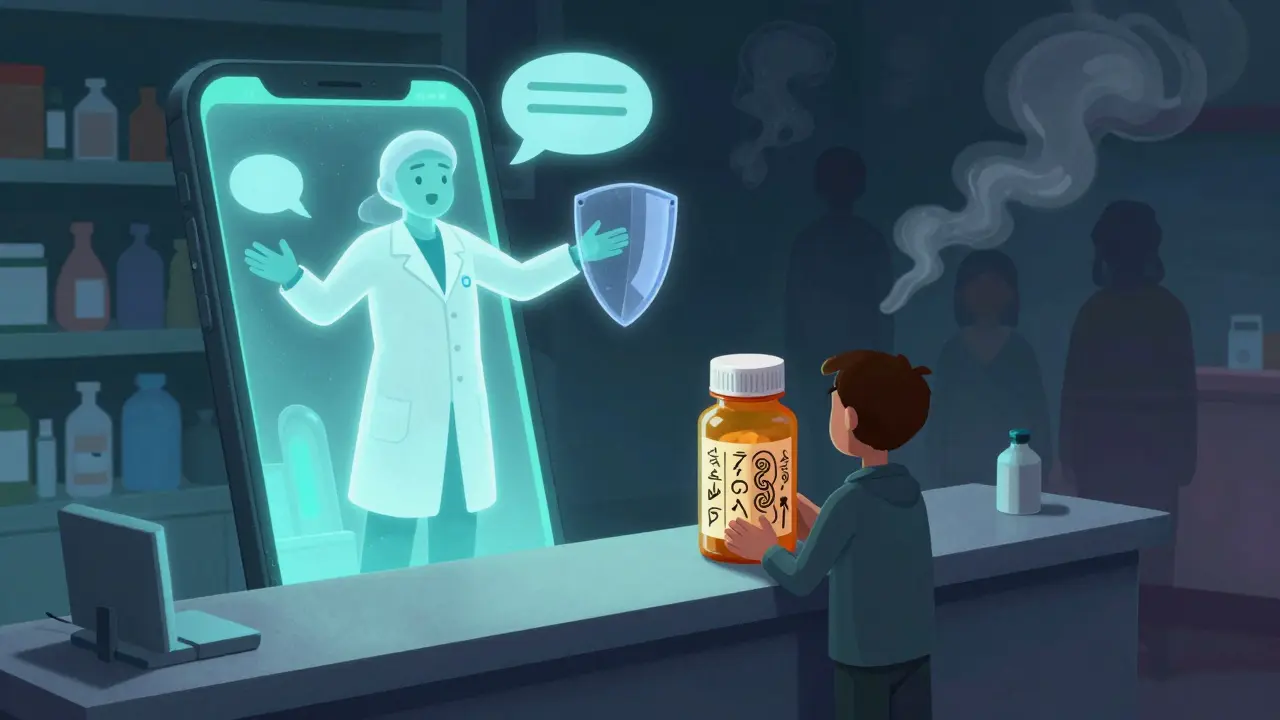
When you or a loved one gets a new prescription, understanding how to take it correctly isn’t just helpful-it’s life-saving. But if English isn’t your first language, the instructions on the label might as well be written in code. That’s where professional translator services for medication counseling come in. By law, pharmacies in the U.S. must provide these services for free. You don’t need to ask twice. You don’t need to beg. You just need to say it clearly.
Why Language Help for Medications Isn’t Optional
In 2012, researchers at the University of California, San Francisco found that patients who don’t speak English well are three times more likely to make dangerous mistakes with their medications-like taking too much, too little, or at the wrong time-when no interpreter is available. These aren’t small errors. They lead to hospital visits, emergency room trips, and sometimes death. Federal law makes this clear: if a pharmacy gets federal funding (and nearly all do), they must offer language help. That’s thanks to Section 1557 of the Affordable Care Act. It’s not a suggestion. It’s a requirement. And it covers more than just translating labels. It means someone trained in medical terms must explain your prescription out loud, answer your questions, and make sure you understand the risks. States like California go even further. Their SafeRx program requires pharmacies to provide interpreters during every medication counseling session-whether in person, over the phone, or by video-and they can’t charge you a cent. If you’re told, “We don’t have an interpreter right now,” that’s not okay. It’s a violation of your rights.How to Ask for Help-The Right Way
Don’t say, “Can someone help me?” or “My daughter speaks English, she can translate.” That’s how mistakes happen. Family members, even fluent ones, aren’t trained in medical terminology. A 2021 study in JAMA Pediatrics found using family members as interpreters increases the risk of serious medication errors by 49%. Instead, say this: “I need a professional interpreter for my medication counseling.” Say it clearly. Say it early. Say it before the pharmacist starts explaining your prescription. If you’re at a chain pharmacy like CVS, Walgreens, or Rite Aid, ask to speak with the pharmacist directly. If they say they don’t have one on-site, ask for phone or video interpreting. Most pharmacies now use services like RxTran, which connects you to certified medical interpreters in under 30 seconds. You don’t need to wait hours. You don’t need to reschedule. You just need to ask.What Services Are Available?
There are three main ways pharmacies provide interpreter services:- Phone interpreting - Fast, affordable, and available 24/7. Costs about $2.50 per minute. Best for simple instructions, but can be confusing for older adults or people with hearing issues.
- Video interpreting - Lets you see the interpreter, so body language and lip movements help. Costs $3-$5 per minute. Used by 65% of healthcare facilities as of 2023. Ideal for complex meds or if you’re nervous about asking questions.
- In-person interpreters - The gold standard. Pharmacists say patients understand 78% better with face-to-face interpreters. But these are rare outside big cities. If you live in a rural area, this might not be an option.
What to Expect When You Request a Translator
A good pharmacy will follow a simple three-step process:- Identify the need - They’ll ask you, “What language do you speak best?” or “Do you need an interpreter?” If they don’t ask, say it yourself.
- Connect you - They’ll dial a phone, open a video app, or call in an interpreter. This should take less than a minute.
- Document it - They’ll log the service using a billing code (T-1013) and note the interpreter’s name, language, and how long the session lasted. This isn’t just paperwork-it’s how pharmacies get reimbursed and prove they’re following the law.
What Happens If They Refuse?
In 2022, a national pharmacy chain paid $1.2 million in penalties after the U.S. Department of Health and Human Services found they failed to provide interpreters for LEP patients. That’s not a rare case. Since 2016, there have been 47 federal settlements over language access violations in healthcare. If you’re denied service:- Ask for a written complaint form.
- Take a photo of the pharmacy’s name and location.
- Call the Office for Civil Rights at 1-800-368-1019 or file a complaint online at hhs.gov/ocr.
What You Can Do Right Now
You don’t have to wait for the system to change. You can fix this today:- Before your next pharmacy visit, write down your main questions: “What does this medicine do?” “What happens if I miss a dose?” “What foods or drugs should I avoid?”
- When you arrive, say, “I need a professional interpreter for my medication counseling.” Don’t apologize. Don’t wait.
- If you’re helping someone else, don’t assume they understand. Even if they nod along, they might not. Ask them to repeat the instructions in their own words.
- Keep a printed copy of the translated directions if the pharmacy gives them to you. Store it with your meds.
Why This Matters More Than You Think
By 2030, over 28 million Americans will have limited English proficiency. That’s nearly 1 in 10 people. And yet, only 54% of community pharmacies have a formal system to request interpreters. Most still rely on staff who “speak a little Spanish” or “have a cousin who can help.” That’s not safe. Professional interpreters aren’t just translators. They’re medical communicators. They know the difference between “take once daily” and “take every 24 hours.” They know how to explain side effects without scaring you. They know when to pause and check for understanding. This isn’t about politics. It’s about safety. It’s about dignity. It’s about making sure no one dies because they didn’t understand the label.What’s Changing in 2025?
New rules took effect on January 1, 2025. AI translation tools-like Google Translate or chatbots-are now banned for use on prescription labels and medication instructions unless a human reviews them first. That’s because automated tools get medical terms wrong. They translate “take with food” as “take with meal,” which sounds fine… until someone takes it with a candy bar. Also, Medicare and Medicaid now reimburse pharmacies at a 75% rate for interpreter services when helping children in non-English-speaking households. That means more pharmacies will be incentivized to offer better services. California is adding translations for Tagalog and Arabic, with pilot programs launching in Los Angeles. Other states are watching closely.Final Thought: Your Voice Is the Key
You don’t need to be fluent in English to get safe care. You don’t need to be wealthy. You don’t need to be loud. You just need to ask. The system is built to fail you if you don’t speak up. But if you say, “I need a professional interpreter,” you’re not asking for a favor. You’re exercising a right. And you’re helping make the system better for everyone else who comes after you.Don’t wait for someone to offer. Don’t assume they’ll know. Say it. Loud. Clear. And keep saying it until you get it.
Dolores Rider
So now the government’s gonna force pharmacies to hire interpreters… but who’s gonna pay for it? 😏 I bet the cost gets passed to us through higher premiums. And don’t get me started on how they pick who gets an interpreter-what if you speak Tagalog but your dialect’s from Mindanao? 😭 They’ll send someone who thinks ‘sakit ng ulo’ means ‘headache’ when it’s actually ‘my soul is crying’ 😵💫
Vatsal Patel
Ah yes, the sacred ritual of demanding a professional interpreter like it’s a divine right. How quaint. We live in a world where AI can diagnose cancer from a selfie, yet we still cling to human translators who mispronounce ‘hypertension’ as ‘high tension’? 🤦♂️ The real tragedy isn’t language-it’s our refusal to evolve. Let machines translate. Let humans rest.
Gina Beard
It’s not about asking. It’s about expecting. If you walk into a pharmacy and don’t get an interpreter, it’s not a service gap-it’s a moral failure. No one should have to beg for safety. Not in a country that claims to value life.
Juan Reibelo
I… I’ve seen this… too many times…
My mother… she took her pills wrong… because the label said ‘take with food’… and she thought ‘food’ meant ‘bread’…
She didn’t know ‘food’ meant ‘any meal’…
She didn’t know ‘avoid alcohol’ meant ‘no wine… no beer… no medicine with vodka’…
She didn’t know… until she collapsed…
And then… they said… ‘we didn’t have an interpreter’…
And I… I just… cried…
Because I didn’t know how to say it… in English… either…
Heather McCubbin
OMG I just got prescribed Adderall and the pharmacist handed me a Spanish flyer and said ‘you’re Latina right?’ I was like… I’m from Ohio and my last name is McAllister 😭 I swear if I hear ‘we have a cousin who speaks Spanish’ one more time I’m gonna scream into a pillow
Shanta Blank
Let me guess… the same people who think ‘I speak a little Spanish’ is enough to explain warfarin are the same ones who think ‘I’m not racist I have a Black friend’ 🤡 You think your cousin’s ESL class qualifies them to explain why you can’t drink grapefruit juice with your statin? That’s not help. That’s a death sentence with a smiley face 😘
Tiffany Wagner
i just wanted to say thank you for writing this. i’m a nurse and i see this every day. people nodding because they’re too scared to say they don’t understand. it breaks my heart. i wish more people knew they have the right to ask
Viola Li
Wow so now we’re giving free interpreters to non-English speakers but I still have to pay $80 for my insulin? That’s not equity. That’s performative compassion. Let’s fix the cost of medicine first before we start hiring interpreters for people who chose to move here
venkatesh karumanchi
Every time I hear someone say ‘I need a professional interpreter’ I feel hope. Not because the system works-but because people are finally waking up. You’re not being loud. You’re being brave. Keep saying it. Even if they roll their eyes. Even if they sigh. Say it again. And again. 🙏
Jenna Allison
For those asking about the T-1013 billing code-it’s correct. It’s the HCPCS code for ‘medical interpreter services, per 15 minutes.’ Pharmacies get reimbursed by Medicaid/Medicare for it, so if they say ‘it’s too expensive,’ they’re lying. Also, if they offer a phone interpreter but the connection drops every 30 seconds, demand video. It’s legally required to be functional.
Kat Peterson
Ugh I just had to wait 45 minutes for a Korean interpreter because the pharmacy ‘didn’t have one on-site’… and then the guy came in wearing flip-flops and a tank top and said ‘hi’ like we were at a beach party 🤡 I’m not asking for a spa day. I’m asking not to die. And they treat it like a customer service ticket? 🙄
Himanshu Singh
My uncle in Punjab took his blood pressure pill at night instead of morning because the label said ‘daily’ and he thought it meant ‘once a day’… not ‘every day’. He ended up in ICU. We didn’t know how to explain ‘every’ in Punjabi. That’s why this matters. Not for politics. Not for laws. For love. 🌱