
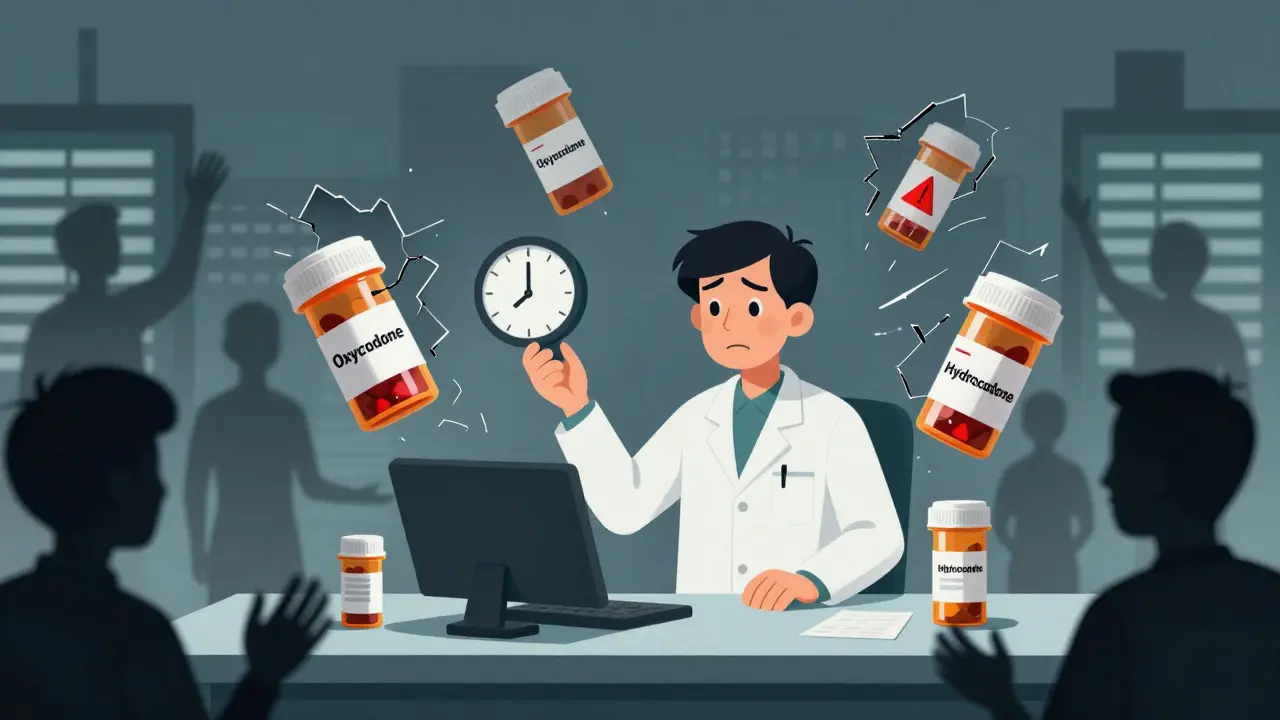
Every month, pharmacists face the same challenge: patients showing up for a refill before they should. Some claim their insurance allows it. Others say their doctor wrote it. A few even offer to pay cash, thinking that clears the way. But behind these requests often lie hidden dangers - early refills that lead to overdose, duplicate prescriptions that cause toxic interactions, and broken systems that let mistakes slip through. These aren’t just inconveniences. They’re medication safety failures that can land people in the ER - or worse.
The truth is, early refills and duplicate therapy aren’t random. They’re predictable patterns. And when pharmacies treat them as surprises instead of system failures, patients pay the price. The good news? You can stop these mistakes before they start. It doesn’t require fancy tech or huge budgets. It takes clear protocols, trained staff, and a mindset shift: refills aren’t emergencies - they’re scheduled events.
Understand Why Early Refills Happen
Most patients don’t try to game the system. They’re confused. Insurance plans often say you can get a 30-day supply "5 days early." Many patients hear that as "I can use up my meds 5 days early, then refill." That’s not how it works. The 5-day window is meant for travel or emergencies - not to stretch out your supply. But without clear communication, patients assume they’re entitled to refill early every time.
Then there’s the real problem: patients using multiple pharmacies. A person on pain meds might get one script from their primary care doctor, another from a specialist, and a third from a pharmacy across town. If those pharmacies don’t talk to each other, duplicate therapy slips through. One pharmacist sees a prescription for oxycodone. Another sees a separate one for hydrocodone. Neither knows the patient is doubling up. The result? Respiratory depression. Hospitalization. Death.
Controlled substances make this worse. DEA rules say Schedule II drugs - like oxycodone, fentanyl, or Adderall - can’t be refilled at all. But some patients still try. They’ll call multiple prescribers. They’ll claim their prescription was lost. They’ll say they "ran out early" because of work stress. Without a system to catch these patterns, you’re not just filling a prescription - you’re enabling misuse.
Build a Risk-Based Refill Protocol
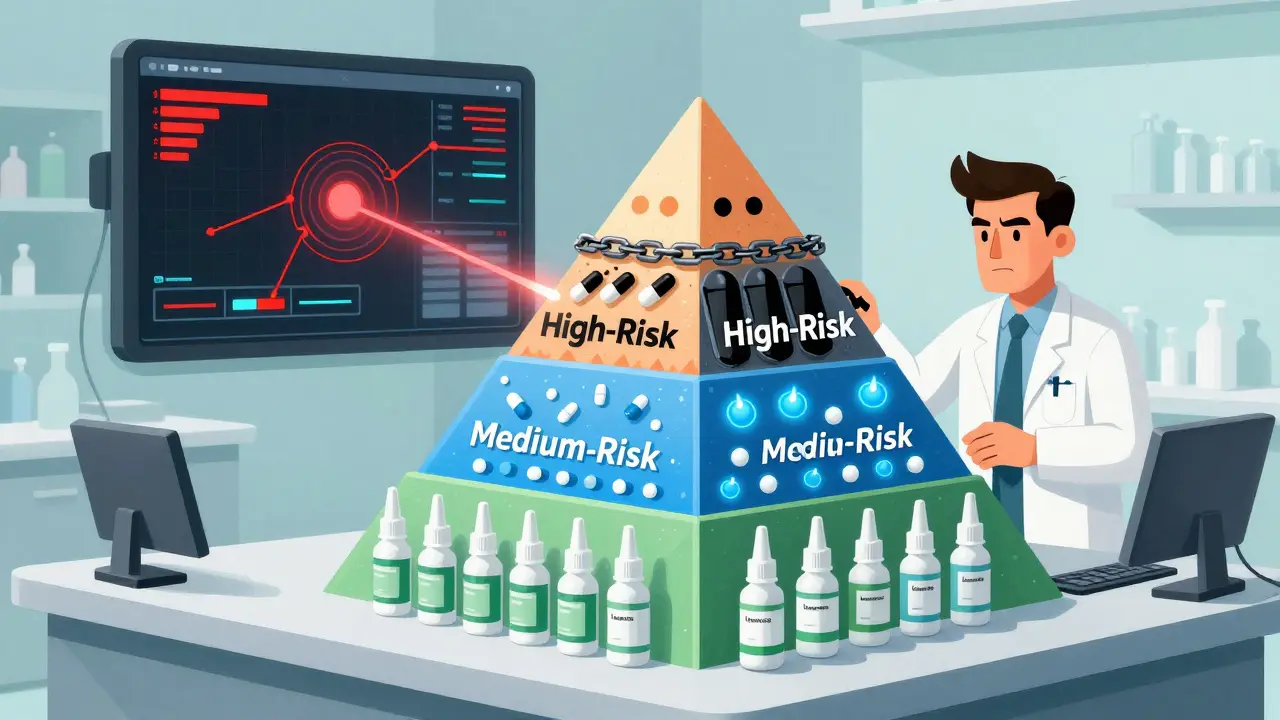
Not all medications are equal. A nasal spray for allergies? Low risk. A blood thinner? High risk. A controlled painkiller? Highest risk. Your refill protocol should reflect that.
Start by grouping medications into three tiers:
- Low-risk: Things like nasal steroids, thyroid meds, or antihistamines. These can be auto-approved if the patient has been seen in the last 6 months.
- Medium-risk: Blood pressure pills, diabetes meds, or birth control. These can be refilled for up to 90 days if the patient has had labs or a visit in the last 90 days. Let nurses or medical assistants handle these approvals.
- High-risk: Opioids, benzodiazepines, stimulants. These require direct provider approval every time. No exceptions.
One health system saw a 78% drop in provider workload after implementing this system. Nurses approved 64% of refill requests automatically. Only 18% needed a doctor’s sign-off. That’s not just efficient - it’s safer.
Use Your EHR Like a Safety Net
Your Electronic Health Record (EHR) isn’t just for charting. It’s your frontline defense against duplicate therapy and early refills.
Set up automated alerts. If a patient requests a refill 7 days before their last one was filled, the system should flag it. If they’ve had two opioid prescriptions from different doctors in the last 30 days, it should stop the refill and notify the prescriber.
Also, use EHR notes to track refill history. When a patient gets a refill early, add a note: "Refilled 3 days early on 2/12/2026 - patient reported lost bottle." That way, next time, the pharmacist sees the pattern. Don’t rely on memory. Rely on data.
And don’t forget the clinical viewer. In Australia, systems like My Health Record and state-based prescription monitoring tools let pharmacists see what’s been dispensed elsewhere. If a patient fills a script at a pharmacy in Melbourne and another in Sydney, you’ll know. That’s how you catch duplicate therapy.
Train Your Team to Ask the Right Questions
Pharmacists aren’t cops. But you are the last line of defense. And that means asking questions - not just scanning barcodes.
When someone asks for an early refill, don’t say "No." Say: "Can you tell me what happened?"
Maybe they lost the bottle. Maybe they ran out because they forgot to take it. Maybe they’re using it for anxiety and their doctor didn’t realize. The answer changes your response.
Train your staff to look for red flags:
- Asking for cash only
- Claiming the prescription was "written by a different doctor"
- Coming in right after a weekend or holiday
- Refusing to let you call the prescriber
Also, check for gaps. If a patient hasn’t picked up a refill in 4 months and suddenly shows up for 3 bottles - that’s not compliance. That’s stockpiling. Talk to them. Call the prescriber. Don’t assume.
Set Clear Policies - and Stick to Them
One pharmacy in Sydney stopped early refills for controlled substances cold. No exceptions. Not even for "emergencies." The rule? Two days early, max. And even then, only if the prescriber confirms.
It sounds strict. But here’s what happened: early refill requests dropped 82%. Patient complaints? Fewer than before. Why? Because patients learned: this pharmacy doesn’t play games.
Write your policy. Post it. Train every staff member on it. Include:
- Maximum early refill window (e.g., 2 days for controlled substances, 5 days for others)
- When provider approval is required
- How to handle patients who insist on cash
- How to check for duplicate therapy using monitoring tools
And make sure everyone knows: if a patient threatens to go elsewhere, you don’t bend. You say: "I want you to be safe. Let me help you talk to your doctor."
Make Refills Predictable - Not Reactive
The biggest mistake? Waiting for patients to call.
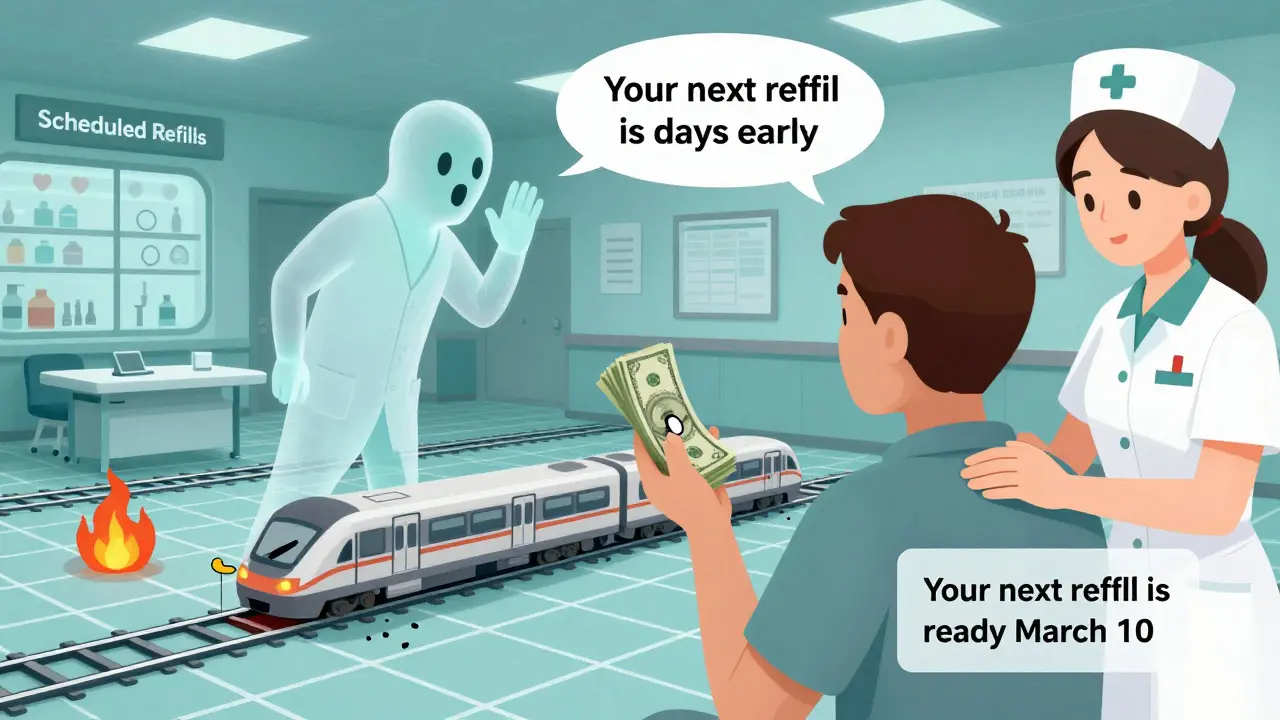
Think of refills like a train schedule. If you know someone needs a refill every 30 days, don’t wait for them to ask. Proactively prepare it.
Doctors can sign prescriptions in advance. If they’re going on vacation, they can authorize a refill for their patients. Nurses can send reminders: "Your next refill is due on March 10. Would you like us to prepare it?"
One practice in Perth cut refill-related ER visits by 40% just by sending automated text reminders. Patients didn’t run out. They didn’t panic. They didn’t seek early refills.
Technology Is Your Ally - Not Your Replacement
Yes, CDS tools help. Yes, prescription monitoring programs catch patterns. But tech alone won’t stop a patient who says, "I just need one more pill - I’m in pain."
What works? A system where:
- Technology flags risks
- Staff are trained to respond
- Policies are clear and enforced
- Prescribers and pharmacists talk
That’s how you stop early refills. That’s how you stop duplicate therapy. That’s how you save lives.
Can I refill a Schedule II controlled substance early?
No. Under DEA regulations, Schedule II drugs - such as oxycodone, fentanyl, and Adderall - cannot be refilled under any circumstances. Even if the patient claims they lost the prescription, ran out early, or need it for an emergency, a new prescription must be written. Pharmacies that refill these drugs without a new script risk legal penalties and endanger patient safety.
How do I know if a patient is getting duplicate therapy?
Use your pharmacy’s clinical viewer or state prescription monitoring program. These tools show prescriptions filled at other pharmacies. Look for overlapping drugs with similar effects - like two different opioids, or two benzodiazepines. Also check for timing: if a patient fills a script for gabapentin on Monday and another for pregabalin on Wednesday, they’re likely doubling up. Always verify with the prescriber before dispensing.
What should I do if a patient insists on an early refill and offers to pay cash?
Don’t accept cash as a reason to override policy. Politely explain that your pharmacy follows safety protocols to protect patients - not just insurance rules. Say: "I can’t fill this early, even if you pay cash, because it could be dangerous." Then offer to contact the prescriber with them. Most patients will accept that. If they refuse, document the interaction and report the behavior to your state’s prescription monitoring program.
How can I reduce the number of refill calls from patients?
Set up automated refill reminders via text or email. Let patients know their refill is ready 3-5 days before it’s due. For chronic meds, offer 90-day supplies with prior authorization. Train staff to ask: "Would you like us to prepare your next refill now?" This turns reactive calls into proactive service. One pharmacy reduced refill calls by 60% using this approach.
Is it okay to refill a medication if the patient says their doctor told them they could?
No. Always verify. Patients sometimes misunderstand what their doctor said. Or they confuse one prescriber with another. Or they’re repeating misinformation. Your responsibility is to check the prescription against your records and, if needed, call the prescriber directly. Never assume. Always confirm. It’s not about distrust - it’s about safety.
Nina Catherine
I love this! My grandma used to refill her pain meds early and I didn’t even realize how dangerous it was until she ended up in the ER. This whole post is like a wake-up call. Thanks for laying it out so clearly 💕
Taylor Mead
Honestly? This is the most practical thing I’ve read all year. I work in a pharmacy and we’ve been winging it for years. Time to get our act together.
Amrit N
I work in India and we dont have much tech but we do have strong community trust. We just ask people: "kya aapko lagta hai ye dawa sahi se use ho rahi hai?" (Do you think you're using this medicine right?) and 80% of the time they open up. Simple human connection beats algorithms any day.
Robert Shiu
This is why I love pharmacists. You’re the unsung heroes who catch the mistakes before they become tragedies. I’ve seen too many people lose their lives because no one asked the right questions. Thank you for fighting the good fight. 🙏
Greg Scott
I’m a nurse and we push refills through all the time because we’re rushed. But you’re right - it’s not about being hard, it’s about being smart. Gonna share this with my team tomorrow.
Scott Dunne
I find it amusing that Americans think they need a whole manual to do basic safety. In Ireland, we’ve been doing this since the 1970s. We don’t need EHR alerts. We just don’t refill early. End of story.
Chris Beeley
Let me break this down for you, because clearly, the average pharmacist hasn’t read a single peer-reviewed journal since 2012. The CDC’s 2021 guidelines on opioid stewardship explicitly state that refills without prescriber verification constitute a breach of the standard of care - and yet here we are, in 2026, with pharmacists still acting like they’re working at a 7-Eleven. The system isn’t broken. The people running it are. And no, I don’t care if you ‘don’t have the budget.’ That’s not an excuse - it’s a moral failure.
Benjamin Fox
Yessss this!! 🙌 I had a guy try to pay cash for oxycodone last week and I said NO and he yelled at me. I didn’t care. My job isn’t to be popular - it’s to keep people alive. 💪
Hariom Sharma
In India we don’t have fancy EHRs but we have chai breaks. We sit with patients, ask them how they’re sleeping, if their kids are okay. Sometimes that’s all it takes. One guy told me he was taking two painkillers because his wife was sick and he couldn’t sleep. We didn’t refill. We called his doctor. He cried. We cried. Now he’s on a proper plan. Tech helps - but heart? Heart saves lives.
James Roberts
Wow. Just… wow. I’ve been doing this for 18 years, and this is the first time someone actually framed refills as scheduled events. I’m printing this out and taping it to my counter. Also - ‘refill-related ER visits dropped 40%’? That’s not efficiency. That’s a revolution.
Maddi Barnes
I’m a single mom with chronic pain. I’ve been called a drug seeker so many times I’ve stopped talking. But here’s the truth: I lost my insurance last year. I had to go to three different pharmacies because my regular one wouldn’t refill early. I didn’t want to. I was terrified. I just wanted to not scream through the night. This system? It’s not just broken - it’s cruel. And now I’m supposed to trust it? 😔
Jana Eiffel
The philosophical underpinning of this approach - that refills are scheduled events, not emergencies - aligns with the Kantian imperative of universalizability. One cannot will that pharmacists universally act as gatekeepers of last resort without recognizing the moral agency of the patient. To treat refills as deviations from normative care is to infantilize those who rely on medication for dignity. This is not merely a protocol. It is an ethical framework.
John Cena
I used to think this was just about paperwork. Now I get it. It’s about humanity. I’m going to start asking patients ‘what happened?’ instead of ‘why are you here?’ Small shift. Big difference.
Irish Council
You know who’s really behind this? The pharmaceutical companies. They want you to refill early so you keep buying. The DEA doesn’t care. The insurance companies don’t care. Only you do. And they’ve trained you to think you’re helping - but you’re just part of the machine.
Freddy King
Let’s be real - this is just harm reduction theater. You’re not preventing overdoses. You’re just shifting the burden. The real problem? The prescribers. They’re the ones writing 30-day scripts for opioids like they’re giving out candy. You’re the janitor cleaning up the mess they made. Fix the source - not the symptom.