
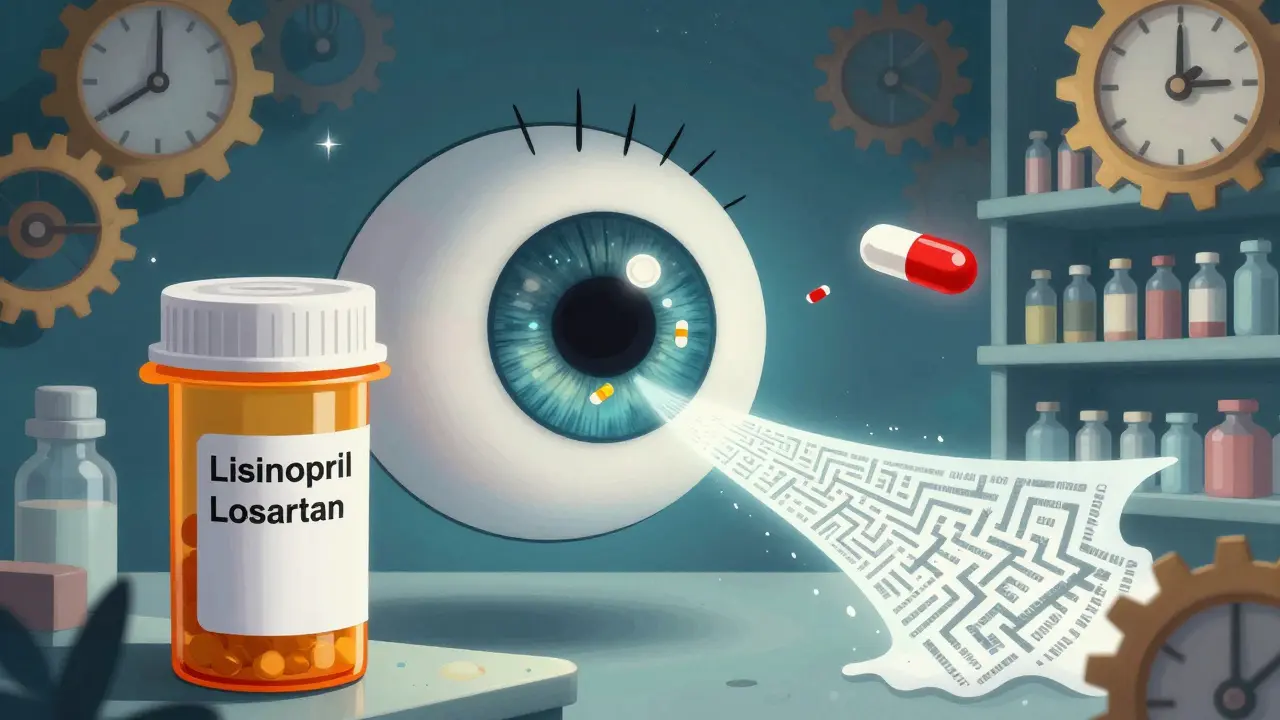
Getting your prescription filled should be simple. But if you’ve ever picked up a bottle and thought, “Is this really mine?” - you’re not alone. A prescription label is your first and last line of defense against dangerous medication errors. Every year, thousands of people accidentally take the wrong drug, wrong dose, or someone else’s medicine - often because they never checked the label. The good news? It takes less than 30 seconds to catch a mistake before it becomes a crisis.
Why Checking Your Prescription Label Matters
Medication errors are one of the most common causes of preventable harm in healthcare. According to the Institute for Safe Medication Practices, about 25% of these errors happen because the label didn’t match what the doctor ordered. That could mean your blood pressure pill was labeled as a blood thinner, or your 5 mg dose was printed as 50 mg. Both mistakes can be deadly.
Here’s the reality: pharmacies are busy. Pharmacists do their best, but mistakes happen - especially when names are similar (like “Lisinopril” and “Losartan”), or when two patients have the same first name. That’s why your eyes on the label aren’t just helpful - they’re essential. A 2020 study in the Journal of the American Pharmacists Association found that patients who checked their labels reduced their risk of taking the wrong medication by 67%.
What Should Be on Your Prescription Label?
By law, every prescription label in the U.S. must include six key pieces of information. If any are missing or unclear, ask the pharmacist to fix it before you leave.
- Your full legal name - not just “John,” but “John Michael Smith.” If your middle name or initial is on file, it should appear here.
- Medication name - both brand (e.g., “Lipitor”) and generic (e.g., “Atorvastatin”). If you only know one, ask which is which.
- Strength - always check the number and unit. “5 mg” is ten times weaker than “50 mg.”
- Dosage instructions - “Take one tablet by mouth twice daily” should match what your doctor told you.
- Pharmacy name and phone number - if you can’t read it, you can’t call if something’s wrong.
- Prescription number and date - these help the pharmacy track your refill history.
Look for warning labels too: “May cause drowsiness,” “Take with food,” or “Avoid alcohol.” These aren’t suggestions - they’re safety rules.
How to Verify Your Label: A Simple 6-Step Check
You don’t need a medical degree. Just follow these steps every time you pick up a new prescription.
- Hold the bottle at eye level - good lighting matters. Use a lamp or stand near a window. The FDA recommends at least 500 lux of light - about as bright as a typical kitchen ceiling light.
- Confirm your full name - read it out loud. Does it match your driver’s license or Medicare card? If it’s “E. Smith” and you’re “Elias Smith,” ask if they can add your full first name.
- Match the medication name - compare the label to what your doctor told you. If they said “the blue pill for cholesterol,” and the label says “Simvastatin,” that’s correct. But if it says “Metformin” (a diabetes drug), stop and ask.
- Double-check the strength - this is where most errors happen. A 5 mg pill looks like a 50 mg pill. Don’t assume. Read the number and unit carefully. If you’re unsure, ask the pharmacist to show you the original prescription.
- Verify the directions - “Take once daily” is very different from “Take three times daily.” If the label says “Take at bedtime,” but your doctor said “take in the morning,” speak up.
- Check the pharmacy contact info - if you can’t read the phone number, you won’t be able to call later if you have questions. Ask for a larger-print label or a printed copy.
Common Mistakes and How to Avoid Them
Here’s what usually goes wrong - and how to stop it.
- Small print - Many labels use 10-point font. If you’re over 65 or have trouble reading, ask for a large-print label. CVS and Walgreens offer this at 78% and 65% of locations respectively. AARP found that 71% of adults over 50 feel safer with larger text.
- Similar-sounding names - “Hydrocodone” vs. “Hydromorphone.” Even pharmacists mix them up. If a drug sounds unfamiliar, ask: “Is this the same as what my doctor prescribed?”
- Wrong patient - One Reddit user shared how they almost took their roommate’s blood pressure pill because the label had their name but the pill looked different. Always check the pill color, shape, and markings too.
- Abbreviations - “QD” means once daily, “BID” means twice daily. If you don’t know what it means, ask. Never guess.
What to Do If Something’s Wrong
If you spot a mistake - don’t just walk away. Stay calm and say:
- “I think there might be an error on this label.”
- “Can you double-check the prescription with the doctor’s office?”
- “Can I see the original prescription printout?”
Pharmacists are trained to handle this. In fact, the American Medical Association found that when patients asked questions like this, medication errors dropped by 40% in pilot programs. If they refuse to fix it, call the pharmacy’s manager. You have a right to safe medication.
Tools to Help You Stay Safe
You don’t have to rely on your eyes alone.
- Pocket magnifier - A $5 tool from any drugstore can help if text is too small.
- Smartphone magnifier - iPhone and Android both have built-in magnifiers. Just open the camera app, pinch to zoom, and hold it over the label.
- Medication apps - Apps like Medisafe or GoodRx can scan your label and remind you when to take your pills. But don’t use them as a replacement for checking the physical label.
- Ask for a printed copy - Many pharmacies will give you a paper sheet with your medication list. Keep it in your wallet.
What’s Changing in 2025 and Beyond
The FDA is pushing for a national standard for prescription labels. By the end of 2025, all labels must:
- Use 24-point font for patient names (much larger than now)
- Place the name at the very top of the label
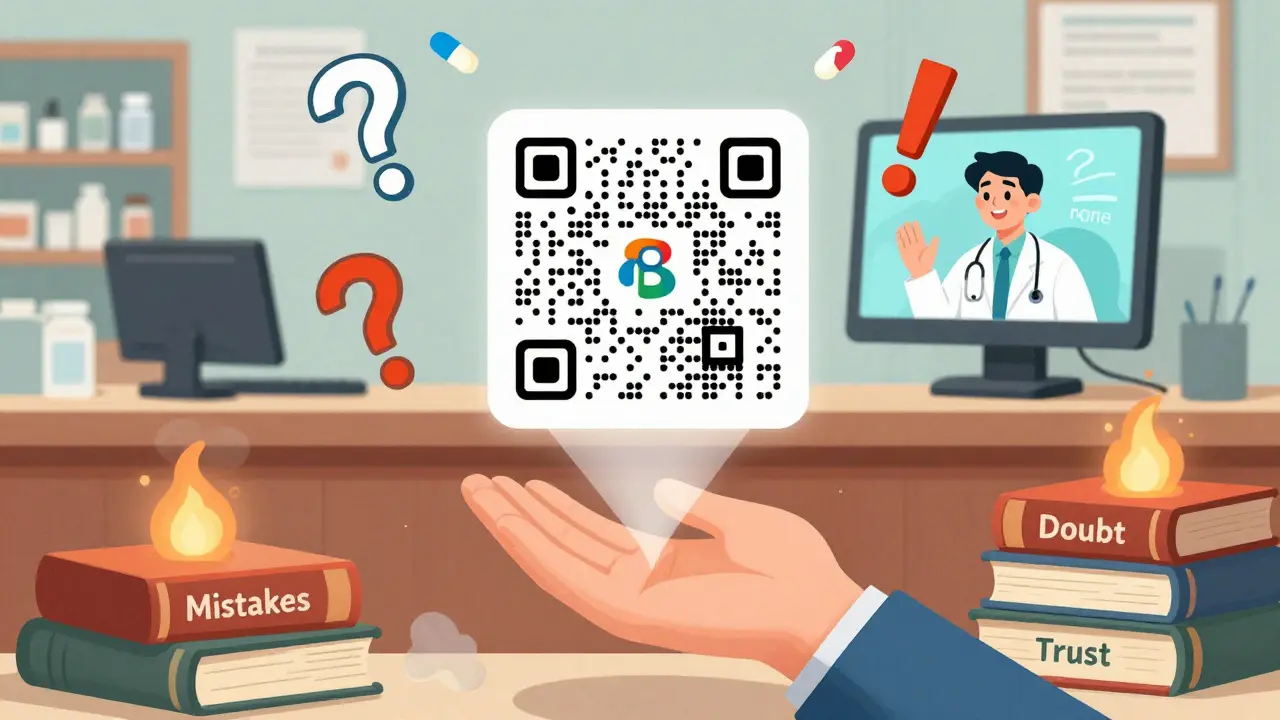
- Include QR codes linking to video instructions in multiple languages
By 2026, 60% of prescriptions for older adults will have these QR codes. Scanning one might play a 30-second video explaining your medicine in Spanish, Mandarin, or plain English.
These changes are happening because of real mistakes. A 2023 survey found 18% of patients discovered an error on their label in the past year. Most were caught by patients - not pharmacists.
Final Reminder: Your Eyes Save Lives
Pharmacies are not perfect. Systems fail. People make mistakes. But you? You’re the final checkpoint. No app, no barcode, no robot can replace your ability to look at the label and say, “That’s not right.”
Take 30 seconds. Ask one question. Save yourself or someone you love from a preventable error. It’s not paranoia - it’s smart.
Gloria Ricky
I always forget to check the name until I'm already in the car. Last month I almost took my sister's thyroid med because the bottle looked familiar. Thank god I glanced at the label before swallowing. Now I keep a little sticky note on my phone: "NAME. MED. DOSE." It's saved me twice. 😅
Stacie Willhite
This made me tear up a little. My mom almost died from a mix-up like this. She didn’t speak up because she didn’t want to be "a bother." Please, if you’re reading this - be the bother. Ask. Twice. Ask again. It’s not rude. It’s survival.
Jason Pascoe
In Australia, we’ve had the same issue. Pharmacists are amazing, but they’re juggling 12 prescriptions at once. I started carrying a small notebook with my med list - name, dose, reason. Shows them I’m serious. They always slow down and double-check after seeing it. Small effort, huge difference.
Sonja Stoces
LMAO this post is so condescending. Like, wow, who knew you should read the label? 🤡 Next you’ll tell us to check if the pills are in the bottle. I once took a pill labeled 'aspirin' and it was just sugar. Probably a government conspiracy. #PharmaLies
Annie Joyce
I used to roll my eyes at label-checking… until I got handed a bottle of Cymbalta instead of my Zoloft. Same color, same shape, different brain chemistry. I didn’t notice until I took it and felt like I’d been hit by a truck. Now I do the 6-step like a ritual. I even hum the chorus of my favorite song while I check - makes me slow down. And yes, I carry a magnifier. It’s my tiny superhero cape.
Rob Turner
There’s something deeply human about this. We outsource our health to systems - and then wonder why we feel unsafe. The label isn’t just information. It’s a contract. Between you, your doctor, the pharmacist, and your own body. If you don’t read it, you’re breaking your end of the deal. And no, that’s not paranoia. That’s responsibility.
Luke Trouten
The 67% risk reduction statistic is compelling, but it’s worth noting that this assumes patients have the literacy, vision, and time to check labels. For many - especially elderly, low-income, or disabled - this isn’t a choice. The FDA’s 2025 standards are a step forward, but we need mandatory accessibility features built into the system, not just a reminder to the individual.
Gabriella Adams
I have a 78-year-old aunt who refuses to check her labels. Says, 'I trust the pharmacist.' I sent her a laminated card with a checklist and a QR code that links to a 2-minute video of me reading the label out loud. She says it’s the only thing she’s kept from me. I cried when she told me that. We need more of this.
Joanne Tan
OMG YES. I just got my new insulin and the dose was printed as 10u instead of 100u. I almost took it. My husband caught it. We went back and they were like, 'Oh, typo.' Like, WHAT. Now I take a pic of every label and save it. My phone is full of blurry pill photos. Worth it.
Carla McKinney
This is such a performative safety guide. You’re not saving lives by checking a label - you’re just enabling a broken system. The real problem? Pharmacies are understaffed, insurance companies force generic substitutions without consent, and doctors don’t communicate with pharmacists. Fix the system, not the patient.
Ojus Save
i used to not care til i got my moms med by mistake. she had diabetis and i took her metformin. i felt dizzy for 3 hours. now i always check. even if its the same bottle. u never know. lol
Jack Havard
This is just fear-mongering. Every time someone says 'check your label,' it’s just another way to make you paranoid about medicine. I’ve been on 12 different prescriptions and never had an issue. You don’t need to be a detective. Just take the pill. Trust the system. Or don’t. I’m not stopping you.
Kristin Jarecki
The FDA’s proposed 2025 standards represent a critical alignment with human factors engineering principles. The elevation of patient name to primary visual hierarchy, coupled with typographic standardization and multimodal instruction delivery, directly addresses cognitive load and perceptual thresholds observed in geriatric and low-literacy populations. This is not merely policy - it is a public health imperative.