
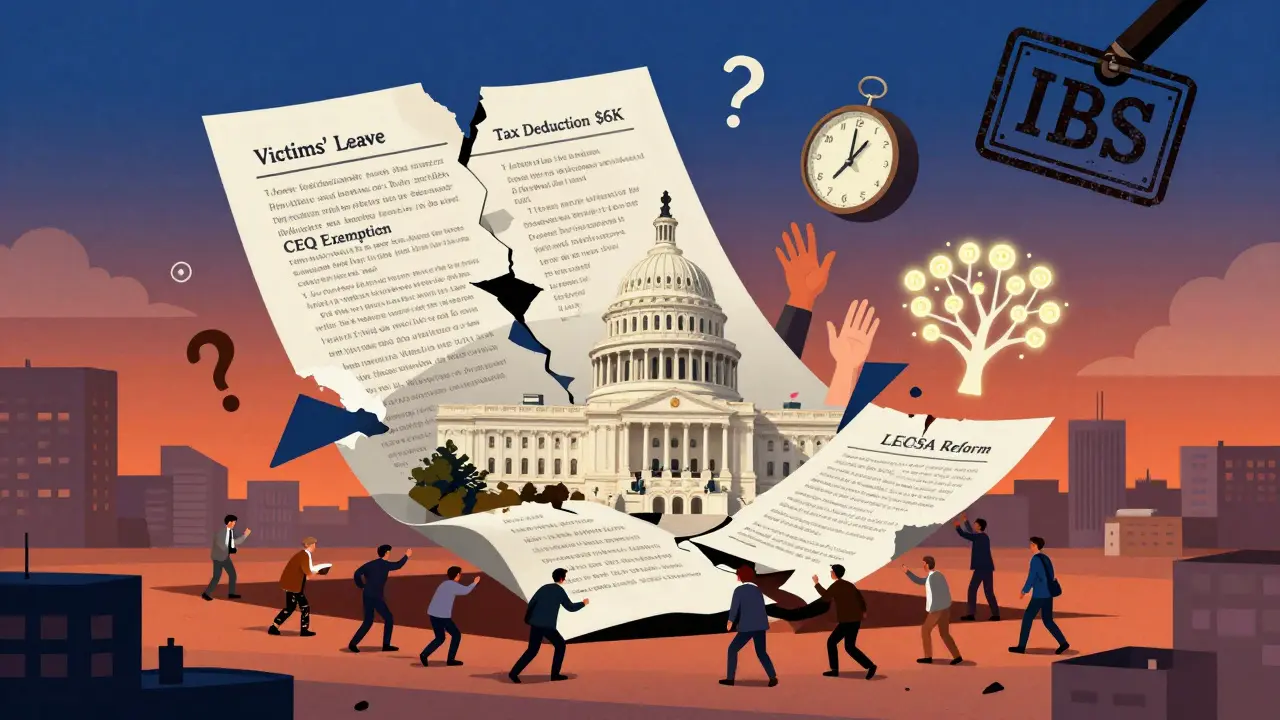
What’s Changing in the Law in 2025 and 2026?
If you’re running a business, managing employees, or just trying to stay on top of your rights, the legal landscape is shifting faster than ever. 2025 and 2026 aren’t just another couple of years-they’re a turning point. Over 4,800 new regulations were published in 2024 alone, and the pace hasn’t slowed. From tax breaks to housing rules, from workplace rights to gun laws, changes are hitting at the federal level, state by state, and sometimes even in conflicting ways. You can’t ignore this anymore. Compliance isn’t a once-a-year task. It’s daily work.
California’s Labor Laws Just Got a Major Overhaul
In California, the biggest changes landed in October 2025. Assembly Bill 406 didn’t just tweak a rule-it rewrote how employers handle leave for victims of violence. Before, these protections were scattered across two different sections of the labor code. Now, they’re all under the Fair Employment and Housing Act (FEHA). That means clearer rules, better enforcement, and a new mandatory notice employers must post by January 2026. If you’re a California employer, you’ve already had to update your HR handbooks. If you’re an employee, you now have stronger rights to take time off if you or a family member is affected by domestic violence, stalking, or sexual assault.
On top of that, paid sick leave rules were updated to match the new leave structure. The old system had confusing caps and accrual rules. The new version gives workers more flexibility and removes loopholes that let employers dodge obligations. And it’s not just sick leave. Senate Bill 590 is coming, too. Starting July 1, 2028, you’ll be able to take paid family leave to care for someone who isn’t a relative-but who you treat like family. A close friend? A partner? A guardian? They count. It’s a big step toward recognizing modern family structures.
The Federal Tax Game Has Changed
Don’t let the name fool you: the ‘One, Big, Beautiful Bill’ (Public Law 119-21) isn’t pretty for everyone. Signed on July 4, 2025, it introduced a $6,000 tax deduction for people aged 65 and older. That’s not a credit-it’s a deduction, so it reduces your taxable income, not your tax bill directly. But for retirees living on fixed incomes, that’s meaningful. The IRS rolled out Form 1099-K updates too. Remember when you had to report income over $600? That’s gone. For 2025 and 2026, the threshold is back to $20,000. Freelancers, gig workers, and small sellers breathing a sigh of relief? Maybe. But don’t celebrate yet. The IRS is still watching for suspicious patterns, and audits haven’t disappeared.
There’s also the Employee Retention Credit (ERC) cleanup. Many businesses claimed this credit during the pandemic, but the rules were messy. The new law closes loopholes and forces repayment of improper claims. If you got ERC money between 2020 and 2023, you should have received a letter from the IRS by now. Ignoring it isn’t an option.
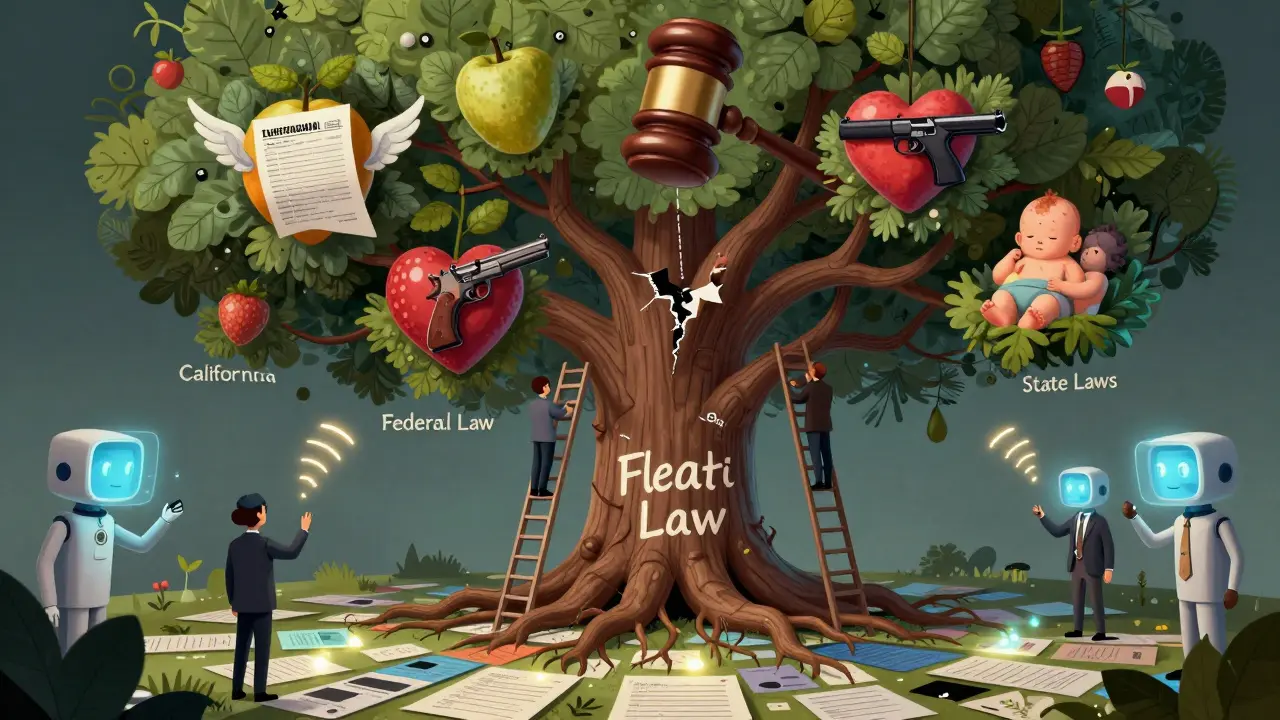
Gun Laws Are Expanding-But Not Everywhere
The LEOSA Reform Act of 2025 (H.R.2243) passed the House in May and is sitting in the Senate. If it becomes law, retired and active law enforcement officers will be allowed to carry concealed weapons in places they couldn’t before: school zones, national parks, and even some federal buildings. States can still set their own rules, but they can’t block this federal right. The catch? Officers must still meet qualification standards-just less often. States can now let them requalify every five years instead of annually.
This isn’t about expanding gun rights for everyone. It’s about giving trained professionals more mobility. But it’s also creating confusion. If you’re a business owner in a state that bans firearms on private property, does this law override your rights? The answer isn’t clear yet. Courts will likely settle it. In the meantime, businesses should review their signage and policies. What was legal last year might not be next month.
Housing in California Is About to Get a Lot Faster
California’s housing crisis got a bold answer in June 2025. Assembly Bill 130 and Senate Bill 131 slashed red tape for new housing projects. The changes target CEQA-the California Environmental Quality Act-which used to let lawsuits delay projects for years. Now, certain affordable housing, transit-oriented developments, and infrastructure projects get automatic exemptions. That means timelines shrink from five years to three. Some projects could be approved in under 18 months.
Builders are already adjusting. The California Building Industry Association estimates 18-24 months shaved off approval times for qualifying projects. That’s huge. But it’s not all good news. Critics warn that faster approvals could mean weaker environmental reviews. The state says accountability measures are built in-like mandatory public reporting and third-party audits. Still, if you live near a planned development, expect more construction noise, more traffic, and more questions about what’s being built.
The Supreme Court Is About to Reshape American Law
The Roberts Court turns 20 in 2025. And it’s getting ready to make history. Legal analysts predict major rulings on presidential power, voting rights, and federal agency authority. One case could limit how much power agencies like the EPA or the SEC have to write their own rules. Another might redefine what counts as ‘due process’ in administrative hearings. These aren’t abstract legal debates. They’ll change how businesses operate, how the government enforces rules, and how much power courts have to step in.
Companies are already preparing. Legal departments are hiring constitutional lawyers at a 25% higher rate than last year. Compliance teams are mapping out worst-case scenarios. If the Court limits agency power, federal regulations could suddenly vanish overnight. But that doesn’t mean you’re safe. States will fill the gap. California, New York, and Illinois are already drafting backup rules to replace any federal rollbacks.
Why Compliance Can’t Be an Afterthought Anymore
Here’s the hard truth: you can’t rely on your lawyer to catch every change. The volume is too high. The speed is too fast. RegEd’s data shows a 22% jump in state insurance rules alone in the first half of 2025. That’s not a glitch. It’s the new normal.
Organizations that survive this wave are building systems-not checklists. They’re using RegTech tools to track changes in real time. They’re training HR, legal, finance, and operations teams to talk to each other. They’re not waiting for a fine to wake them up. They’re running simulations: What happens if the Supreme Court strikes down a federal rule? What if California passes another leave law next month? What if the IRS audits us for a 2023 ERC claim?
Costs are rising. California employers are spending $1,200 to $1,800 per employee just to train staff on the new leave laws. Tax professionals are seeing a 40% spike in course enrollments. But the bigger cost? Getting it wrong. PwC estimates companies that ignore these changes face 15-25% higher compliance costs over three years. That’s not a risk. That’s a financial liability.
What You Should Do Right Now
- For employers: Review your leave policies. Update your employee handbook. Post the new victims’ leave notice. Train managers on the expanded definitions of ‘family’ under paid family leave.
- For retirees and seniors: Check your 2025 tax forms. Make sure you’re claiming the $6,000 deduction. Keep records of income from gig work, even if you didn’t get a 1099-K.
- For business owners: Talk to your accountant about ERC repayment rules. If you claimed it, don’t wait for the IRS to come to you.
- For property developers: If you’re working in California, study the CEQA exemptions. Are you eligible? What documentation do you need?
- For everyone: Sign up for alerts from your state’s attorney general or labor department. Don’t wait for news articles. Get the official notices.
What’s Coming Next?
2026 will bring more. The IRS will release tax inflation adjustments tied to the ‘One, Big, Beautiful Bill.’ More states will pass wage theft and independent contractor laws. The Supreme Court will likely rule on at least three major cases. And AI-powered compliance tools? They’re not science fiction anymore. Deloitte found that 78% of Fortune 500 companies are deploying them by 2026. If you’re not thinking about tech to help you stay compliant, you’re already behind.
This isn’t about fear. It’s about control. The laws are changing. You can’t stop that. But you can adapt. Faster than your competitors. Smarter than your peers. And that’s how you don’t just survive-you thrive.
Are these legal changes happening everywhere in the U.S.?
No. There’s a growing divide between federal and state laws. The federal government is rolling back rules in areas like Medicare and financial oversight, while states like California, New York, and Washington are adding more protections for workers, tenants, and consumers. If your business operates in multiple states, you’re now dealing with a patchwork of rules-not one standard. What’s legal in Texas might be illegal in Oregon.
Do I need to hire a compliance officer because of these changes?
Not necessarily-but you need someone who owns compliance. Small businesses can assign it to an HR manager or controller. Larger companies are adding dedicated roles. The key isn’t the title-it’s accountability. Someone must track changes, update policies, train staff, and audit practices. If no one is responsible, you’re at risk.
Will the new tax deduction for seniors affect my Social Security benefits?
No. The $6,000 deduction reduces your taxable income, not your Social Security payments. However, if your total income (including pensions, investments, and part-time work) is high enough, it could affect how much of your Social Security is taxed. That’s a separate calculation. Talk to a tax pro if you’re unsure.
What happens if I ignore a new regulation?
Fines, lawsuits, or shutdowns. In California, violating the new victims’ leave law can lead to penalties of up to $5,000 per employee. For tax errors, the IRS can demand repayment plus interest and penalties. Federal agencies can sue. And reputational damage? That’s harder to fix than a fine. Don’t gamble on ignorance.
Can I use AI tools to track legal changes?
Yes-and many businesses already are. Tools like LexisNexis Regulatory Intelligence, Thomson Reuters Checkpoint, and newer AI platforms scan government websites, court filings, and regulatory bulletins daily. They flag changes relevant to your industry and send alerts. They won’t replace lawyers, but they’ll save you hours and prevent missed deadlines. Look for tools that let you filter by state, industry, and regulation type.
How do I know if a law has actually passed or is still pending?
Always check the official source. For federal laws, go to congress.gov. For California, visit leginfo.legislature.ca.gov. Don’t rely on news headlines or LinkedIn posts. A bill can be introduced, debated, amended, and stalled for years. Only when it’s signed by the governor or president-and published in the official register-is it law. If it says ‘introduced’ or ‘pending,’ it’s not in effect yet.
phara don
So the IRS is going back to $20k for 1099-Ks? 😅 I thought we were done with this rollercoaster. Guess I’ll keep receipts just in case. Still, better than $600 lol.
Eli Kiseop
California just keeps going harder with leave laws like its some kind of progressive Olympics and honestly i love it
Ellie Norris
I work in HR in London and we’re watching this like a Netflix series 😅 The US is doing wild stuff with family definitions - we’re still stuck on ‘spouse or child’ but I reckon we’ll catch up. Also, that CEQA change? Massive. Hope the audits hold up.
Marc Durocher
The LEOSA Reform Act is basically letting cops turn every Walmart into a gun show. And don’t even get me started on ‘trained professionals’ - yeah, you trained to shoot, but now you’re also trained to ignore private property rights? Cool. Cool cool cool. 🤷♂️
larry keenan
The aggregation of regulatory changes across jurisdictions presents a non-trivial operational challenge for multi-state entities. The variance in statutory interpretation, particularly regarding FEHA expansion and ERC clawbacks, necessitates a tiered compliance architecture. Failure to implement real-time monitoring systems may result in material exposure.
Akhona Myeki
You Americans think you're so advanced with your 'modern family' nonsense. In South Africa we have real families - the ones that feed each other, bury each other, and don't need a law to say a friend is family. This is why your society is falling apart. All these laws - you're just trying to fix what your morals broke.
Chinmoy Kumar
I’m from India and honestly this is kinda beautiful. People fighting for better leave, for dignity, for fairness. Even the tax thing - $6k for seniors? That’s huge. We don’t have that here. Maybe one day. I hope you all keep pushing. And yeah, AI tools? I use one to track Indian tax changes - it’s a game changer. You’re not behind, you’re leading.
Vatsal Srivastava
You people are obsessed with compliance. The real problem? You let the state write your life for you. If you’re worried about 1099-K thresholds, you’re already living in a cage. Just don’t do anything illegal and stop paying attention to the noise.
Brittany Marioni
I just want to say - thank you for writing this. Seriously. I’ve been overwhelmed. I work in a small nonprofit, and the FEHA update? We didn’t even know we were supposed to post the notice until last week. We’ve been scrambling. But now we’ve got it done. And I’m printing copies for everyone. Thank you for making it clear. 🙏❤️
Monica Slypig
This is what happens when you let woke bureaucrats write laws. Paid family leave for ‘close friends’? What’s next? Paid leave for your therapist? The IRS is going to audit your emotional support cat next. And California? You’re not a state, you’re a cult with a constitution.
Becky M.
I’m a single mom in Ohio. My best friend is like family - she helped me through chemo, stayed with my kid when I was hospitalized. I cried reading about SB 590. Not because it’s political. Because it’s human. We don’t always get to choose our family. But we choose who holds us when we break. This law? It sees that. Thank you.