
Feverfew-Anticoagulant Risk Calculator
This tool estimates your bleeding risk when taking feverfew with anticoagulants. Based on clinical evidence that feverfew can increase bleeding risk by 18-22% for warfarin users and disrupt clotting for up to 4 months after stopping.
Critical Safety Information
Do not stop anticoagulants without consulting your doctor. If your risk is high, contact your healthcare provider immediately.
Warfarin users: Feverfew may increase INR by 18-22%, risking dangerous bleeding. If you've been on feverfew long-term, it may take 3-4 months for effects to clear.
Personalized Recommendations
Select your anticoagulant type to see recommendations
If you’re taking blood thinners like warfarin, apixaban, or rivaroxaban, and you’re also using feverfew for migraines or inflammation, you could be at risk for serious bleeding-even if you feel fine. This isn’t theoretical. There’s at least one documented case where a woman on feverfew developed dangerously prolonged clotting times, dropping her hemoglobin to 10 g/dL (normal is 12-15.5). Her numbers only returned to normal after she stopped taking it for four months.
What Is Feverfew, Really?
Feverfew (Tanacetum parthenium) is a daisy-like plant that’s been used for over 2,000 years. Ancient Greeks chewed its leaves to reduce fever and inflammation. Today, it’s mostly taken as a capsule or liquid extract to prevent migraines. The active ingredient, parthenolide, makes up 0.1% to 1.0% of the dried leaf and works by blocking serotonin’s effect on platelets. That sounds helpful-until you realize serotonin is one of the triggers that makes platelets stick together to stop bleeding. If you’re already on a blood thinner, you’re already slowing that process. Adding feverfew? You’re stacking the deck.
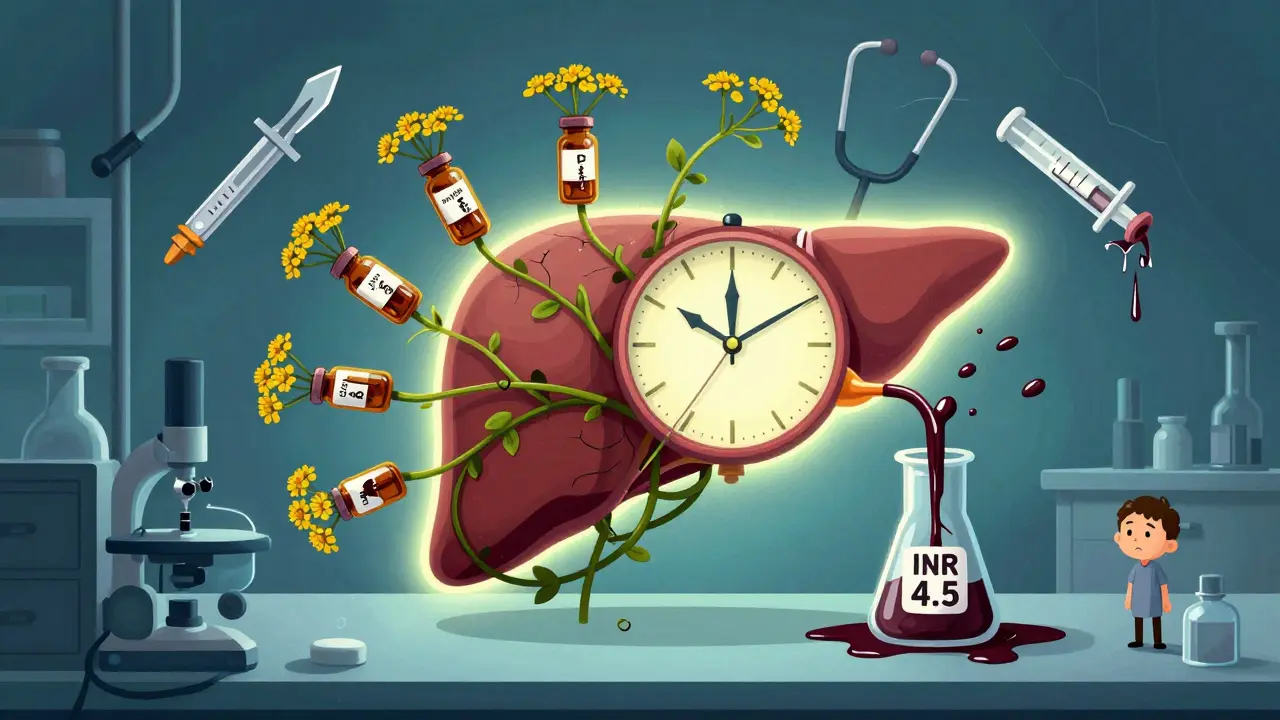
It’s not just parthenolide. Feverfew also interferes with liver enzymes (CYP1A2, CYP2C9, CYP3A4) that break down anticoagulants like warfarin. In lab studies, it can raise warfarin levels in the blood by 18-22%. That’s enough to push someone from a safe INR of 2.5 to a dangerous 4.5 or higher-where spontaneous bleeding becomes a real threat.
The ‘Few Gs’ and Why It Matters
Doctors and pharmacists use a simple mnemonic to remember the top five herbs that can thin your blood: Feverfew, Ginger, Ginkgo biloba, Garlic, and Ginseng. These are the ones that show up most often in emergency rooms when patients have unexplained bruising or bleeding.
Among them, feverfew is tricky. Ginkgo has 12 confirmed case reports of dangerous INR spikes. Garlic and ginger clear from your system in under 72 hours. Feverfew? It lingers. And unlike the others, it doesn’t just affect platelets-it messes with how your body metabolizes your prescription blood thinner. That’s a double hit.
Real Cases, Real Risks
The 2021 NIH case report (PMC8383641) is the only published example of feverfew causing full-blown coagulopathy. A 36-year-old woman took feverfew for months to manage migraines. She didn’t tell her doctor. Then she started bleeding heavily after minor trauma. Her PT was 27.3 seconds (normal: 11-16). Her PTT was 42 (normal: 18-28). Her hemoglobin was 10. She needed blood transfusions. After stopping feverfew and waiting four months, everything normalized.
That’s not an outlier. Reddit threads from r/herbalremedies in early 2023 had 27 users reporting nosebleeds, bruising, or bleeding gums after combining feverfew with low-dose aspirin. Fourteen of them said their nosebleeds lasted 15-45 minutes-far longer than their usual 5-10. One woman described bleeding for 12 hours after a dental cleaning.
Even without a major bleed, the numbers add up. A 2023 survey of 1,287 feverfew users on Healthline found that 41% of those on anticoagulants reported increased bruising. Only 12% of users not on blood thinners saw the same. That’s more than three times the risk.
What Happens When You Stop?
Stopping feverfew isn’t as simple as quitting caffeine. People who’ve used it for more than six months often get what’s called ‘post-feverfew syndrome.’ Symptoms include:
- Headaches (41%)
- Insomnia (32%)
- Joint pain (27%)
- Anxiety (73%)
- Muscle stiffness (87%)
These can last 3 to 14 days. That’s why doctors recommend tapering off over 2-3 weeks, not just stopping cold turkey. Abruptly quitting can make you feel worse than before you started-and it doesn’t fix your bleeding risk any faster.
When Surgery Is Involved
If you’re scheduled for any procedure-even a simple tooth extraction-you need to stop feverfew well in advance. The American Society of Anesthesiologists says 14 days minimum. For high-risk surgeries like spine or brain procedures, they recommend 21 days.
Why so long? Because feverfew’s effects on platelets don’t disappear when you stop taking it. Your body needs time to rebuild its normal clotting capacity. And if you’re on warfarin, you also need to wait for the drug’s metabolic interference to clear. Two weeks isn’t enough if you’ve been on feverfew for a year.
And don’t assume your surgeon knows you’re taking it. Most don’t ask about herbal supplements unless you bring it up. Be specific: say “I’ve been taking feverfew for migraines,” not “I take natural remedies.”
What About Other Herbs?
Feverfew isn’t the only one to worry about, but it’s the most misunderstood.
- Ginkgo biloba: Strongest evidence. 12+ documented cases of dangerous INR spikes. Avoid entirely if you’re on anticoagulants.
- Garlic and ginger: Clear in 72 hours. Safe to stop 3 days before surgery.
- Ginseng: Can raise INR, but clears faster. Stop 7 days before surgery.
- Dong quai: Contains natural coumarin-like warfarin. Category A risk. Don’t use at all.
Feverfew sits in the middle: less proven than ginkgo, but more persistent than garlic. And unlike ginkgo, it doesn’t just affect platelets-it affects your liver’s ability to process your medication.
What Should You Do?
If you’re on anticoagulants and taking feverfew:
- Don’t panic. But do stop taking it without consulting your doctor.
- Get a baseline INR and PT/PTT test now, even if you feel fine.
- Start tapering: Reduce your dose by 25% every 5 days over 2-3 weeks.
- Track symptoms: Note bruising, nosebleeds, heavier periods, or gum bleeding.
- Inform every healthcare provider-dentist, surgeon, pharmacist-before any procedure.
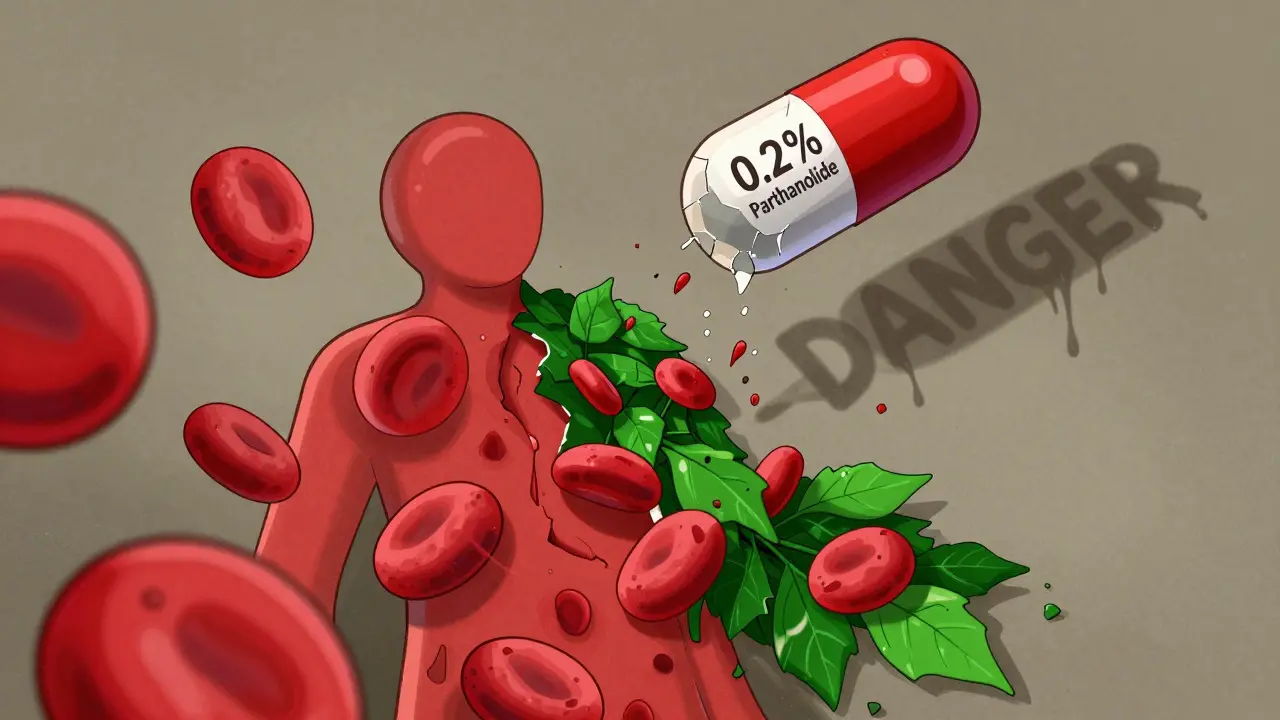
- Switch to a standardized capsule (0.2-0.7% parthenolide). Avoid chewing fresh leaves-they cause mouth ulcers in 1 in 9 users.
And if you’re considering feverfew for the first time while on blood thinners? Don’t. The risk isn’t worth it. There are safer migraine preventatives-like riboflavin, magnesium, or prescription options-that don’t mess with your clotting system.
The Bottom Line
Feverfew isn’t dangerous on its own. But when combined with anticoagulants, it’s a silent multiplier. It doesn’t always cause bleeding. But when it does, it can be life-threatening-and hard to reverse. There’s only one confirmed case, but that’s enough. We don’t wait for a hundred deaths to act on a known risk.
Doctors are starting to screen for it. The American College of Physicians now recommends checking for feverfew use in patients with unexplained bleeding, especially women. Research is ramping up too-$1.2 million was funded in 2023 to study feverfew’s interaction with apixaban.
For now, the safest choice is simple: If you’re on blood thinners, skip feverfew. Your body doesn’t need another thing working against your clotting system. There are better ways to manage migraines. And if you’ve already been taking it? Talk to your doctor. Taper slowly. Get tested. And never assume ‘natural’ means safe.
Winni Victor
So let me get this straight - you’re telling me that a plant my grandma used to chew when she had headaches is now a ‘silent killer’ because Big Pharma doesn’t profit off it? 🤡 I’ve been taking feverfew with my Eliquis for three years and I’ve never bled out. Meanwhile, my cousin took aspirin and ended up in the ER because she didn’t know it was ‘dangerous.’ Natural doesn’t mean safe? Tell that to the 7 billion humans who evolved eating dirt and leaves.
Terry Free
Let’s be clear: if you’re on anticoagulants and still popping herbal supplements like they’re Skittles, you’re not ‘natural’ - you’re just negligent. The fact that people think ‘I feel fine’ means it’s fine is why we have ERs full of people who didn’t read the fine print. Parthenolide isn’t magic fairy dust. It’s a biochemical modulator. Stop pretending your intuition beats clinical pharmacology.
Lindsay Hensel
I appreciate how deeply researched this is. Thank you for sharing the data, the case studies, and the practical steps. Many of us are navigating this alone - with no one asking about supplements during appointments. This is the kind of clarity that saves lives.
Linda B.
Wait - so the FDA and the AMA are hiding the truth about feverfew because the pharmaceutical industry owns the herbs now? And the 12 million people who use it are just lab rats in a controlled experiment? Why is there only one published case? Because they bury the rest. And don’t tell me about ‘peer-reviewed’ - the same journals that published the tobacco studies are the ones approving this now
Christopher King
This is the new witch hunt - but instead of burning women at the stake, we’re demonizing chamomile and feverfew because they can’t be patented. You know what’s really dangerous? Trusting a system that tells you to take warfarin for life but won’t let you try something that’s been used for 2000 years without a 12-step consent form. Wake up. The body knows. The plants know. The doctors? They’re just reading the script.
Oluwatosin Ayodele
As a pharmacist in Lagos, I’ve seen this exact scenario. Patients come in with bleeding gums and say ‘I take the green leaf for my head pain.’ No documentation. No lab tests. No awareness. This post is accurate. In Nigeria, we don’t have the luxury of ‘case reports’ - we have bodies. Stop romanticizing herbs. They are drugs. Treat them like it.
Jason Jasper
I’ve been on rivaroxaban for 5 years. Took feverfew for 8 months for migraines. Never had a bleed. But I also got my INR checked every 6 weeks. Knowledge is power. If you’re going to mix things, monitor. Don’t just assume. That’s the real takeaway here.
Justin James
Let’s not forget the deeper pattern here - the suppression of botanical medicine is a deliberate tactic by the pharmaceutical-industrial complex to maintain monopoly over physiological regulation. Feverfew doesn’t just interfere with CYP enzymes - it disrupts the entire paradigm of synthetic dependency. The fact that your liver can metabolize it naturally is why they fear it. The ‘four-month recovery’ in the case study? That’s not healing - that’s your body detoxing from pharmaceutical enslavement. The system wants you dependent. Don’t let them win.
Zabihullah Saleh
I grew up in Afghanistan where every family had a jar of dried feverfew for headaches. We never thought of it as ‘medicine’ - just part of life. But I’ve been on warfarin since my pulmonary embolism. I stopped it after reading this. No drama. No panic. Just… respect. Some things are better left in the garden.
Rick Kimberly
Thank you for providing not only the risks but also the actionable protocol: tapering, monitoring, and communication. This is the gold standard for patient education. Too often, we’re given fear without guidance. You’ve provided both. This should be shared with every anticoagulation clinic.
Sophie Stallkind
I am a nurse in a cardiac clinic. We have seen three patients in the past year with unexplained hemorrhage who were using feverfew. None disclosed it unless directly asked. We now have a standardized question on intake forms: ‘Are you taking any herbal supplements, including feverfew, ginkgo, or garlic?’ The answer changes everything.
Gary Hartung
Oh, wow. A 12-million-dollar study on apixaban and feverfew? That’s cute. Meanwhile, the FDA approved a new blood thinner last month that costs $1,200 a month - and has a 3% risk of internal bleeding. But hey, at least it’s patentable. So we’re supposed to be terrified of a $12 herb that’s been around since Aristotle, but fine with a $1,200 chemical that’s been on the market for 18 months? Please. The entire system is a farce.
Ben Harris
My mom took feverfew for 17 years. She had a stroke last year. The neurologist asked if she took anything else. She said ‘just the herb.’ He looked at her like she’d confessed to witchcraft. She’s now on a strict no-herb protocol. I just wish someone had told us this before she lost half her vision. Don’t wait for the stroke. Don’t wait for the bleed. Just stop.
Mussin Machhour
Just stopped feverfew last week after reading this. Tapered over 3 weeks like you said. Felt like hell for 10 days - anxiety, headaches, stiff as a board. But my bruises are fading. My INR dropped from 4.1 to 2.8. Worth it. Thanks for the heads-up - you saved my life without even knowing it.