
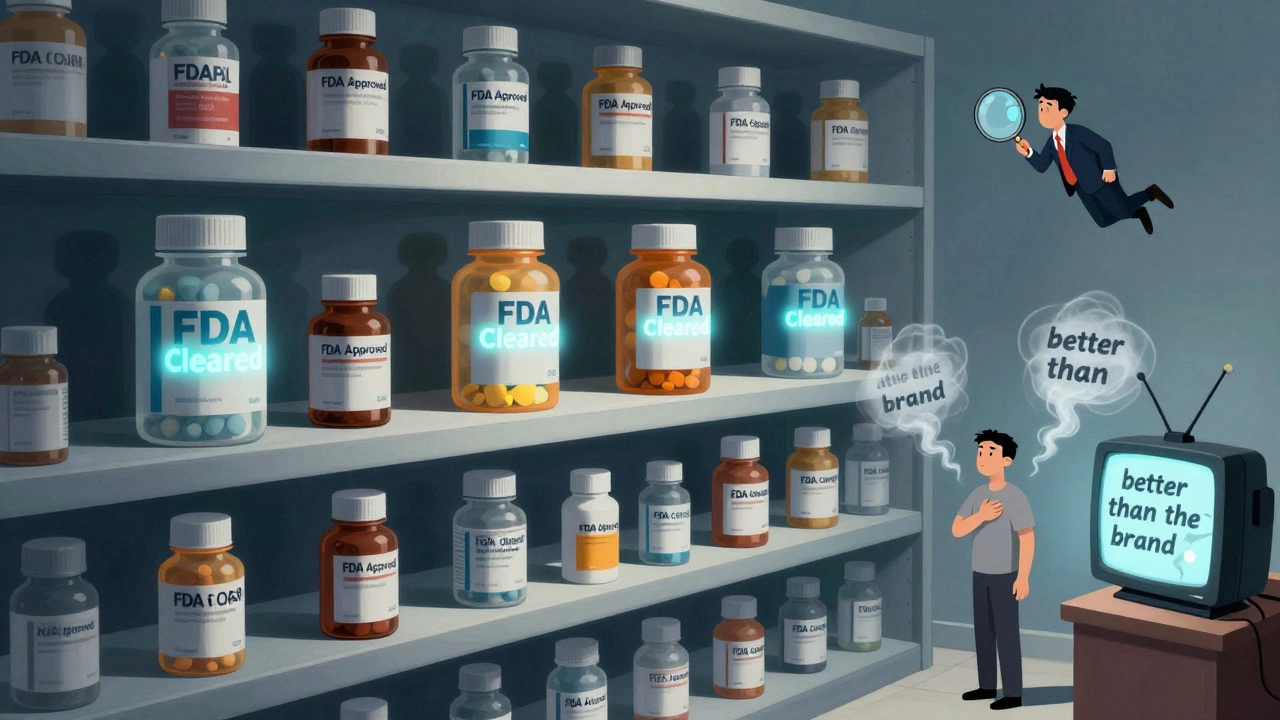
Every year, over 6.8 billion prescriptions are filled in the U.S. - and 90% of them are generic drugs. That’s not just a statistic. It’s your pharmacy shelf, your monthly co-pay, your grandfather’s thyroid pill. But what if the ad you saw on TV made you think those generics weren’t safe? What if the label on the bottle didn’t match what the commercial promised? That’s not a mistake. That’s false advertising - and it’s illegal.
What Counts as False Advertising in Generic Drugs?
False advertising in generic pharmaceuticals isn’t about lying outright. It’s about creating a misleading impression. You see an ad that says, "The brand you trust," with the same color scheme, font, and logo style as the brand-name drug - but it’s a generic. The voiceover never says "This is a generic drug." That’s a problem. The FDA requires clear, upfront disclosure that the product is generic. If they don’t say it, consumers assume it’s the same as the brand - and that’s exactly what the law forbids. It’s not just visuals. Claims like "more effective," "faster acting," or "better tolerated" without clinical proof are banned. Generic drugs must be bioequivalent - meaning they deliver the same amount of active ingredient into your bloodstream at the same rate as the brand-name version. The FDA requires this to be within 80-125% of the reference drug. But ads that say "just as good as" or "equivalent" without that technical basis can mislead patients into thinking they’re getting something superior - or worse, something unsafe. Even the word "FDA Approved" can be dangerous. Some companies use it to describe products that only have "FDA clearance" - a legal gray area that’s triggered lawsuits under the Lanham Act. Clearance doesn’t mean the same thing as approval. Approval means the FDA reviewed clinical data. Clearance just means the product met basic manufacturing standards. Confusing the two is a legal trap.The Legal Framework: What Laws Are You Breaking?
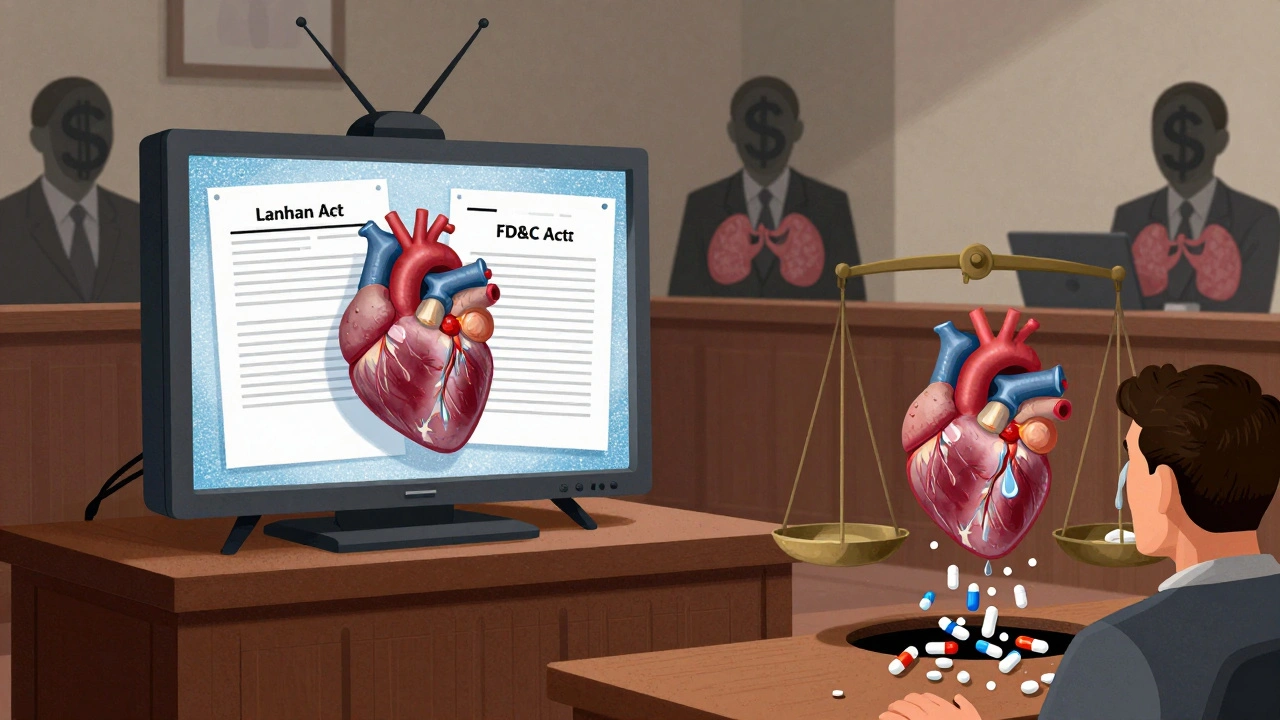
Three major laws govern this space. First, the Federal Food, Drug, and Cosmetic Act (FD&C Act) - passed in 1938 after 107 people died from a toxic drug - gives the FDA authority over drug labeling and advertising. If your ad misrepresents safety, efficacy, or equivalence, the FDA can issue a warning letter. In 2025 alone, over 100 such letters were sent to companies making false claims about generic drugs. Second, the Lanham Act lets competitors sue each other for deceptive marketing. If a brand-name company believes a generic ad is confusing consumers into thinking the generic is inferior - or superior - they can take legal action. In 2024, a case against a generic manufacturer for implying their levothyroxine was "more consistent" than the brand led to a $2.3 million judgment. The court found the ad created consumer confusion, which is all the Lanham Act needs. Third, every state has its own consumer protection law. New York’s General Business Law § 349 lets the state go after companies for deceptive practices and award triple damages. California’s Unfair Competition Law is even stricter - requiring proof that the ad misled a reasonable consumer, not just that it was false. A company running a national campaign has to satisfy 50 different legal standards. That’s why compliance teams now include legal experts from multiple states.The FDA’s 2025 Crackdown: What Changed?
On September 9, 2025, the White House issued a presidential memorandum directing the Department of Health and Human Services to crack down on misleading drug ads. The goal? Stop companies from pushing expensive brand-name drugs over cheaper generics by distorting the facts. The FDA’s new rules target three key areas:- Banning the "adequate provision" loophole. Since 1997, TV and radio ads could say "see your doctor for full risks" instead of listing them. That’s gone. Now, every broadcast or digital ad must include all major risks - in clear, readable text or audio. No more fine print.
- Requiring explicit "generic" labeling. Ads must now say "This is a generic version of [Brand Name]" in the first five seconds of video or audio. No hiding it behind jargon.
- Prohibiting comparisons without proof. You can’t say your generic is "just as good" unless you have head-to-head clinical trials. Even saying "costs less" requires documentation - you can’t just claim savings without data.
What Happens When Patients Believe the Lies?
This isn’t just about legal fines. Real people get hurt. In 2024, the FDA reviewed 1,247 patient complaints tied to misleading ads. Thirty-two percent of those patients stopped taking their medication because they believed the generic was unsafe. Many had serious health consequences - uncontrolled seizures, thyroid crashes, high blood pressure spikes. One patient on Reddit, r/pharmacy, wrote: "I refused my generic levothyroxine because of an ad saying it caused cancer. My TSH went to 80. I ended up in the ER. The pharmacist had to explain the FDA’s bioequivalence standards to me. I felt stupid - but I almost died because of a 30-second ad." Consumer surveys show 41% of patients are confused about whether generics are truly equivalent. Meanwhile, seniors who saw compliant ads - clear, factual, and focused on cost savings - reported 78% more confidence in switching. That’s the difference between truth and fear.How Companies Stay Compliant (And Why It Costs Millions)
Big pharma doesn’t wing it. Companies like Teva, Sandoz, and Mylan have compliance teams of 15 to 25 people. These aren’t marketers. They’re regulatory specialists - lawyers, pharmacists, and former FDA inspectors who review every word, image, and sound in an ad before it runs. The process looks like this:- Marketing drafts the ad.
- Legal checks for Lanham Act and state law risks.
- Regulatory affairs verifies FDA labeling rules.
- Medical writers confirm all claims are backed by data.
- Quality assurance runs a final audit.
What You Should Do as a Patient or Pharmacist
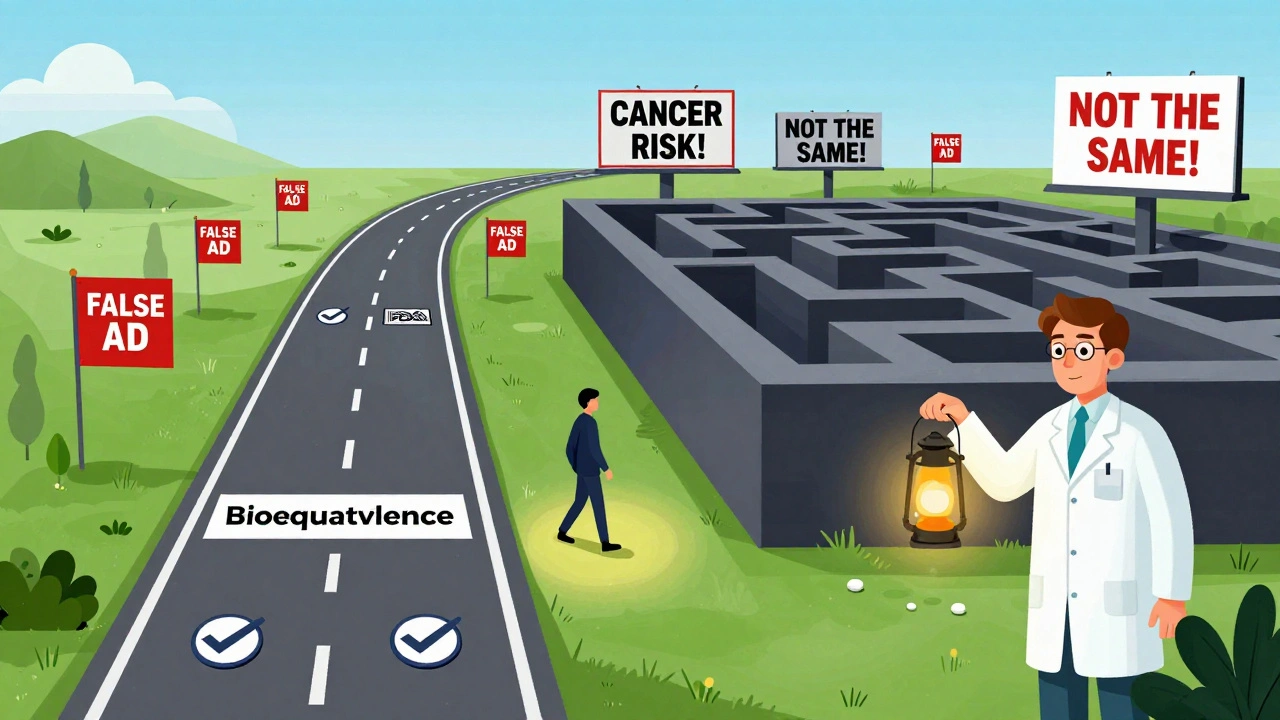
If you’re a patient:- Ask your pharmacist: "Is this generic approved by the FDA as equivalent to the brand?"
- Don’t trust ads that say "better," "stronger," or "new formula." Those are red flags.
- Check the FDA’s website for your drug’s approved labeling. You don’t need to be a scientist - just read the side effects section.
- Be ready to explain bioequivalence in plain language. "It works the same way. The active ingredient is identical. The FDA tests it."
- Warn patients about ads that use fear tactics - especially around narrow therapeutic index drugs like warfarin, levothyroxine, or lithium.
- Report suspicious ads to the FDA’s MedWatch program. One call can stop a campaign.
What’s Next? The Future of Generic Drug Ads
The FDA and FTC are working on new federal rules to standardize risk disclosures across all platforms - TV, social media, billboards, even YouTube. Draft legislation called the "Transparency in Drug Advertising Act" could force all ads to use a uniform risk summary format, like the one used in prescription labels. Expect more lawsuits. More fines. More public shaming. Companies that treat compliance as a cost center will get crushed. Those that build it into their culture - like Pfizer, which spent $45 million on an AI-powered ad review system - will win trust, market share, and legal safety. The bottom line? Generic drugs save the U.S. healthcare system over $300 billion a year. They’re safe. They’re effective. But if you let false ads scare people away from them, you’re not protecting patients - you’re hurting them.Can a generic drug be less effective than the brand-name version?
No - if it’s FDA-approved. All generic drugs must prove they are bioequivalent to the brand-name drug. That means they deliver the same amount of active ingredient into your bloodstream at the same rate. The FDA tests this using strict standards (80-125% range). If a generic doesn’t meet this, it’s not approved. Any ad claiming a generic is "less effective" without clinical proof is false advertising.
Are generic drugs FDA-approved?
Yes - but only if they’ve gone through the Abbreviated New Drug Application (ANDA) process. This requires proof of bioequivalence, identical active ingredients, and same dosage form. The FDA does not approve generics the same way it approves new brand drugs - but they still must meet the same quality, safety, and effectiveness standards. Ads that say "FDA Approved" without specifying it’s a generic can be misleading and violate the law.
What’s the difference between "FDA Approved" and "FDA Cleared"?
"FDA Approved" means the agency reviewed clinical data proving safety and effectiveness. "FDA Cleared" applies to devices or products that meet basic manufacturing standards but don’t require clinical trials - like some over-the-counter products. For generic drugs, only "approved" is correct. Using "cleared" to describe a generic drug is false and can lead to lawsuits under the Lanham Act.
Can I trust a generic drug if it looks different from the brand?
Yes. Generic drugs can look different - different color, shape, or size - because the inactive ingredients (fillers, dyes) can vary. But the active ingredient must be identical. The FDA requires manufacturers to clearly label generics as such. If the packaging doesn’t say "generic," or the ad hides that fact, it’s a red flag. Trust the label, not the appearance.
Why do some doctors hesitate to prescribe generics?
Some doctors were trained when generics had quality issues decades ago. Others are influenced by aggressive marketing from brand-name companies. But today’s generics are held to the same standards. The American Medical Association found that 67% of physicians believe misleading ads cause patients to refuse generics - leading to higher costs and worse outcomes. Most doctors now support generics when appropriate - but they need patients to ask the right questions.
john damon
Bro this is wild 😱 I saw an ad for generic levothyroxine that looked EXACTLY like Synthroid. No mention it was generic until the tiny disclaimer at the bottom. I almost didn't fill mine because I thought it was a scam. 🤯
Monica Evan
My grandma switched to generic blood pressure med last year after the pharmacist explained bioequivalence she was saving $40 a month and her numbers stayed perfect she said the ad that scared her was just trying to sell brand name stuff not help people 💪
Taylor Dressler
The FDA’s 2025 crackdown is long overdue. Companies have been exploiting consumer confusion for decades by mimicking brand packaging and omitting the word 'generic' in broadcast ads. The requirement to state 'This is a generic version of [Brand Name]' in the first five seconds is a minimal but critical safeguard. Patients deserve transparency, not marketing manipulation.
Aidan Stacey
I work in pharmacy and let me tell you this is not just about money - it’s about lives. I had a woman cry because she thought her generic thyroid med was 'fake' after watching an ad that said 'Don’t risk your health with knockoffs.' She had a TSH of 78. We had to sit there for 45 minutes explaining bioequivalence. That’s not marketing. That’s medical negligence.
Jim Irish
The Lanham Act cases are particularly telling. Competitors suing each other over misleading claims proves the system is self-correcting. If a generic ad implies superiority without clinical data, it’s not just unethical - it’s legally indefensible. The courts are catching up.
Lisa Stringfellow
So now we’re supposed to trust the FDA more? Funny how they approved Vioxx and then changed their minds. And what about the 2018 valsartan recall? All those generics were 'FDA approved' too. This whole thing feels like a PR stunt to make people feel safe while they’re still getting poisoned by Chinese factories.
Eddie Bennett
I used to be skeptical too until my dad’s generic statin saved him $600 a year and his cholesterol dropped better than the brand. The FDA’s 80-125% range isn’t a loophole - it’s science. People panic over looks or price, but the science doesn’t lie. Just ask your pharmacist.
Doris Lee
Love this post!! So many people don’t realize generics are the reason they can afford meds at all 🥹 I tell my friends all the time - if it’s FDA approved, it’s legit. No need to overthink it! 💖
Michaux Hyatt
The compliance cost breakdown is eye-opening. $2.1 million a year just to make sure an ad doesn’t say 'better' without data? That’s insane. No wonder small companies cut corners - they can’t compete. Maybe the solution isn’t more rules, but more public education.
Raj Rsvpraj
In India, we have 100% generic drugs - and they are better than American brands! Why? Because we don’t have corporate greed poisoning the system. Your FDA is too slow, your lawyers too greedy, your ads too manipulative. We make life-saving drugs for $0.10 per pill. You pay $10 for the same thing. This is capitalism at its worst.
Jack Appleby
Let’s be precise: The 80-125% bioequivalence range is not 'within acceptable limits' - it’s a 25% variance in AUC and Cmax. That’s clinically significant for narrow therapeutic index drugs. The FDA’s enforcement is still too lenient. Anyone who says 'it’s the same' is either misinformed or complicit.
Kaitlynn nail
It’s not about the drug. It’s about trust. We’ve been lied to so much - by ads, by doctors, by the system - that now we don’t believe anything. Even the truth sounds like a sales pitch.
Nikki Smellie
I’ve read the FDA’s documents. The approval process for generics is a sham. The data is often submitted by the same labs that work for the brand manufacturers. There’s a revolving door between the FDA and Big Pharma. The 'FDA Approved' stamp is just a logo. Don’t be fooled. This is all part of the Great Pharmaceutical Control Agenda. 🕵️♀️💊