
When you buy a bottle of medicine, a ready-to-eat meal, or a jar of lotion, you expect it to be safe. But behind that simple promise is a complex system designed to catch contamination before it ever reaches you. Environmental monitoring is that system. It’s not just about cleaning surfaces - it’s about systematically testing air, water, and equipment to find hidden threats that could ruin a product or make people sick.
Why Environmental Monitoring Matters
Every manufacturing facility - whether making pills, packaged food, or cosmetics - has invisible risks. Mold spores in the air. Bacteria on a conveyor belt. Metal particles from worn machinery. Left unchecked, these can contaminate products. The CDC says environmental monitoring is one of the best ways to confirm a hazardous condition is under control. In food plants, one outbreak of Listeria can cost millions in recalls and lawsuits. In pharma, a single contaminated batch can trigger a global recall. The U.S. economy loses $77.7 billion a year to foodborne illness, and nearly 9 out of 10 of those outbreaks could have been stopped with proper environmental testing.
This isn’t optional. Regulators like the FDA and EMA require it. The FDA’s 2023 guidelines make it clear: environmental monitoring and product testing are key steps to verify control of microbial hazards. Companies that skip this step don’t just risk their reputation - they risk breaking the law.
The Zone System: How Facilities Map Risk
Not all surfaces are created equal. That’s why every serious facility uses a zone classification system. Think of it like a security clearance level - the closer you are to the product, the tighter the controls.
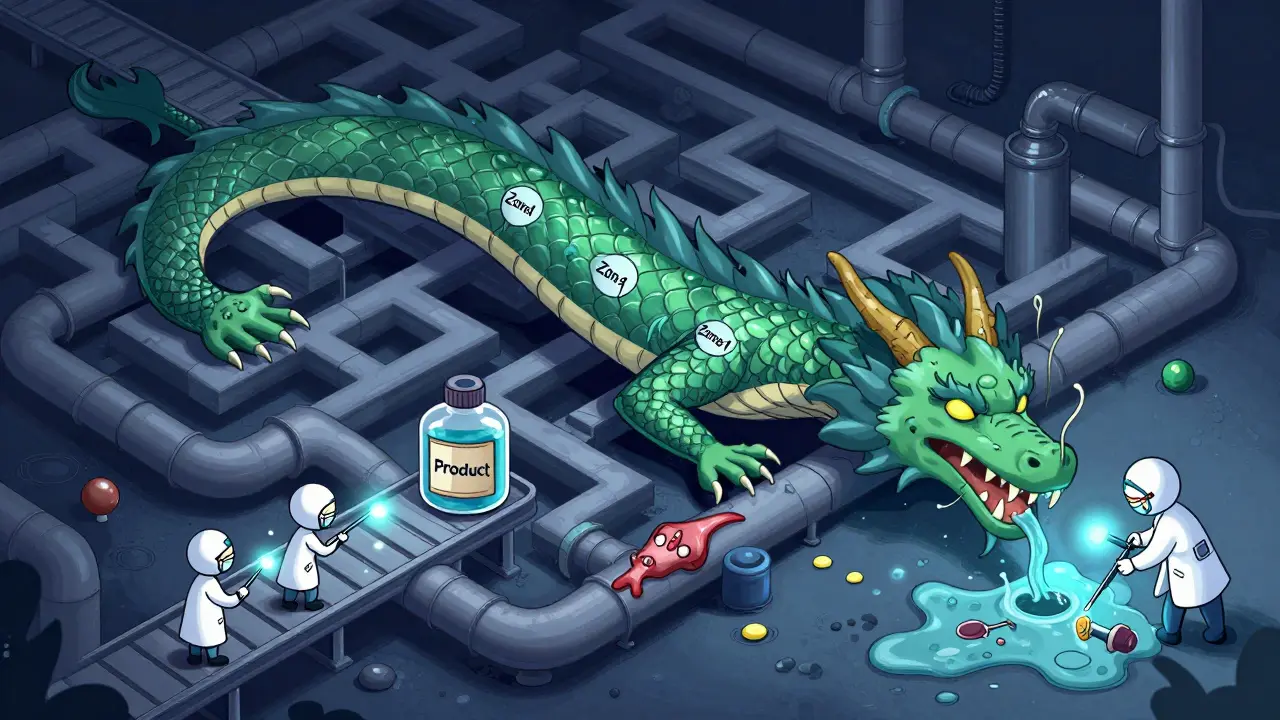
- Zone 1: Direct contact with the product. Think slicers, mixers, filling nozzles, and packaging surfaces. This is ground zero. If something grows here, it goes straight into the product.
- Zone 2: Near food or drug contact. Equipment exteriors, refrigeration units, nearby carts. These surfaces don’t touch the product directly, but they’re close enough to spray or drip contamination onto it.
- Zone 3: Remote but still inside the production area. Forklifts, overhead pipes, door handles, utility panels. People often ignore these - until a study from PPD Laboratories found that floors (a Zone 3 surface) were the source of 62% of all contamination alerts.
- Zone 4: Outside the production area. Break rooms, hallways, restrooms. Low risk, but still monitored because contamination can spread.
Here’s the catch: one facility might treat an overhead pipe as Zone 1 because condensation drips onto products. Another might call it Zone 3. That inconsistency is one of the biggest problems in the industry. Risk assessment isn’t just about location - it’s about how the environment behaves. A wet surface near a filling line? That’s Zone 1. A dry one? Maybe Zone 2. The rules aren’t written in stone - they’re built from observation.
What’s Being Tested and How
Environmental monitoring isn’t one test. It’s a toolkit of methods, each designed for a different kind of threat.
- Microbiological sampling: Swabs or sponges collect samples from surfaces. These are sent to labs to grow and identify bacteria like Listeria, Salmonella, or E. coli. Results take 24 to 72 hours.
- Air sampling: Liquid impingers and solid impactors pull air through devices to trap airborne particles. Results are measured in colony-forming units per cubic meter (CFU/m³). These are critical in cleanrooms where even a few particles can ruin a sterile product.
- Total Organic Carbon (TOC) and conductivity: Used to test water quality. In pharma, purified water must meet USP <645> standards. If TOC levels spike, it means organic waste is building up - a sign of biofilm growth.
- Inductively Coupled Plasma (ICP): Detects trace metals from corroded pipes or worn equipment. A single metal particle in an injection can cause a severe immune reaction.
- ATP testing: A fast alternative. ATP (adenosine triphosphate) is found in all living cells. A handheld device gives a reading in seconds - no waiting. Facilities using ATP see 32% faster turnaround between production runs because they can clean and restart immediately if levels are high.
Chromatography (GC, HPLC) is used for chemical residues. But most facilities focus on microbes. The FDA specifically looks for Salmonella and Listeria monocytogenes during inspections. These two pathogens are the red flags.
Industry Differences: Pharma vs. Food vs. Cosmetics
Not all industries play by the same rules.
Pharmaceutical facilities follow EU GMP Annex 1 (updated in 2023). They monitor air continuously in cleanrooms at ISO Class 5 standards - equivalent to a hospital operating room. They track humidity and temperature 24/7. Water systems are tested daily. Their goal: zero microbes in sterile products.
Food processing - especially Ready-to-Eat (RTE) - follows USDA’s Listeria Rule (9 CFR Part 430). They test Zone 1 surfaces for Listeria at least once a week. They don’t care as much about air particles. They care about where the bacteria lives: drains, floors, and damp corners. A 2022 FDA survey found 76% of food facilities have formal environmental programs - but only 48% of small ones (<50 employees) are fully compliant.
Cosmetics fall somewhere in between. They follow similar rules to pharma but with less intensity. Still, they must test for molds and yeasts that can spoil products. The market for environmental monitoring is growing fast - $7.2 billion in 2022, projected to hit $12.5 billion by 2027. Pharma leads with 42% of the market, food at 33%, and cosmetics at 15%.
What Goes Wrong - And How to Fix It
Even the best programs fail - usually because of human error or poor systems.
One major issue? Sampling technique. The CDC warns that samplers themselves can become sources of contamination if not sterilized. A swab that’s not sterile? It’s not a test - it’s a false positive. A 2020 IDFA survey found 68% of facilities had inconsistent sampling methods.
Another? Data silos. Many facilities use ATP testers, microbiology labs, and allergen checks - but don’t connect the data. One team sees a spike in ATP. Another sees a Listeria alert. They don’t talk. The result? Confusion. The 3M Environmental Monitoring Handbook says this lack of integration is a critical gap.
Training is another weak spot. The FDA recommends 40 hours of hands-on training before someone can collect official samples. Yet many small facilities train staff on the job - with no formal program. That’s how mistakes happen.
And then there’s the myth that more testing = better results. PPD Laboratories’ 2017 study showed that combining limited environmental monitoring with culture tracking and GMP practices gave better control than flooding the facility with tests. It’s not about volume - it’s about smart targeting.
What’s Next: Technology and Trends
The future of environmental monitoring is faster, smarter, and connected.
Next-generation sequencing (NGS) and metagenomics are starting to replace traditional culturing. Instead of waiting 3 days to grow bacteria, labs can now sequence all microbial DNA in a sample and identify pathogens in under 24 hours. The FDA is encouraging this shift in its 2023 draft guidance.
Real-time monitoring is also growing. EU Annex 1 now requires continuous data trending for critical parameters. That means sensors in cleanrooms send live updates to dashboards - alerting staff the moment humidity spikes or particle counts rise.
AI is coming fast. MarketsandMarkets predicts AI-powered analytics will jump from 12% market use in 2022 to 38% by 2027. These systems can spot patterns humans miss - like a spike in contamination every time a new shift starts, or a correlation between a specific cleaning product and recurring mold.
But there’s a dark side. Antimicrobial resistance is rising. The CDC found 19% of Listeria isolates from food plants now resist multiple antibiotics. That means traditional disinfectants might not work. Facilities must adapt - not just clean more, but clean smarter.
How to Build a Strong Program
Start with zones. Map every surface. Assign risk levels. Don’t guess - observe.
Focus on Zone 1 first. That’s where the product touches the environment. Then Zone 2. Save Zone 3 and 4 for monthly checks - but don’t ignore them. Floors and drains are silent killers.
Use ATP for quick checks. Use microbiology for confirmation. Don’t rely on one method.
Train your team. 40 hours isn’t optional. It’s the baseline.
Integrate your data. Link ATP results, air samples, and swab reports into one dashboard. If one system alerts, the others should too.
Review your program quarterly. What changed? Did you add a new line? Move equipment? Update your zones.
And remember: environmental monitoring isn’t about passing an audit. It’s about preventing illness. Every test is a shield - between a product and a person who trusts you to keep them safe.
What is the main purpose of environmental monitoring in manufacturing?
The main purpose is to detect and prevent contamination - microbial, chemical, or particulate - before it affects products. It’s a proactive system that identifies where and how contamination enters the production environment, helping to ensure product safety and regulatory compliance.
How often should environmental samples be taken?
Frequency depends on the zone and industry. Zone 1 (direct product contact) is tested daily to weekly. Zone 2 is sampled weekly to monthly. Zones 3 and 4 are typically tested monthly to quarterly. Regulatory requirements, like the FDA’s Listeria Rule for RTE food, may mandate weekly testing in high-risk areas.
What’s the difference between ATP testing and microbiological testing?
ATP testing detects organic residue (like food, sweat, or microbes) in seconds using a handheld device - it tells you if a surface is clean, but not what’s on it. Microbiological testing takes 24-72 hours to grow and identify specific bacteria or fungi. ATP is great for quick checks; microbiology is needed for confirmation and regulatory proof.
Why do pharmaceutical facilities monitor air more than food facilities?
Pharmaceutical products, especially injectables and sterile formulations, must be free of any particles or microbes because they enter the body directly. Even a single particle can cause infection. Food products are consumed, but they’re not sterile - so food facilities focus more on pathogen presence (like Listeria) than airborne particles.
Can environmental monitoring prevent outbreaks?
Yes. The CDC estimates that 87% of foodborne illness outbreaks linked to environmental contamination could have been prevented with proper monitoring. By catching contamination early - like a Listeria spike in a drain - facilities can clean before the product is made or shipped, stopping outbreaks before they start.
What are the biggest mistakes facilities make in environmental monitoring?
The top three are: inconsistent zone classification, poor sampling technique (like using unsterilized swabs), and not integrating data from different tests (ATP, microbiology, allergens). These lead to false results, wasted resources, and missed contamination events.
Zola Parker
So we're just supposed to trust that some lab tech in a hazmat suit swabbing a conveyor belt is doing their job? 🤔 I've seen factory tours. Half the time they're just checking boxes. Real monitoring? That's a myth. We're all just one contaminated batch away from a national panic. 😅
florence matthews
I love how this breaks down zones like a sci-fi map 🌍✨ Honestly, it makes me feel safer knowing there's a whole system behind my yogurt and painkillers. Zone 3 being the sneaky culprit? Mind blown. We all think it's about clean surfaces, but it's really about *flow*-how gunk moves. So cool. 🙌
Kenneth Jones
Regulators don't care about small businesses. They slap on 200-page compliance docs while mom-and-pop shops go under. This 'system' is a tax on survival. Stop pretending this protects people. It protects lawyers.
Mihir Patel
omg i just read this and my brain exploded 🤯 like zone 3?? floors?? i always thought the machines were the problem but nooo it's the *floor*?? and atp testing?? like a glow stick for germs?? 🤯🤯 i work in a bakery and now im scared to walk near the sink. also who wrote this?? u a wizard??
Kevin Y.
Thank you for this comprehensive overview. The distinction between Zone 1 and Zone 3 is particularly enlightening. I’ve worked in GMP-compliant facilities for over a decade, and I can confirm that ATP testing has revolutionized our turnaround times. The 32% improvement is not anecdotal-it’s measurable, repeatable, and transformative. Well-documented and essential reading for anyone in manufacturing.
Raphael Schwartz
USA makes the best medicine. Why do we let europe tell us how to test air? FDA rules are fine. EU Annex 1? That's just fancy paperwork for people who like to wear lab coats. We don't need their rules. We need more factories. Less paperwork. More pills.
winnipeg whitegloves
I live in Winnipeg and we have a joke here: 'If you can't see the mold, it's probably plotting.' But seriously-this breakdown is gold. I once saw a guy in a meat plant ignore a dripping pipe because 'it's Zone 3.' Two weeks later? Listeria in the bologna. The system works when people stop treating zones like zoning laws. It's about *behavior*, not borders. This post should be mandatory in every trade school.
Marissa Staples
It’s weird how we treat contamination like a villain in a movie. But it’s not evil-it’s just life trying to exist. Bacteria don’t care about our regulations. They just want to grow. Maybe instead of fighting it with zones and swabs, we should be asking: why are we creating such perfect little ecosystems for them? Is the real problem the system… or the assumption that we can control nature?
Rachele Tycksen
zone 1 sounds like a horror movie. also why is water testing a thing? i thought we just boiled it? 🤷♀️