

Echinacea & Immunossuppressant Interaction Checker
Check Your Risk
Risk Assessment
This tool uses information from the article "Echinacea and Immunosuppressants: What You Need to Know About the Dangerous Interaction". It is for informational purposes only.
HIGH RISK
Do not take echinacea if you're on immunosuppressants. This interaction can cause organ rejection or life-threatening complications.
What You Should Do
- STOP taking echinacea immediately if you're on immunosuppressants
- Contact your doctor or transplant coordinator right away
- Do not wait for symptoms - rejection can occur without warning
Many people take echinacea to fight off colds or boost their immune system. It’s natural, widely available, and marketed as safe. But if you’re on immunosuppressants - drugs prescribed after a transplant or for autoimmune diseases like lupus or rheumatoid arthritis - taking echinacea could be risky. Not just slightly risky. Potentially life-threatening.
How Echinacea Works: A Double-Edged Sword
Echinacea isn’t just one herb. It’s a group of plants, mostly Echinacea purpurea, used for centuries by Native American tribes to treat wounds, infections, and snakebites. Today, it’s one of the top-selling herbal supplements in the U.S., with over $29 million in retail sales in 2022 alone.Here’s the problem: echinacea doesn’t just boost your immune system - it does it in two very different ways. In the short term, it activates immune cells like neutrophils, macrophages, and natural killer cells. It increases phagocytosis - the process where immune cells swallow up invaders. It even stimulates fibroblasts and boosts respiratory activity in white blood cells. These effects are why people feel like it helps them recover faster from a cold.
But here’s what most labels don’t tell you: if you take echinacea for more than eight weeks, the opposite can happen. Studies from the American Academy of Family Physicians and Memorial Sloan Kettering show that long-term use may actually suppress immune function. This isn’t a myth. It’s a documented shift in how the body responds.
Immunosuppressants: Why They Exist
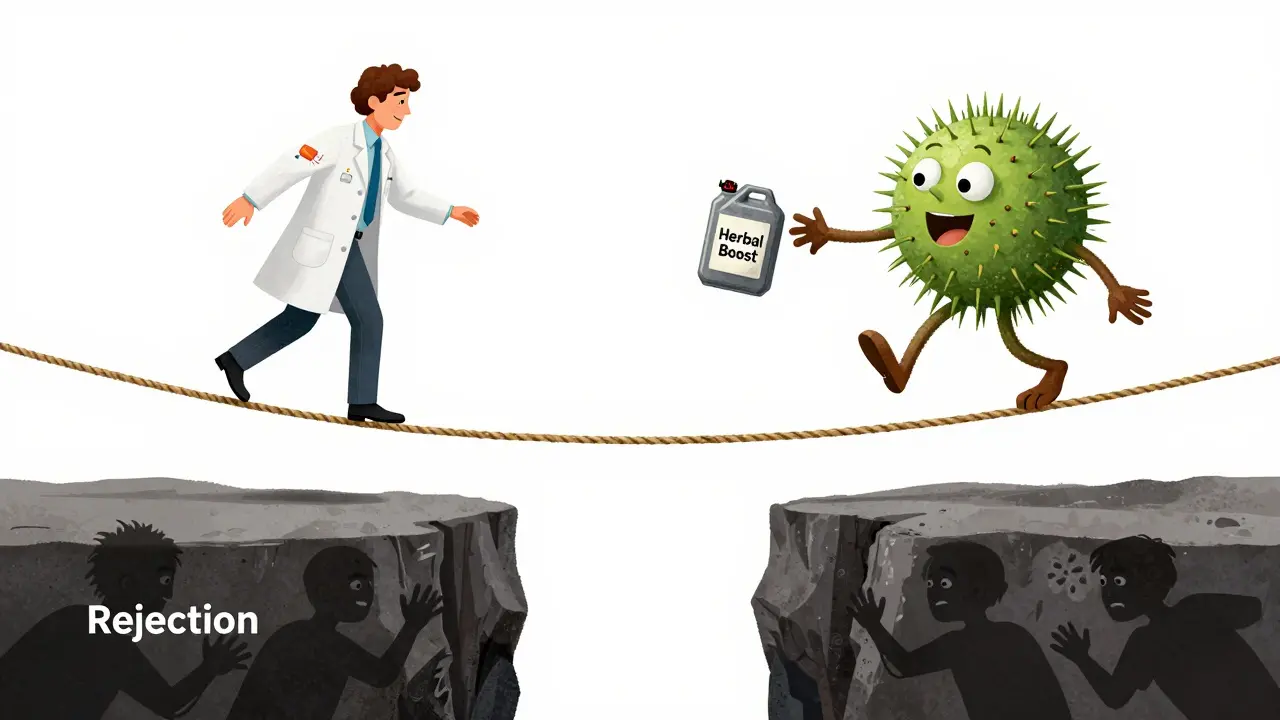
Immunosuppressants aren’t optional. They’re essential. If you’ve had a kidney, liver, or heart transplant, your body sees the new organ as an invader. Without these drugs - like cyclosporine, tacrolimus, or mycophenolate - your immune system would attack and destroy it. The same goes for people with autoimmune diseases like multiple sclerosis, Crohn’s disease, or pemphigus vulgaris. Their immune systems are already attacking their own tissues. Immunosuppressants calm that down.These drugs work by targeting specific parts of the immune response. They don’t just weaken the body - they carefully balance it. Too little suppression, and rejection or flare-ups happen. Too much, and you’re vulnerable to infections or cancer. This tightrope walk is why even small changes matter.
The Conflict: When Nature Meets Medicine
Now imagine taking echinacea while on one of these drugs. If echinacea is stimulating your immune system, it’s working directly against the purpose of your medication. It’s like trying to put out a fire while someone keeps pouring gasoline on it.The American Society of Health-System Pharmacists (AHFS) classifies this interaction as “moderate” - meaning it’s not just theoretical. It’s been seen in real patients.
Case reports show serious outcomes:
- A 55-year-old man with pemphigus vulgaris, on immunosuppressants, started taking echinacea for a cold. His skin lesions worsened. His doctors had to increase his medication just to regain partial control.
- A 61-year-old lung cancer patient developed severe low platelets (thrombocytopenia) after combining echinacea with chemotherapy drugs.
- A 32-year-old man developed thrombotic thrombocytopenic purpura - a rare, deadly blood disorder - after using echinacea for a respiratory infection.
These aren’t rare outliers. A 2021 survey of 512 transplant patients found that 34% had used echinacea after their transplant. Of those, 12% reported complications their doctors suspected were linked to herbal use. In transplant forums, 23 out of 147 posts described suspected interactions - with 17 patients needing higher doses of immunosuppressants and 6 experiencing acute rejection episodes.
Why Other Herbs Are Different
Not all supplements behave like echinacea. Milk thistle affects liver enzymes - it can change how your body processes drugs, but it doesn’t directly touch immune cells. Ginger has mild anti-inflammatory effects but doesn’t trigger immune activation. Turmeric? It modulates inflammation, but not in the same aggressive, cell-activating way.Echinacea is unique because of its alkamides - compounds that bind to cannabinoid receptor type 2 (CB2) on immune cells. This is a direct, biological pathway that can turn up immune activity. That’s why it’s so dangerous when paired with drugs designed to turn it down.
What the Experts Say
The evidence isn’t based on one study. It’s built from case reports, pharmacological research, and decades of clinical observation.- The Memorial Sloan Kettering Cancer Center explicitly warns that echinacea “may antagonize the effects of immunosuppressants.”
- The American Society of Transplantation recommends complete avoidance of echinacea in all solid organ transplant recipients.
- The American College of Rheumatology advises patients on immunosuppressive therapy for autoimmune diseases to avoid echinacea due to “potential reduction in medication efficacy.”
- The European Medicines Agency says the interaction “cannot be excluded” - and has required updated labeling across the EU.
- The U.S. FDA issued warning letters in 2023 to three supplement makers for selling echinacea products without disclosing interaction risks.
Even the National Center for Complementary and Integrative Health (NCCIH) lists echinacea-immunosuppressant interactions as a primary safety concern - alongside liver toxicity.
What You Should Do
If you’re on immunosuppressants:- Stop taking echinacea. Even if you feel fine. The damage might be happening without symptoms.
- Tell your doctor. Not just your pharmacist. Your doctor. Many patients don’t mention supplements because they think they’re “natural” and therefore safe. That’s the biggest mistake.
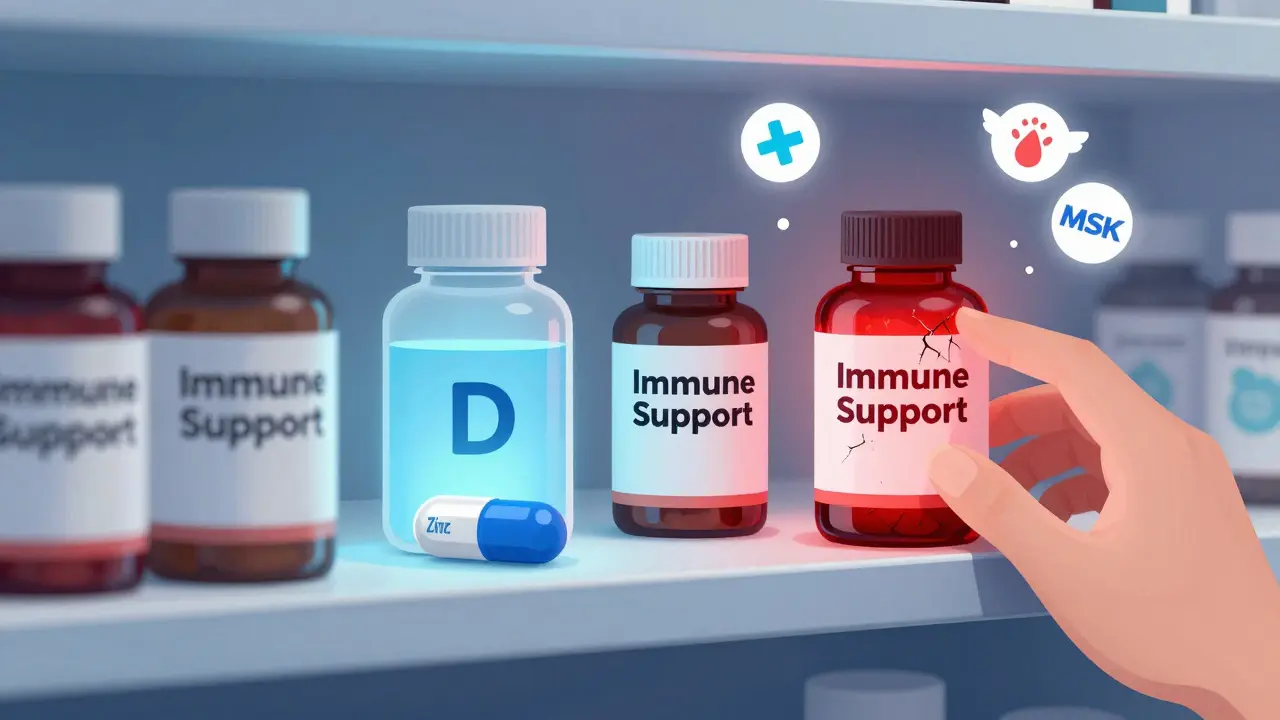
- Ask for alternatives. If you want immune support, talk to your care team. Vitamin D, zinc, and sleep are safer, evidence-backed options.
- Check every product. Echinacea is in teas, tinctures, capsules, and even some cold remedies. Read the ingredient list. Look for “Echinacea purpurea,” “Echinacea angustifolia,” or “Echinacea pallida.”
The supplement industry isn’t regulated like pharmaceuticals. Labels can be misleading. A product might say “immune support” without saying it contains echinacea. Or it might list echinacea but not mention the risk.
The Bigger Picture
Over 500,000 Americans take immunosuppressants after transplants. Millions more take them for autoimmune conditions. Meanwhile, nearly half of all echinacea users say they take it for “immune support.” That’s a dangerous overlap.There’s no large-scale clinical trial proving exactly how often this interaction causes rejection - yet. But we don’t need one to know it’s risky. We have enough real-world evidence to say: don’t take the chance.
The NIH is currently funding a $2.4 million study (NCT04851234) to measure how echinacea affects tacrolimus levels in kidney transplant patients. Results are expected in 2025. But waiting for that study means risking your health.
Right now, the safest choice is simple: if you’re on immunosuppressants, don’t use echinacea. Not for a week. Not for a month. Not even once.
Can I take echinacea if I’m not on immunosuppressants?
If you’re not taking drugs that suppress your immune system, short-term use of echinacea (up to 7-10 days) is generally considered safe for healthy adults. But even then, it’s not proven to prevent colds. Some studies show no benefit over placebo. And it can cause allergic reactions, especially in people with ragweed allergies. Always check with your doctor before starting any new supplement.
What happens if I accidentally take echinacea while on immunosuppressants?
If you’ve taken echinacea once or twice and are on immunosuppressants, don’t panic - but do act. Stop taking it immediately and contact your doctor or transplant coordinator. They may want to check your drug levels or run blood tests to make sure your immune system hasn’t been overstimulated. Don’t wait for symptoms. Rejection can happen without warning.
Are there any safe herbal alternatives to echinacea for immune support?
Yes - but only if approved by your doctor. Vitamin D is one of the most studied and safest options for immune health, especially if you’re deficient. Zinc, when taken in recommended doses, can also help. Sleep, hydration, and stress management are just as important. Avoid anything labeled as an “immune booster” unless your doctor says it’s safe. Many herbs, like astragalus or elderberry, also affect immune function and carry similar risks.
Why don’t supplement labels warn about this interaction?
In the U.S., herbal supplements aren’t required to prove safety or efficacy before being sold. The FDA only steps in after problems arise. That’s why you’ll often see “natural” or “safe” on labels - even when there’s clear risk. The 2023 FDA warning letters to three companies show this is changing, but slowly. Always assume a supplement could interact unless proven otherwise.
I’m a transplant patient. Should I avoid all herbal supplements?
Most transplant centers recommend avoiding all herbal supplements unless specifically approved. Even those that seem harmless - like garlic, green tea, or St. John’s wort - can interfere with your medications. Your immune system is already on a tightrope. Adding unregulated substances increases the risk of rejection or infection. Stick to what your care team prescribes.
Kathy Scaman
I took echinacea for three weeks last winter and felt fine. Then I got a weird rash and my kidney numbers spiked. My transplant nurse asked if I’d been taking anything herbal. I didn’t even think to mention it. Lesson learned. Now I check every label like it’s a bomb schematic.
Anna Lou Chen
Ah, the grand irony of biosemiotic hegemony: we’ve pathologized nature’s innate immunomodulatory cascades while sanctifying synthetic pharmacodynamics as ‘medical truth.’ Echinacea’s alkamides don’t ‘counteract’ immunosuppressants-they reveal the ontological fragility of our pharmacological paradigm. The CB2 receptor isn’t a target-it’s a mirror. And we’re terrified of what it reflects: that our medicine is built on suppression, not harmony. The FDA’s warning letters? A band-aid on a hemorrhage.
Mindee Coulter
My mom’s on tacrolimus after her liver transplant and she swears by elderberry tea. I just showed her this post. She cried. Then she threw out every herbal bottle in the house. We’re doing vitamin D and sleep now. Simple stuff. It’s scary how easy it is to accidentally hurt yourself when you’re just trying to feel better.
Lexi Karuzis
EVERYTHING IS A CONTROLLED SUBSTANCE. EVERYTHING. The FDA doesn't care about you. The supplement industry is owned by Big Pharma anyway. Echinacea? They let it in so you'd think you're safe while they're quietly adjusting your drug levels through the gut-brain axis. They WANT you to get rejection so you'll need more meds, more hospital visits, more $$$! They even funded that NIH study to distract you. Don't trust ANYTHING. Not even your doctor. They're paid. Read the fine print. ALWAYS.
Phil Davis
So… we’re supposed to believe that a plant that’s been used for centuries suddenly became dangerous because someone ran a few lab tests? I mean, I get the concern. But if we’re going to ban everything that ‘might’ interfere, we might as well ban sunlight and breathing. Also, I’ve never met a transplant patient who didn’t sneak something herbal. We’re not robots.
Irebami Soyinka
My cousin in Lagos took echinacea after his transplant and got sick. The hospital said it was 'unconventional medicine.' I told them: 'You think your pills are magic? We’ve used bitter leaf and neem for 500 years!' Now he’s fine, but they still won’t admit herbal medicine has value. You Americans treat herbs like toys while you sell pills like gospel. 🤦♀️💊
Mel MJPS
This post saved my life. I was about to order an echinacea tincture for my cold. I almost didn’t read the whole thing. Thank you for writing this with so much care. I’m sharing it with my support group. We all need to hear this.
Jess Bevis
Read labels. That’s it. That’s the whole thing.
Sue Latham
Oh honey, I’ve been on my third transplant since 2018. I’ve tried every ‘natural’ thing under the sun. Echinacea? No. Elderberry? No. Turmeric? Only if it’s lab-tested and approved by my team. I don’t care if it’s ‘organic’ or ‘fair trade’-if it says ‘immune support,’ it’s a red flag. I’m not being paranoid. I’m being alive.
Mark Alan
MY MOM DIED BECAUSE OF THIS. She took echinacea for a cold. Said it was ‘just a little.’ Then she had acute rejection 11 days later. They said it was ‘unpredictable.’ But I know. I read the research. I begged her not to. She didn’t listen. Now I scream this from the rooftops. Don’t let your grandma be the next statistic. 🚨💔
Linda O'neil
As a pharmacist who works with transplant patients, I see this every week. People think ‘natural’ = ‘safe’ and ‘I’m just taking it for a few days’ = ‘no big deal.’ It’s not. I keep a printed handout in my office titled ‘Herbs That Can Kill Your New Organ.’ I hand it out like candy. If you’re on immunosuppressants, your supplement shelf should be empty. Period. And if your doctor doesn’t know this? Find a new one.