
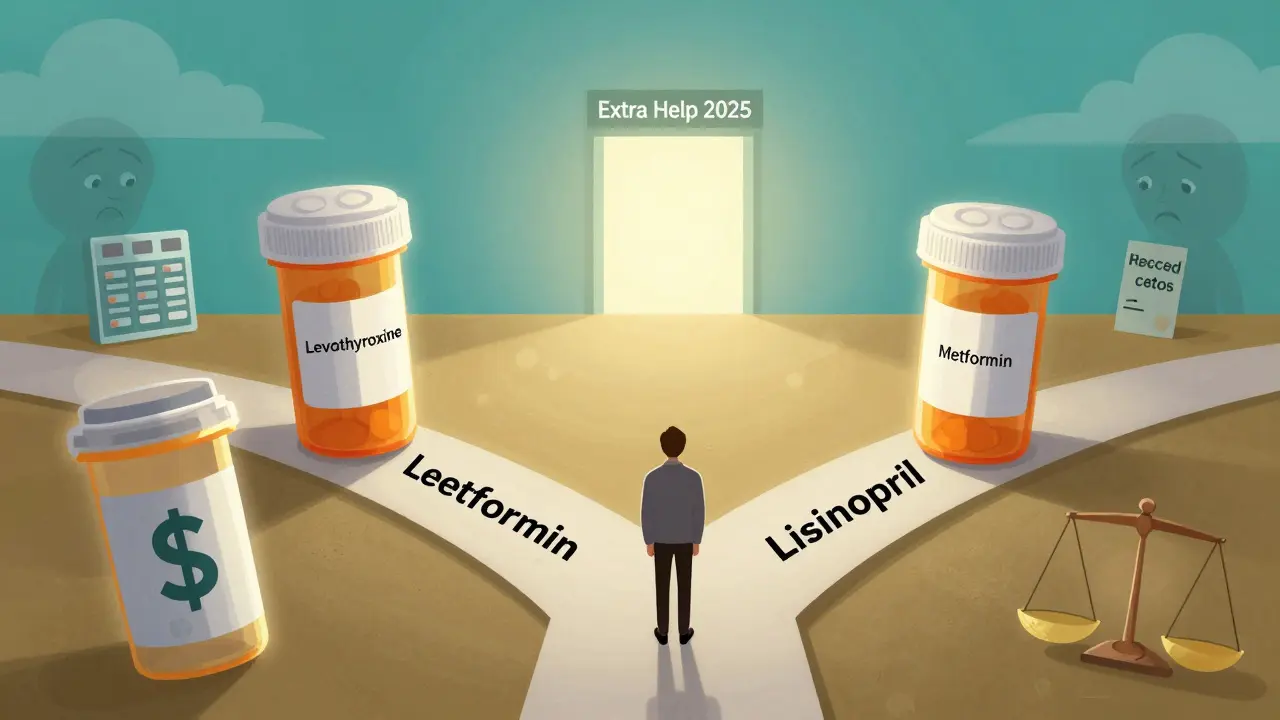
Getting your monthly prescriptions shouldn’t feel like a financial gamble. Even though generic drugs cost 80-85% less than brand names, many people still struggle to pay their copays. A 2023 KFF survey found that 26% of U.S. adults skip or cut pills because they can’t afford them-even for generics. If you’re taking levothyroxine, metformin, lisinopril, or any other common generic medication, you’re not alone. And there are real ways to cut those costs, if you know where to look.
Why Generics Still Cost Too Much
Generic drugs are supposed to be the affordable alternative. But even at $5 to $10 per prescription, that adds up. Three generics a month? That’s $15-$30. Four? $20-$40. For someone on a fixed income or working two jobs, that’s not small change. And insurance doesn’t always help. Many plans still make you pay the full copay before your deductible is met. Worse, some copay assistance programs won’t touch you if you’re on Medicare or Medicaid-even though those programs often don’t fully cover the cost.Here’s the truth: generic drug makers don’t offer copay cards like big pharma does. Why? Because they’re already selling at near-break-even prices. You won’t find a $0 copay coupon for metformin from a manufacturer. Instead, help comes from other places-and you need to know where to find them.
Medicare’s Extra Help Program: Your Best Bet
If you’re on Medicare Part D and your income is below $21,870 (individual) or $29,580 (couple) in 2025, you likely qualify for Extra Help. This is the most powerful program for generic drug users. Starting January 1, 2025, it caps your generic copay at exactly $4.90 per prescription. Brand-name drugs? $12.15. No deductible. No coverage gap. No surprises.People who’ve applied say it’s life-changing. One user on the Medicare Rights Center forum shared: “Before Extra Help, my five generics cost $45 a month. Now? $24.50 total. I can finally breathe.”
Applying takes paperwork-tax returns, bank statements, proof of income-but you don’t have to do it alone. Call your local State Health Insurance Assistance Program (SHIP). They’re free, trained counselors who help people navigate this exact process. In 2023, they handled over 1.2 million calls about generic drug costs. Don’t wait until you’re choosing between meds and groceries. Apply now.
Pharmacy Discount Programs: No Application Needed
You don’t need insurance to use these. Major chains like Walmart, Kroger, and Rite Aid offer ultra-low generic pricing with no sign-up, no eligibility check. Just ask for their list.- Walmart’s $4/$10 list: Covers about 150 generics, including antibiotics, blood pressure meds, and thyroid drugs. Most cost $4 for a 30-day supply, $10 for 90 days.
- Kroger’s $15 generics: Similar list, slightly fewer drugs, but often available at Kroger-owned pharmacies like Fred Meyer or Ralphs.
- SingleCare, GoodRx, Blink Health: These apps give you printable or digital coupons that work at most pharmacies. They’re not insurance-they’re cash prices. Sometimes they’re cheaper than your insurance copay.
Here’s the catch: you can’t combine these with your insurance. If your insurance copay is $12 and the coupon is $8, you pay $8-but it won’t count toward your deductible. That’s fine if you’re just trying to get through the month. But if you’re trying to reach your out-of-pocket maximum, stick with insurance.
Studies show 62% of patients don’t even ask for these discounts. Pharmacists say it’s because people assume generics are already cheap enough. Don’t be one of them. Always ask: “Do you have a cash price for this?”
The Assistance Gap: Who’s Left Out
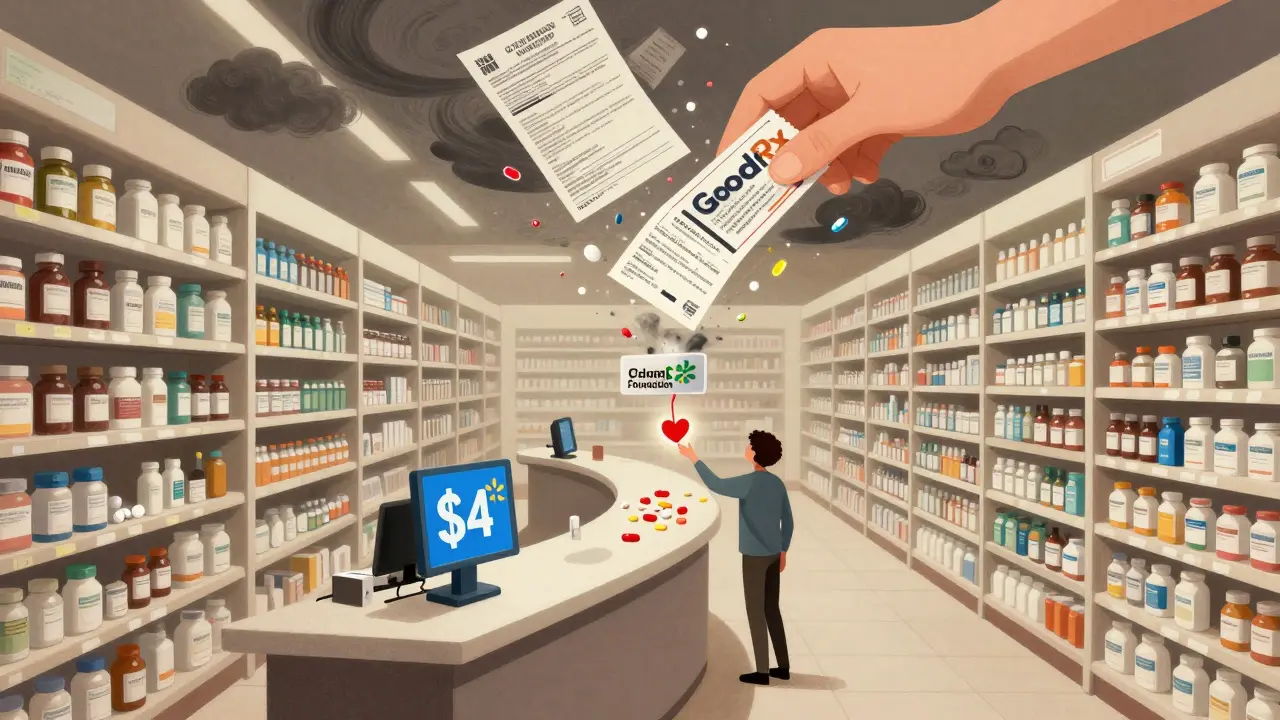
The biggest problem isn’t the poor-it’s the near-poor. People making $25,000 to $50,000 a year. Too much for Medicaid. Too little to afford insurance premiums. No manufacturer assistance. No Extra Help. And no pharmacy discount that brings their $30/month metformin down to $5.That’s the “assistance cliff.” A Reddit user wrote: “I make $2,100 a month. My three generics cost $32. I’m $300 over the Medicaid limit. No help. No options.” This isn’t rare. Nonprofit NeedyMeds found only 12% of applicants in this income range got assistance in 2023.
There’s no easy fix. But you can still try: apply for Extra Help anyway. Sometimes income is calculated differently than you think. Check with your state’s Medicaid office-some states have expanded programs. And don’t forget nonprofit foundations like the PAN Foundation. They cover 17 conditions that rely mostly on generics, including hypertension, diabetes, and hypothyroidism. Approval takes 3 weeks, but if you qualify, they’ll pay your copay directly to the pharmacy.
What’s Changing in 2025
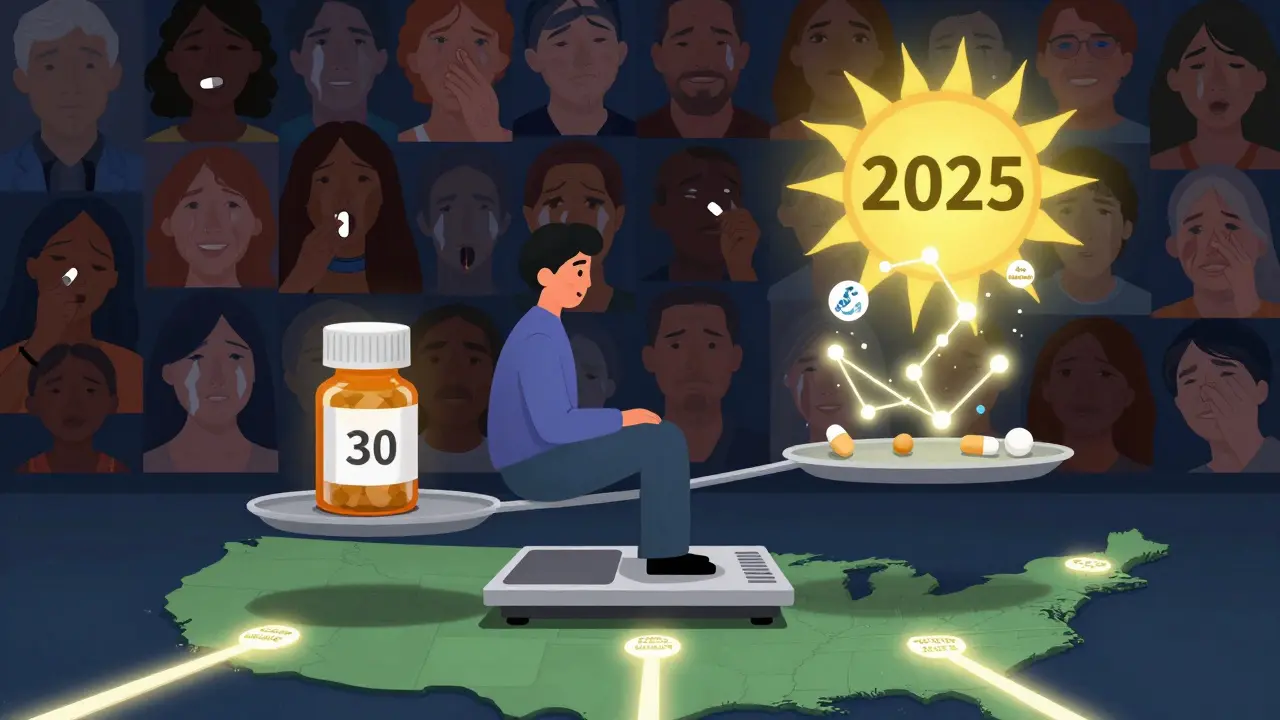
Big changes are coming. The Inflation Reduction Act kicks in January 1, 2025. For Medicare Part D users, the annual out-of-pocket cap drops from $8,300 to just $2,000. That’s huge. If you’re taking five generics a month at $10 each, you’d hit that cap in 20 months. After that? Your meds are free for the rest of the year.Also, insulin will cost no more than $2 a month-no matter if it’s brand or generic. And Extra Help recipients won’t pay any deductible at all.
But here’s the twist: these changes mostly help people who take multiple generics. The more meds you take, the faster you hit the $2,000 cap. That’s why experts say generic users will benefit the most. If you’re on a handful of generics, 2025 could be the year your drug costs finally drop.
How to Get Started Today
Don’t wait. Here’s your action plan:- Check your eligibility for Extra Help at Medicare.gov or call 1-800-MEDICARE. Even if you think you make too much, apply. Income rules are flexible.
- Compare prices using GoodRx or SingleCare. Type in your drug and your pharmacy. See if cash price beats your insurance copay.
- Ask your pharmacist if they have a discount program. Don’t assume they’ll tell you. Ask.
- Apply to PAN Foundation if you have diabetes, high blood pressure, or another chronic condition treated mostly with generics. Go to panfoundation.org.
- Call SHIP in your state. They’ll walk you through every option. No charge. No sales pitch.
Most people who use two or more of these options save at least $200 a year. Some save over $1,000.
Common Mistakes to Avoid
- Assuming generics don’t need help. A 2023 study in the Annals of Internal Medicine found 38% of people skipped their generic meds because they thought they couldn’t afford them-even though prices were low.
- Not checking prices every month. Generic prices change. A drug that was $12 last month might be $6 this month.
- Trying to combine coupons with insurance. It doesn’t work. Choose one or the other.
- Waiting until you run out. Apply for help before you’re in crisis. Extra Help applications take 45-90 days to process.
There’s no shame in asking for help. These programs exist because the system is broken. You’re not asking for charity-you’re using tools designed to make healthcare affordable.
Can I use GoodRx if I have Medicare?
Yes, but you can’t use it at the same time as your Medicare Part D coverage. You have to choose: either pay with your Medicare copay or pay the cash price using GoodRx. If the GoodRx price is lower, you can ask your pharmacist to process it as a cash transaction. Just remember: cash purchases won’t count toward your Medicare out-of-pocket maximum.
Why don’t generic drug companies offer copay cards like brand-name ones?
Generic manufacturers operate on razor-thin margins. A brand-name drug might cost $500 per pill and sell for $1,000, so the maker can afford to give away $500 in copay assistance. A generic version might cost $0.10 to make and sell for $1. There’s no profit left to fund discounts. That’s why help comes from pharmacies, nonprofits, and government programs-not the makers.
Does the $2,000 out-of-pocket cap in 2025 apply to all drugs or just generics?
It applies to all drugs covered under your Medicare Part D plan, including brand-name and generic. But because generics are cheaper, you’ll likely reach the $2,000 cap faster if you take multiple generics. That means you’ll get free drugs sooner than someone taking expensive brand-name medications-even with copay cards.
What if I make too much for Extra Help but still can’t afford my meds?
You’re not out of options. Try pharmacy discount programs first-they’re free and immediate. Then apply to nonprofit foundations like PAN Foundation or the Patient Access Network. Some require you to have a specific diagnosis, but many cover common conditions like high blood pressure, diabetes, and high cholesterol-all treated with generics. Also, check with your state’s Medicaid office. Some states have programs for people earning up to 250% of the federal poverty level.
Can I switch pharmacies to get better generic prices?
Absolutely. Prices vary wildly between pharmacies-even for the same drug. A 30-day supply of metformin might cost $12 at one CVS, $4 at Walmart, and $8 at your local independent pharmacy. Use GoodRx to compare before you fill your prescription. Don’t assume your regular pharmacy has the best deal.
Kevin Motta Top
Walmart’s $4 list saved my life. Metformin used to cost me $18 with insurance. Now? $4. I don’t even bother with coupons anymore. Just walk in, ask for the list, and done.
Stop overcomplicating it.
Alisa Silvia Bila
I used to skip my lisinopril every other month just to make it last. Then I found SHIP. They walked me through Extra Help-took three weeks, but now I pay $4.90. No more panic when the prescription refill comes.
Don’t suffer in silence. Call them. Seriously.
Henry Marcus
EVERYTHING HERE IS A LIE-OR A COVER-UP. You think Big Pharma doesn’t control the generics too? Nah. They own the wholesalers, the pharmacy benefit managers, the damn pharmacists who ‘forget’ to tell you about cash prices.
Extra Help? It’s a trap. They want you dependent. The $2,000 cap? A distraction. They’re slowly making us beg for scraps while they raise prices on everything else. You think the $0.10 pill is really $0.10? Check the supply chain. It’s all rigged.
And GoodRx? Owned by the same conglomerates that own your insurance. They profit off your desperation. You’re not saving money-you’re feeding the machine.
They don’t want you to know this. That’s why they publish ‘helpful’ articles like this. To make you feel like you’re in control. You’re not. You’re a number in a spreadsheet.
Aadil Munshi
Interesting that the article mentions PAN Foundation but doesn’t clarify that only 12% of applicants in the ‘assistance cliff’ get approved. That’s not help-that’s a lottery with terrible odds.
And let’s be real: if you’re making $45k and still can’t afford 3 generics, the problem isn’t your budget-it’s the entire healthcare architecture. You’re not failing. The system is.
Also, Walmart’s $4 list? Only covers 150 drugs. What about the other 5,000? You think they’re just ‘too expensive’? No-they’re not on the list because the pharmacy doesn’t want to lose margin. It’s not charity. It’s inventory management.
And yes, I’ve checked. My amlodipine is $14 at CVS, $8 at Walgreens, $6 at Kroger, and $4 at Walmart. But only if you’re not on insurance. So you choose: pay less now, or build deductible credit for later. It’s a trap either way.
mary lizardo
While the article presents a superficially helpful guide, it fails to address the systemic failure of pharmaceutical pricing in the United States. The normalization of $4 generic copays as a ‘solution’ is not empowerment-it is capitulation. One ought to question why, in a nation with the highest per-capita healthcare spending globally, citizens are reduced to scouring discount apps and nonprofit foundations merely to afford essential medication. The moral bankruptcy of this system is not mitigated by coupons. It is exacerbated by them.
Furthermore, the suggestion to ‘ask your pharmacist’ implies a voluntary benevolence that does not exist within a profit-driven model. Pharmacists are employees, not advocates. Their incentive structure does not align with patient welfare.
This article, while well-intentioned, is a Band-Aid on a hemorrhage.
Anna Sedervay
Wait-so you’re telling me that if I use GoodRx, my meds won’t count toward my deductible? That’s… that’s insane. Who designed this? Are they trying to punish people who are just trying to survive? I mean, I get it-insurance companies want you to pay more so they can make more money, but this is like… evil. Like, supervillain-level evil.
And why is there no app that just compares ALL the options-insurance, cash, coupons, state programs-in one place? Why do I have to be a detective just to get my thyroid meds? This isn’t healthcare. It’s a horror game.
I just cried reading this. I’m on metformin and lisinopril. I’m 38. I work full-time. I’m not poor. But I’m one missed paycheck away from skipping doses. And no one talks about this. Not even my doctor.
Why does this have to be so hard?
Matt Davies
Man, I’ve been using SingleCare for my blood pressure med for a year now. It’s $5.50 instead of $15. I used to feel guilty about it-like I was cheating the system. Then I realized: the system cheated me first.
Pharmacists at my local CVS? They’ve started smiling when I walk in. ‘Hey, cash price again?’ they ask. ‘Yep,’ I say. ‘And thanks.’
It’s not glamorous. But it’s real. And it works.
Don’t let pride stop you from saving your life.
Mike Rengifo
I’m on three generics. Used to pay $40/month. Now I use Walmart + Extra Help + a PAN application that took 6 weeks but got approved. Total cost: $18/month.
Not perfect. But way better.
Just do the steps. It’s boring, but it works.
Meenakshi Jaiswal
Hi! I’m a pharmacist in Delhi, but I’ve worked with U.S. patients remotely for years. I see so many people struggling with the same issues.
Here’s what no one tells you: if you’re on Medicare and qualify for Extra Help, you can apply retroactively. If you paid more than $4.90 for a generic in the last 3 months, you can get reimbursed.
Also-PAN Foundation doesn’t just cover diabetes and hypertension. They cover depression meds like sertraline and fluoxetine if they’re your primary treatment.
And yes, call SHIP. They’re underfunded, but they’re warriors. One woman in Ohio got her insulin covered through them after her husband died and her income dropped. She didn’t even know she qualified.
You’re not alone. And help is out there. Just keep asking.
You’ve got this.
Tim Goodfellow
2025 is gonna be the year we stop apologizing for needing help.
Imagine a world where your meds cost less than your coffee. That’s not a fantasy-it’s coming. And if you’re reading this? You’re already part of the change.
Go apply. Call SHIP. Ask for the cash price. Switch pharmacies. Do one thing today.
Because your health isn’t a luxury. It’s your right.
And you deserve to breathe.