
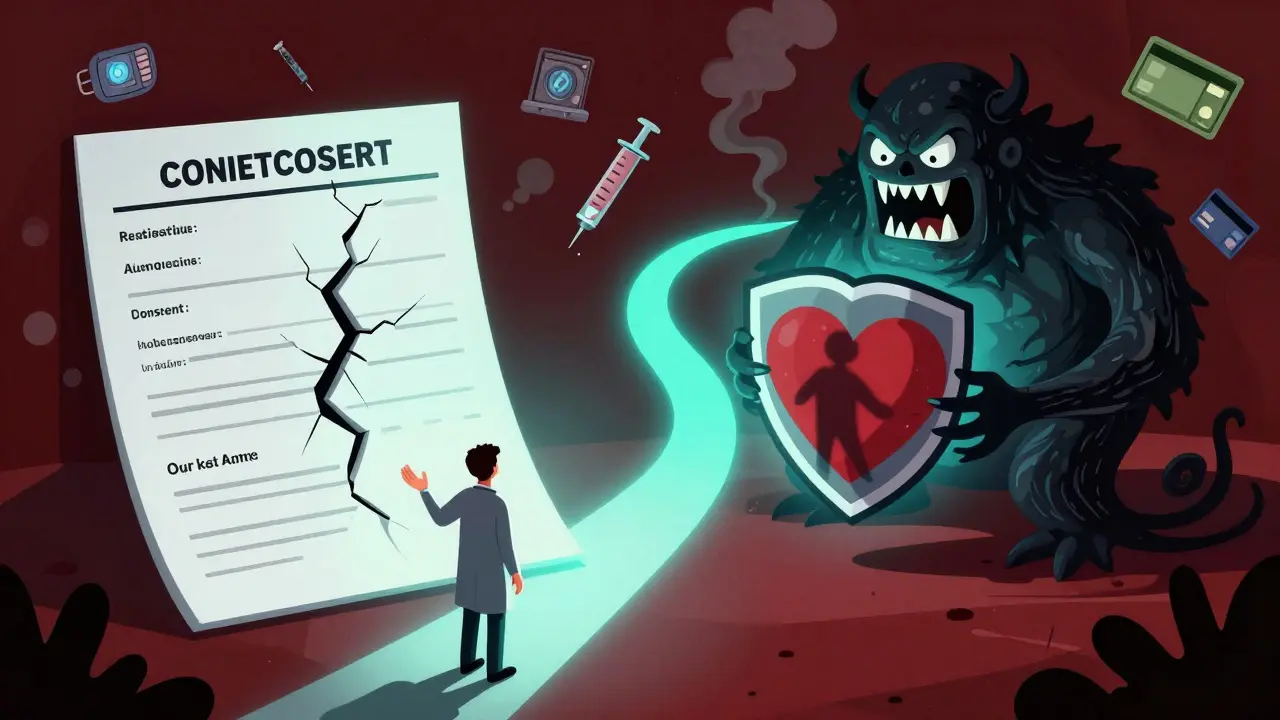
Every year, millions of Americans face bills they never saw coming-emergency room charges from out-of-network providers, surprise lab fees, or credit card applications handed to them in the waiting room. These aren’t accidents. They’re practices that have been legal-until recently. In 2024, New York State changed the game with three new laws designed to stop healthcare providers from exploiting patients financially. These aren’t just paperwork changes. They’re shields against debt traps that have ruined credit scores, forced people into bankruptcy, and made patients afraid to seek care.
Separating Consent: Treatment vs. Payment
For decades, hospitals and clinics used one form to get everything: your signature for treatment, your permission to bill insurance, and your agreement to pay out-of-pocket costs-all in one box. Patients signed without reading. Providers assumed consent. But that’s over. As of October 20, 2024, New York’s Public Health Law Section 18-c requires providers to get separate, explicit consent for treatment and for payment.This means if you go to a clinic for a knee exam, you can’t be forced to sign a document that also lets them charge you $3,000 for an MRI you didn’t ask for. You have to agree to the treatment first. Then, separately, you have to agree to how you’ll pay for it. If a provider skips this step, they face a $2,000 fine per violation. That’s not a warning. It’s a penalty.
Some providers tried to ignore this rule. One law firm, Goldsand Friedberg, reported in August 2025 that enforcement of Section 18-c had been suspended-creating confusion. But that doesn’t mean the law is gone. It means the state is working out how to enforce it properly. Until then, patients should still demand separate consent forms. If a provider says, "We’ve always done it this way," they’re wrong.
No More Sneaky Credit Card Applications
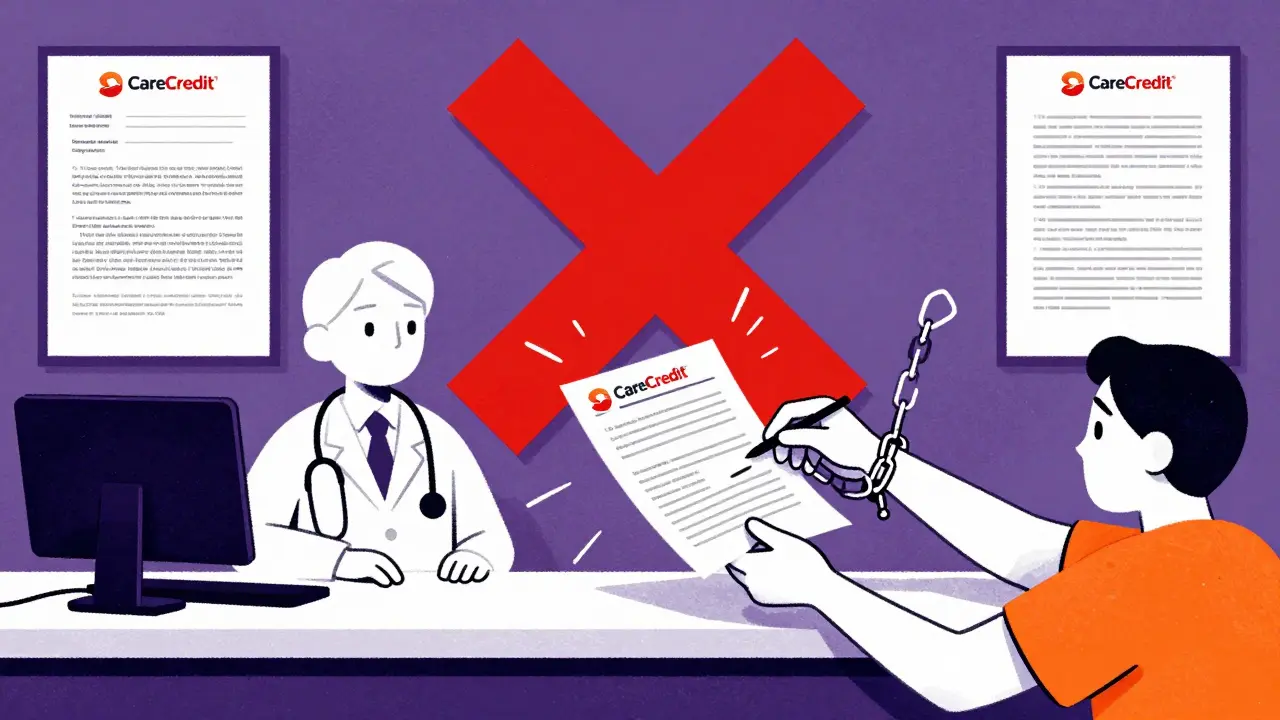
You’re sitting in the exam room. Your doctor says, "We have a financing option to help with your costs." Then a staff member slides over a CareCredit® application. They fill out your name, income, even your Social Security number-"just to speed things up." That’s illegal now.Under General Business Law Section 349-g, healthcare providers in New York can’t complete any part of a medical financing application. Not one field. Not even your phone number. They can answer questions. They can hand you the form. But you have to fill it out yourself. Violate this rule? Up to $5,000 per violation. That’s not a slap on the wrist. It’s a business-killer.
This law targets a common trick: providers pushing patients into high-interest medical credit cards while pretending they’re helping. CareCredit® and similar products often charge 20%+ interest if you miss a payment-even if you paid on time for months. Worse, once you sign up, you lose protections you’d have with regular insurance or payment plans. These laws stop providers from turning your medical need into a payday loan.
Don’t Force Credit Cards Before Emergency Care
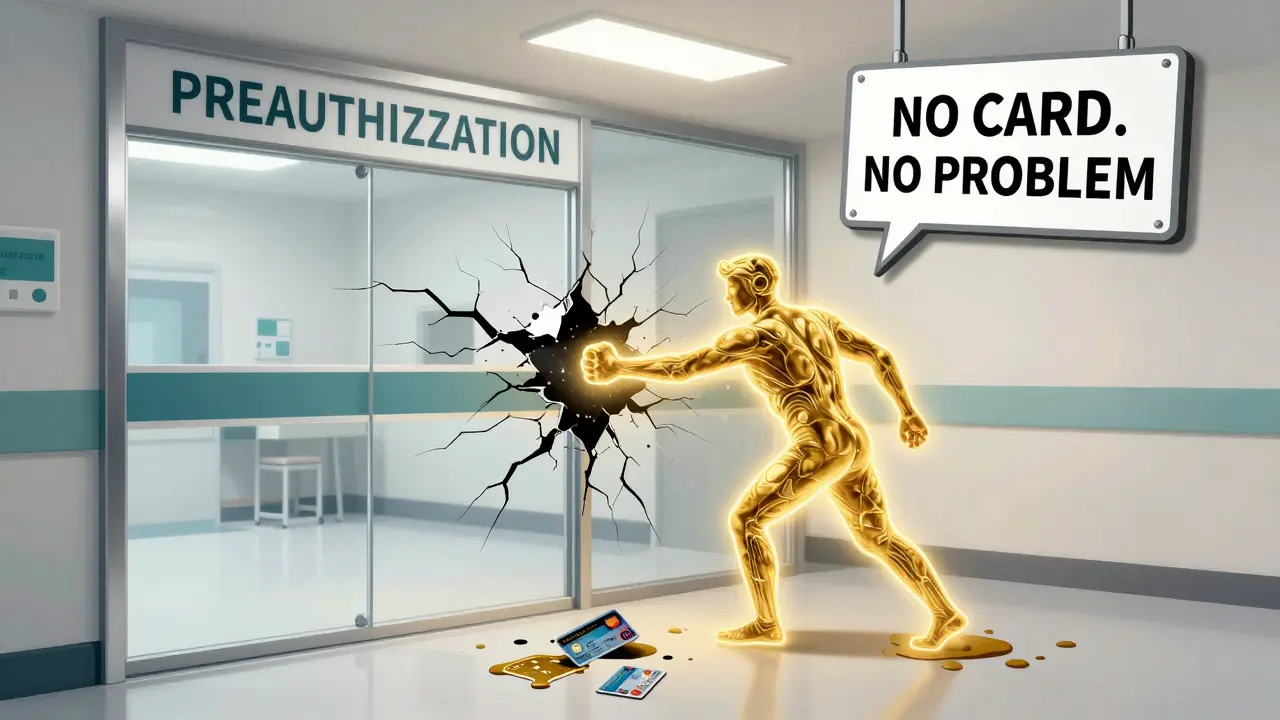
Imagine you fall off your bike. You show up at the ER with a broken arm. The front desk asks for your credit card before they even look at you. That’s not normal. It’s predatory. And in New York, it’s now illegal.General Business Law Section 519-a bans providers from requiring credit card preauthorization or keeping cards on file before giving emergency or medically necessary care. That includes urgent care centers, trauma units, and even outpatient surgery clinics. You can’t be denied treatment because you didn’t hand over your card.
But here’s the twist: if you choose to pay with a regular credit card after treatment, the provider must warn you. They have to tell you, in writing, that using a standard credit card means you lose key protections. Medical debt from CareCredit® can’t be reported to credit bureaus under the CFPB’s 2024 rule. But debt from your Visa? It can. It can lead to wage garnishment, liens on your home, and credit score crashes.
This law doesn’t stop you from using a credit card. It just stops providers from tricking you into it-and makes sure you know the cost.
How This Compares to Federal Law
You might think federal laws already cover this. They don’t-not fully.The No Surprises Act, which took effect in January 2022, stops surprise bills from out-of-network providers. If you go to an in-network hospital but get an out-of-network anesthesiologist, you’re protected. That’s good. But it doesn’t touch what happens inside the hospital.
New York’s laws go further. They regulate in-network billing, consent practices, and financial product sales-all things the federal government ignores. The CFPB’s 2024 rule removing medical debt from credit reports helps, but only for debt from healthcare-specific financing products. If you used your Mastercard to pay for chemotherapy, that debt still shows up on your credit report. New York’s laws force providers to make that distinction clear.
Other states are watching. Barclays Health Law Advisory predicted in late 2024 that New York’s model will spread. California, Illinois, and Massachusetts are already reviewing similar bills. But right now, New York leads the country in patient financial protection.
What This Means for Patients
You don’t need a lawyer to use these laws. You just need to know your rights.- If a provider asks you to sign one form for everything-say no. Ask for separate consent for treatment and payment.
- If someone offers you CareCredit® and starts filling out the form-stop them. Tell them it’s against the law. Fill it out yourself-or walk away.
- If you’re asked for a credit card before emergency care-refuse. You have the right to treatment without payment upfront.
- If you pay with a regular credit card, ask for the risk disclosure form. If they don’t give it to you, report them to the New York State Department of Health.
These laws were written because 100 million Americans carry $195 billion in medical debt. That’s not a statistic. That’s your neighbor. Your coworker. Maybe you.
What This Means for Providers
For clinics and hospitals, this is a nightmare. Staff must be retrained. Forms must be rewritten. Systems must be updated. Many are struggling. The Department of Health released guidance just two days before the laws took effect. No one had time to prepare.But compliance isn’t optional. Fines add up fast. A single provider who accidentally lets staff fill out three CareCredit® applications could owe $15,000. That’s enough to shut down a small practice.
Smart providers are adapting. They’re using digital intake systems that separate consent fields. They’re training front desk staff to say, "I can’t help you fill this out, but I can answer questions." They’re printing risk disclosures for credit card payments. It’s harder. It’s slower. But it’s the law.
What’s Next?
The suspension of Section 18-c is a red flag. If the state can’t enforce it, the law becomes meaningless. Patients must stay vigilant. If you’re asked to sign a combined consent form, document it. Take a photo. Report it. The system only works if people speak up.Looking ahead, more states will follow New York. The CFPB’s move to remove medical debt from credit reports shows federal momentum. But federal law still doesn’t cover the messy middle-where providers push financing, collect cards, and hide costs in fine print.
Until then, New York is the only place where patients have real power over their medical bills. And that’s not just a legal win. It’s a human one.
Can a doctor refuse to treat me if I don’t sign a payment consent form?
No. Under New York’s General Business Law Section 519-a, providers cannot deny emergency or medically necessary treatment because you refuse to sign a payment consent form. You must give separate consent for payment, but treatment cannot be withheld for that reason. This applies even if you haven’t paid anything yet.
What’s the difference between CareCredit® and a regular credit card for medical bills?
CareCredit® and other healthcare-specific financing products are designed to be used for medical expenses. Under federal rules, debt from these products can’t be reported to credit bureaus and can’t lead to wage garnishment or liens on your home. Regular credit cards don’t have those protections. If you use your Visa or Mastercard to pay for surgery, that debt can still hurt your credit score and lead to collection actions.
Are these laws only for New York?
Yes, these specific laws apply only to healthcare providers in New York State. However, other states are considering similar rules. The federal No Surprises Act and CFPB’s medical debt rule offer some protections nationwide, but they don’t cover consent practices or credit card collection like New York’s laws do.
Can I be charged interest on medical bills if I pay with a credit card?
Yes. If you use a regular credit card to pay a medical bill, you’re subject to the card’s standard interest rates-often 15% to 25%. Providers can’t charge you extra interest just because you’re paying with a card, but the card issuer can. That’s why New York requires providers to warn you about this risk before you use a credit card.
What should I do if a provider violates these laws?
Document everything: take photos of forms, record conversations (if legal in your state), and save any paperwork. Then file a complaint with the New York State Department of Health. You can also report violations to the New York Attorney General’s Office. Providers who break these laws face fines of $2,000 to $5,000 per incident, and repeated violations can lead to license suspension.
Shelby Price
Wow, I had no idea this was even a thing. Just got hit with a $1,200 bill last month for an ER visit-turned out they used an out-of-network tech for the X-ray. I signed like 5 forms and didn’t read any of them. 😅
Lorena Druetta
This is a monumental step toward dignity in healthcare. Every patient deserves transparency, autonomy, and protection from predatory financial practices. These laws are not merely regulatory-they are moral imperatives.
Zachary French
So let me get this straight-now doctors can’t even help you fill out a credit card form? Like, I get it, but what if you’re dizzy from pain or don’t know how to spell your last name? This feels like punishing the wrong people. Also, ‘CareCredit’ is basically a loan with a cute name. 😒
Daz Leonheart
Finally. I’ve seen too many people avoid the ER because they’re scared of the bill. This gives people back their power. You don’t need to be a financial expert to get medical care. Just say no to combined forms. It’s that simple.
Samuel Bradway
My mom got stuck with a $4k bill last year because they slipped a CareCredit application into her paperwork. She didn’t even realize she signed up until the collections call. This law is a godsend. I’m printing this out and handing it to every clinic I go to.
Jamillah Rodriguez
So now I have to argue with a receptionist about consent forms? Great. Just what I needed-another thing to fight for while I’m in pain. 🙄
Susheel Sharma
Let’s be honest-this is performative legislation. The real issue is systemic underfunding of public healthcare. These laws shift blame to providers while ignoring the fact that insurance companies dictate pricing. Also, why is New York always the ‘pioneer’? It’s just louder, not smarter.
Janice Williams
Oh, so now patients are innocent victims? What about the ones who lie about income to get financing? Or those who rack up CareCredit balances and never pay? This law rewards irresponsibility. And where’s the accountability for patients who refuse to pay what they owe?
Roshan Gudhe
Humanity is not a transaction. These laws recognize that medical care is a right, not a product to be upsold. The fact that we needed laws to stop hospitals from treating people like ATM machines says more about our society than any statistic ever could. 🌱
Rachel Kipps
I think this is great, but I’m worried about small clinics. They don’t have the staff or tech to update all their forms. Maybe the state should offer grants? I’m sure they mean well, but it’s hard to comply when you’re understaffed.
Wendy Lamb
Separate consent forms. No pre-authorized cards. No filling out applications for you. Done. Simple. Effective.
Antwonette Robinson
Oh wow, New York’s finally doing something that should’ve been federal law since 2010. Took them long enough. Guess we’ll have to wait another decade for the rest of the country to catch up… or not. 😏