

What Bioequivalence Testing Really Means for Generic Drugs
When you pick up a generic pill at the pharmacy, you might wonder: is this really the same as the brand-name version you’ve been taking? The answer isn’t guesswork-it’s science. Bioequivalence testing is the process that proves a generic drug works the same way in your body as the original. It doesn’t just mean the pill looks similar or has the same active ingredient. It means your body absorbs it at the same rate and to the same extent. And that’s the whole point.
How Bioequivalence Is Measured
Here’s how it works in practice. A study is done with 24 to 36 healthy volunteers. Each person takes both the brand-name drug and the generic version, at different times, under controlled conditions-usually on an empty stomach. Blood samples are taken over several hours to track how much of the drug enters the bloodstream and how fast.
Two key numbers are measured: AUC (area under the curve), which tells you the total amount of drug absorbed over time, and Cmax (maximum concentration), which shows how quickly it peaks. For the generic to be approved, both numbers must fall within 80% to 125% of the brand-name drug’s results. That’s not a wide range-it’s tight. If a generic hits 126%, it gets rejected. No exceptions.
This isn’t just a formality. It’s a strict scientific standard set by the U.S. Food and Drug Administration (FDA) and mirrored by agencies like the European Medicines Agency (EMA). These numbers aren’t pulled out of thin air. They’re based on decades of clinical data showing that if two drugs stay within this range, their effects on the body are essentially identical.
Why This Matters More Than You Think
Before bioequivalence testing became standard, generic drugs were a gamble. Some worked. Some didn’t. Patients reported unexpected side effects or lack of relief. That changed with the Hatch-Waxman Act of 1984. It created a clear, science-based path for generics to enter the market without repeating expensive clinical trials. Instead, they had to prove they behaved the same way in the body.
The result? Today, 90% of prescriptions in the U.S. are filled with generic drugs. But they cost only 23% of what brand-name drugs do. In 2020 alone, this saved the healthcare system $313 billion. That’s not just a win for patients-it’s a win for the entire system.
And it’s not just about price. It’s about access. For people managing chronic conditions like high blood pressure, diabetes, or epilepsy, generics make lifelong treatment possible. Without bioequivalence testing, many wouldn’t be able to afford their meds at all.
What Bioequivalence Doesn’t Prove
Here’s where people get confused. Bioequivalence testing doesn’t prove the drug is perfect in every way. It doesn’t test for long-term side effects. It doesn’t compare how well each drug works over years. It doesn’t even test whether the generic helps you feel better-only whether your body absorbs the same amount of the active ingredient at the same speed.
That’s fine for most drugs. But for some, it’s not enough. Take inhalers for asthma, or topical creams for eczema. These drugs act locally. You can’t measure their effect just by checking blood levels. For those, regulators require additional testing-like lung function tests or skin absorption studies. The FDA has issued specific guidelines for these complex products because bioequivalence alone doesn’t cut it.
The same goes for narrow therapeutic index drugs-medications where even a tiny change in dose can cause harm. Think warfarin, lithium, or certain seizure drugs. For these, some experts argue the 80%-125% range is too wide. The FDA sometimes applies stricter standards for these, but it’s not automatic. That’s why some doctors still prefer brand-name versions for patients on these drugs, even if the generic is approved.
Are Generics Really the Same? Real Patient Experiences
Surveys show most people don’t notice a difference. A 2022 Consumer Reports study of 1,200 users found 87% saw no change in effectiveness when switching from brand to generic. Nine percent even said the generic worked better. Only 4% felt it was less effective.
On Reddit’s pharmacy forums, people share stories daily. One man switched from brand-name Adderall to a generic version and noticed no difference in focus. Another woman switched her thyroid med and had no symptoms return. But then there’s the 10% who report minor issues-headaches, nausea, or feeling “off.”
These aren’t usually because the active ingredient is different. They’re often because of the fillers-lactose, dyes, or coatings. Some people are sensitive to those. It’s not bioequivalence failing. It’s a reaction to something else in the pill. Pharmacists can often help by switching to a different generic manufacturer that uses different inactive ingredients.
How the System Keeps Generics Safe
Approval isn’t the end. The FDA inspects over 1,200 generic drug factories every year-both in the U.S. and overseas. They check that each batch meets strict standards for purity, strength, and consistency. If a plant fails inspection, the FDA can block shipments or pull products from shelves.
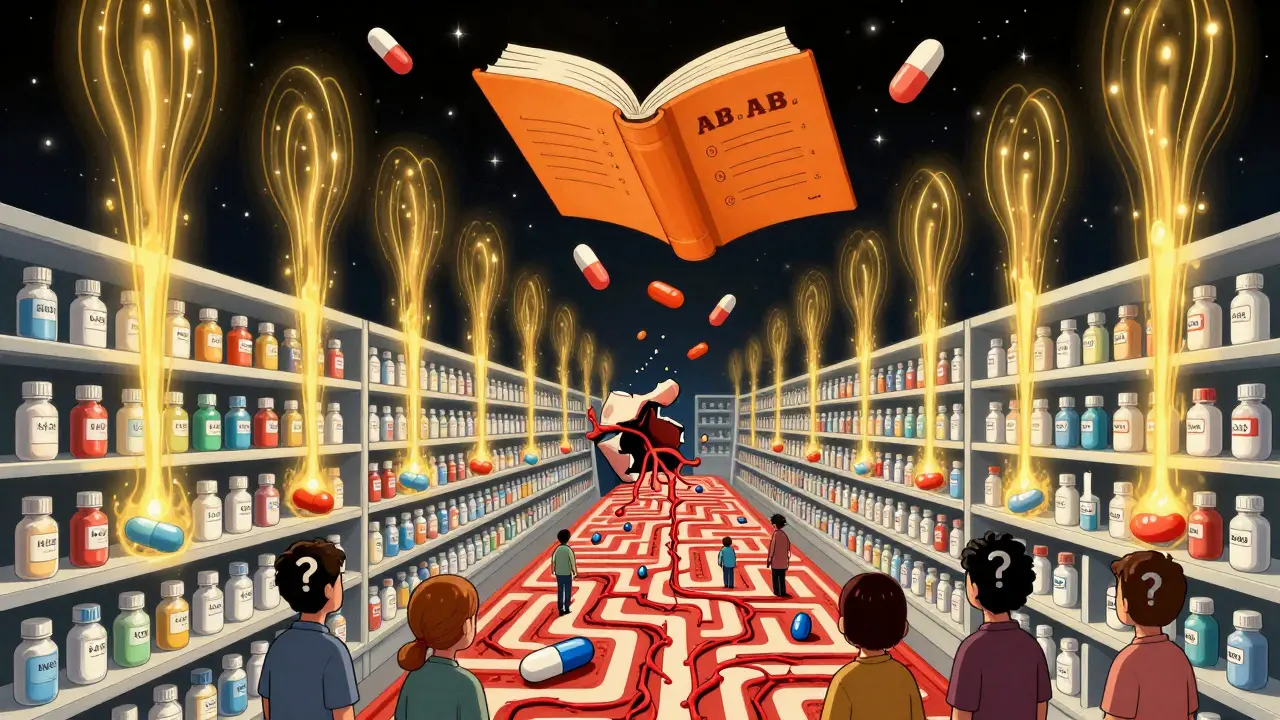
Every approved generic is listed in the FDA’s Orange Book, with a therapeutic equivalence rating. An “AB” rating means it’s bioequivalent and interchangeable. You can swap it freely. Some generics get an “AB2” or “BX” rating, which means they’re not interchangeable due to formulation differences. Your pharmacist should know this. If you’re unsure, ask.
Manufacturers can’t just change the formula after approval. If they tweak the manufacturing process-even slightly-they must retest for bioequivalence. That’s why you might see a different color or shape on your generic pill from month to month. It’s still the same drug. Just made by a different batch or supplier.
The Future of Bioequivalence Testing
The field is evolving. The FDA is now using computer modeling to predict how a drug will behave in the body. This could reduce the need for human studies in some cases, especially for complex generics. Think of it like a digital twin of your bloodstream.
More agencies are adopting these methods. The EMA is already using physiologically based pharmacokinetic (PBPK) modeling for certain drugs. It’s faster, cheaper, and just as reliable when done right.
But the core principle stays the same: if your body doesn’t absorb the drug the same way, it’s not the same drug. That’s why bioequivalence testing isn’t going anywhere. It’s the bedrock of affordable, reliable medicine.
What You Should Know Before Switching
- If your doctor prescribed a brand-name drug, ask if a generic is available. Most are.
- Don’t assume all generics are identical. Different manufacturers may use different inactive ingredients. If you have a reaction, try another brand.
- For critical medications like blood thinners or seizure drugs, monitor your response closely after switching. Tell your doctor if anything feels off.
- Check the FDA’s Orange Book online to see if your generic has an “AB” rating. That means it’s interchangeable.
- Pharmacists can often swap generics without a new prescription-unless your doctor specifically wrote “dispense as written.”
Do generic drugs take longer to work than brand-name drugs?
No. Bioequivalence testing requires that the generic reaches the same peak concentration in your blood at the same time as the brand-name drug. If it took longer, it would fail the Cmax test and be rejected by the FDA. Any perception that generics work slower is usually due to placebo effects or differences in inactive ingredients, not the active drug.
Are generic drugs less potent than brand-name drugs?
Not according to regulatory standards. The FDA requires that generic drugs contain the same amount of active ingredient as the brand-name version, within a very small tolerance. Bioequivalence studies prove they deliver that same amount into your bloodstream at the same rate. If a generic were less potent, it wouldn’t meet the 80%-125% absorption range and would not be approved.
Why do some people say generics don’t work as well?
Most of the time, it’s not the drug itself. Differences in fillers, dyes, or coatings can cause minor side effects like stomach upset or headaches in sensitive individuals. Sometimes, people notice a change in pill size or color and assume it’s less effective. In rare cases, a poorly manufactured generic might have inconsistent dissolution, but that’s why the FDA inspects factories regularly. If you feel a generic isn’t working, talk to your pharmacist about switching to another brand.
Can I trust generics for chronic conditions like high blood pressure or diabetes?
Yes. Millions of people take generic versions of metformin, lisinopril, atorvastatin, and other chronic disease drugs every day with no issues. The FDA approves them using the same bioequivalence standards as for all other drugs. In fact, most clinical guidelines recommend generics as first-line treatment because they’re just as effective and far more affordable.
What about complex drugs like inhalers or topical creams?
For those, bioequivalence testing alone isn’t enough. The FDA requires additional studies-like lung function tests for inhalers or skin absorption tests for creams-because the drug acts locally, not systemically. These products are harder to replicate, which is why fewer generics exist for them. But when they’re approved, they’ve passed even stricter tests than standard pills.
Final Thought: Trust the Science, Not the Myth
Generic drugs aren’t cheaper because they’re weaker. They’re cheaper because they don’t need to pay for advertising, fancy packaging, or years of clinical trials. The science behind bioequivalence is solid. It’s been tested, reviewed, and used for over 40 years. If you’re worried about switching, start with a simple medication-like an antacid or an antibiotic-and see how you feel. Chances are, you won’t notice a difference. And you’ll save money.
Lu Gao
I love that generics are so tightly regulated! 🙌 The 80%-125% range isn't arbitrary-it's science backed by decades of data. I used to be skeptical too, until I switched my blood pressure med and saved $200/month. No side effects, no drama. Just cheaper, same results. 💊
Jaden Green
Let’s be real-bioequivalence testing is a glorified placebo control dressed up as regulatory rigor. The FDA’s 80-125% window is laughably broad when you consider that even a 5% shift in absorption can trigger adverse events in sensitive populations. And don’t get me started on the fact that manufacturers are allowed to change inactive ingredients without retesting, as long as the active compound stays within that absurdly permissive range. It’s not science-it’s corporate compromise masquerading as public health policy. And yes, I’ve read the Orange Book. Twice.
June Richards
I’ve seen people panic over generic Adderall like it’s poison. Bro. It’s the same damn molecule. If you feel weird after switching, it’s probably the filler-maybe you’re lactose intolerant and didn’t even know it. Stop blaming the science and start reading the label. 🤦♀️
Donna Macaranas
I switched my diabetes med to generic metformin last year. No issues. My A1C stayed the same. My wallet thanked me. I think people overthink this. The system works. 🤗
Lisa Rodriguez
One thing people forget-the FDA inspects every single manufacturing plant, even overseas ones. I worked in pharma compliance for 8 years. If a batch fails, it gets destroyed. Not recycled. Not sold overseas. Destroyed. So when someone says 'generics are sketchy'-ask them if they’ve ever seen an FDA warning letter. Most haven’t. And that’s the real story.
Aditya Gupta
In India, generics save lives. My uncle takes warfarin generic-same as brand, half the price. Doctors here trust it. Patients trust it. Science doesn’t care where you buy it. 💪
Melissa Melville
So you’re telling me I paid $300 for brand-name Zoloft for 5 years… and all that time I could’ve been saving $270/month? 😅 Thanks for the guilt trip, science.
Jamie Allan Brown
I used to be the guy who refused generics. Then my kid needed epilepsy meds. We tried three different generics. One caused night terrors. Another made her dizzy. The third? Perfect. We found the right one. It wasn’t the drug-it was the binder. Pharmacists are your secret weapon. Ask them. They know.
Rachel Liew
i switched my thyroid med and felt kinda weird at first. i thought it was the generic but it was just my body adjusting. my pharmacist said to give it 2 weeks. she was right. now i save $150 a month and feel great. thanks for the info!
Nicki Aries
I’m not saying generics are bad... but... have you ever opened a bottle and seen a pill that looks like it was molded by a toddler with a glue stick? The color? The shape? The smell? I’m not saying it’s unsafe... I’m just saying... I’ve seen things...
Ishmael brown
I swear, every time I switch generics, I get a headache. It’s not the drug. It’s the filler. I’ve tried 7 different brands of levothyroxine. One of them made me feel like I was on a rollercoaster. Another? Zero issues. It’s not bioequivalence-it’s the damn coating.
Nancy Nino
The notion that bioequivalence testing is sufficient for all drug classes is a dangerous oversimplification. The FDA’s regulatory framework, while robust for simple oral solids, is demonstrably inadequate for complex formulations such as transdermal patches, inhaled corticosteroids, and long-acting injectables. The reliance on plasma concentration metrics ignores tissue-specific pharmacokinetics. This is not science-it’s regulatory inertia.
Chris & Kara Cutler
SAVE MONEY. STAY HEALTHY. NO BRAIN DAMAGE. 💥
Ed Di Cristofaro
I used to be one of those people who thought generics were 'cheap knockoffs.' Then I found out my dad’s generic statin was made in the same factory as the brand. Same line. Same machine. Same quality control. I felt stupid. And then I felt angry. Why did I pay extra for 10 years?