

Choosing a blood thinner isn’t just about picking a pill. It’s about understanding how it works in your body, what can go wrong, and how your daily life changes because of it. For millions of people with atrial fibrillation, deep vein thrombosis, or mechanical heart valves, this decision can mean the difference between a stroke and safety - or between a minor bleed and a life-threatening one.
Warfarin: The Old Standard with Big Demands
Warfarin has been around since the 1950s. It’s cheap, well-studied, and still used - but only because it’s one of the few options left for certain patients. For everyone else, it’s become a hassle.
Here’s how it works: warfarin blocks vitamin K, which your liver needs to make clotting factors. But vitamin K is everywhere - in leafy greens, broccoli, even some oils. One week you eat a big salad, your INR drops. Next week you skip the greens, your INR spikes. That’s why you need blood tests, often every week at first, then every few weeks after that. If your INR isn’t between 2.0 and 3.0, you’re either at risk of a clot or a bleed.
And it’s not just food. Over 300 medications interact with warfarin. Antibiotics, painkillers, even some herbal supplements can throw your levels off. A single dose of amoxicillin or ibuprofen can send your INR into dangerous territory. That’s why doctors spend so much time reviewing your entire medication list before prescribing it.
Still, warfarin has one big advantage: it has a known antidote. If you bleed too much, vitamin K or fresh frozen plasma can reverse it quickly. That’s why it’s still the go-to for people with mechanical heart valves - DOACs simply don’t work there.
DOACs: The New Kids on the Block
Direct oral anticoagulants - or DOACs - include apixaban (Eliquis), rivaroxaban (Xarelto), dabigatran (Pradaxa), and edoxaban (Savaysa). They hit specific targets in the clotting process: either factor Xa or thrombin. No vitamin K interference. No food restrictions. No weekly blood tests.
That’s why, as of 2023, DOACs made up nearly 80% of all anticoagulant prescriptions in the U.S. Apixaban alone is the most prescribed blood thinner in the country. Why? Because for most people, they’re safer.
Studies show DOACs reduce the risk of stroke in atrial fibrillation by 30% compared to warfarin. They cut intracranial bleeding - the deadliest kind - by about half. And they’re more effective at preventing recurrent blood clots in patients with deep vein thrombosis or pulmonary embolism.
But they’re not perfect. And they’re not for everyone.
When DOACs Are Safer - and When They’re Not
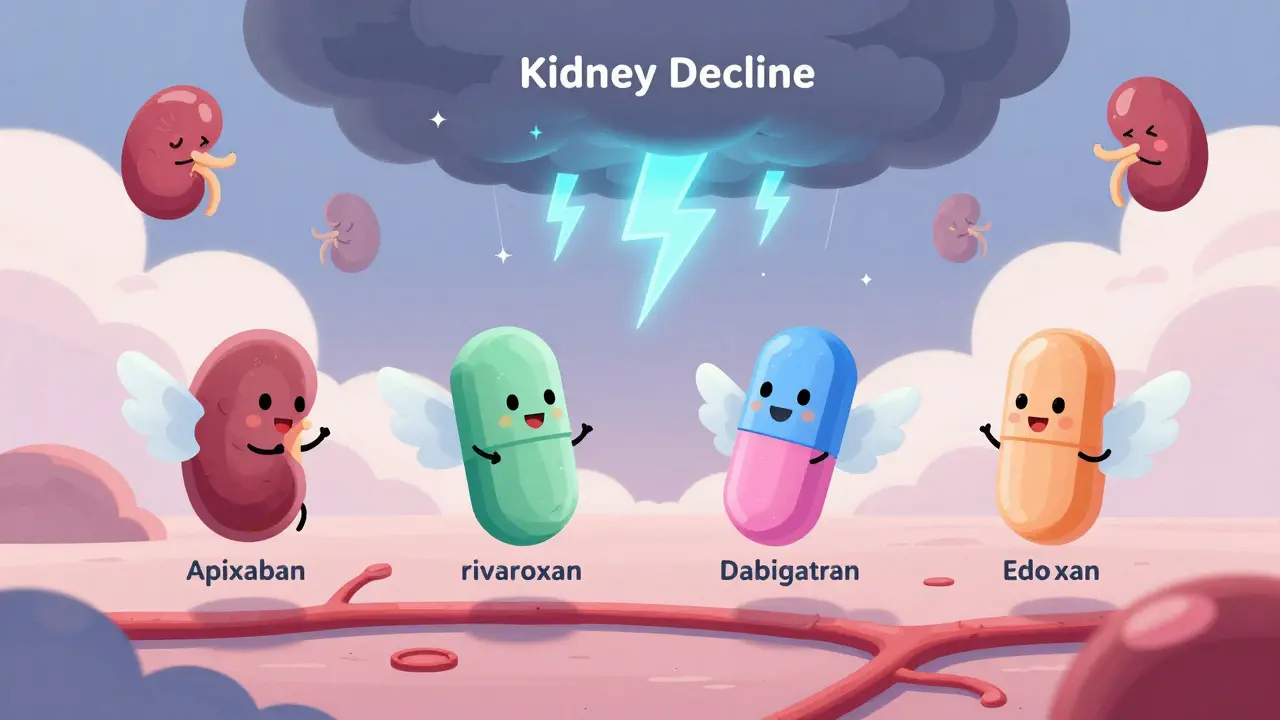
DOACs work best in people with normal kidney function. But here’s the catch: they leave the body through the kidneys. Dabigatran? 80% cleared by the kidneys. Apixaban? Only 27%. That’s why apixaban is often chosen for older patients or those with mild kidney decline.
For patients with severe kidney disease - eGFR below 15 - DOACs aren’t recommended. Warfarin is still the only option. But even for moderate kidney issues (eGFR 25-59), DOACs still outperform warfarin in safety. A 2023 study found that for every 10-point drop in kidney function, DOACs reduced the risk of brain bleeding by 6.2% more than warfarin.
But in patients with very poor kidney function - especially those on dialysis - data is limited. Some studies show DOACs may still be safer, but guidelines still lean toward warfarin here. It’s a gray area, and decisions are made case by case.
There’s also weight to consider. DOACs are dosed based on weight and age. For patients under 60 kg, standard doses can be too high, increasing bleeding risk. That’s why doctors check weight and kidney function before prescribing.
Which DOAC Is Best?
Not all DOACs are the same. Apixaban has the lowest bleeding risk among them. In cancer patients with atrial fibrillation, apixaban cut major bleeding by 42% compared to warfarin. Rivaroxaban? No significant difference in bleeding. Dabigatran had fewer recurrent clots than rivaroxaban in one study.
And reversal matters. If you’re on apixaban or rivaroxaban, there’s now a specific antidote: andexanet alfa. For dabigatran, there’s idarucizumab. Warfarin’s reversal is more general - vitamin K and plasma. But DOACs don’t need reversal in most cases because they clear faster. If you stop a DOAC, it’s mostly gone in 12 to 24 hours. Warfarin lingers for days.
Cost and Adherence: The Hidden Factors
Warfarin costs about $4 for a 30-day supply. Apixaban? Around $587. That’s a huge gap. But cost isn’t just the pill price - it’s the lab tests, the doctor visits, the time off work. A 2023 study found that when patients missed more than 35% of their INR checks, DOACs became more cost-effective overall.
Adherence is another big difference. In one study, DOAC users were 32% more likely to take their medication consistently than warfarin users. That’s especially true for younger patients. Why? Because you don’t have to remember to get blood drawn. You don’t have to count vitamin K. You just take your pill.
On patient forums, 89% of people switching from warfarin to DOACs said they liked the freedom from dietary restrictions. Eighty-two percent said they preferred not having to get blood tests. That’s not just convenience - it’s quality of life.
Real-World Pitfalls
DOACs sound perfect - until something goes wrong.
First: skipping doses. Because DOACs wear off fast, missing even one dose can raise your clot risk. A 2023 study defined adherence as no gap longer than 14 days - much tighter than warfarin’s 30-day window. If you’re traveling, sick, or forgetful, DOACs demand more discipline.
Second: drug interactions. DOACs aren’t immune. Rifampin, St. John’s wort, and some seizure meds can make them less effective. Antifungals and HIV drugs can make them too strong. Your pharmacist needs to know everything you take.
Third: no easy way to check levels. If you’re bleeding and you’re on a DOAC, there’s no quick test like INR. Doctors use special assays - but those aren’t available everywhere. In an emergency, they have to guess.
Fourth: insurance hurdles. Many insurers require you to try warfarin first - even if it’s a bad fit for you. That’s changing, but it still happens.

Who Should Stick With Warfarin?
There are only a few clear cases:
- People with mechanical heart valves - DOACs are dangerous here.
- Those with severe kidney failure (eGFR <15) - DOACs aren’t approved.
- Patients with mitral stenosis - warfarin is still the standard.
- Those who can’t afford DOACs and have no access to free or subsidized programs.
For everyone else - especially those with atrial fibrillation or venous clots - DOACs are the better choice. They’re safer, simpler, and more effective.
What’s Next?
The future is getting even clearer. New trials are testing DOACs in patients with advanced kidney disease - results expected by late 2024. A new combination pill - warfarin plus vitamin K - is in phase 3 trials, aiming to stabilize INR without daily testing.
But for now, the message is simple: if you’re on warfarin and you’re not in one of those rare groups, ask your doctor if switching to a DOAC makes sense. You might be surprised how much easier your life could be.
Are DOACs safer than warfarin?
Yes, for most people. DOACs reduce the risk of stroke and serious bleeding - especially brain bleeds - by about 30-50% compared to warfarin. They also don’t require frequent blood tests or strict diet changes. However, they’re not safer for everyone. People with mechanical heart valves or very poor kidney function should stay on warfarin.
Can I switch from warfarin to a DOAC?
Most people can - but not without medical supervision. Your doctor will check your kidney function, weight, other medications, and whether you have any contraindications like mechanical heart valves. Switching isn’t as simple as stopping one pill and starting another; timing matters to avoid gaps in protection or overdose.
What if I miss a dose of my DOAC?
If you miss a dose, take it as soon as you remember - but only if it’s within half the time until your next dose. For example, if you take apixaban twice daily and you miss your morning pill, take it if it’s less than 6 hours until your next dose. If it’s closer to the next dose, skip it. Never double up. Missing doses increases clot risk because DOACs leave your system quickly.
Do I need blood tests while on a DOAC?
Routine blood tests aren’t needed. But your doctor will check your kidney function at least once a year - and more often if you’re older or have kidney disease. Blood tests may be done in emergencies, like if you’re bleeding or need surgery, to see how much drug is still in your system.
Are DOACs covered by insurance?
Many insurers require you to try warfarin first, especially if you’re on Medicare or Medicaid. But that’s changing. If your doctor documents that warfarin isn’t right for you - because of diet, monitoring, or safety - insurers often approve DOACs. Patient assistance programs from drugmakers can also help with the cost.
Can I drink alcohol on a DOAC?
Moderate alcohol is usually fine - one drink a day for women, two for men. But heavy drinking increases bleeding risk and can interfere with how your body processes the drug. If you drink regularly, tell your doctor. Some DOACs, like dabigatran, are more affected by alcohol than others.
What happens if I need surgery while on a DOAC?
Your doctor will stop the DOAC 1 to 3 days before surgery, depending on the type and your kidney function. For major surgeries or if you’re at high risk of clotting, they may bridge with heparin. If bleeding happens during surgery, reversal agents like andexanet alfa or idarucizumab can be used - but only in hospitals with the right resources.
Final Thoughts
There’s no one-size-fits-all blood thinner. Warfarin isn’t obsolete - it’s just specialized. DOACs aren’t magic - they require discipline and awareness. But for most people, they’re the smarter, safer, simpler choice.
If you’re on warfarin and you’re tired of the blood tests, the dietary rules, the constant worry - talk to your doctor. You might be one conversation away from a better life.
Patrick Roth
Let’s be real - DOACs are just fancy pharmaceutical marketing with a side of corporate greed. Warfarin’s been saving lives since before most of you were born, and now we’re told it’s ‘outdated’? I’ve been on it for 12 years. My INR’s stable, I know my body, and I don’t need some $600 pill that disappears if I sneeze wrong. Also, who decided kidney function should dictate who gets to live? That’s not medicine, that’s rationing dressed in lab coats.
Liberty C
It’s not about cost or convenience - it’s about accountability. DOACs are a black box. No INR, no transparency, no way to know if you’re even in range. And yet, we’re told to trust these ‘precision’ drugs? Meanwhile, warfarin’s reversal protocol is textbook, time-tested, and available in every ER. The fact that hospitals are pushing DOACs because they’re easier to prescribe doesn’t make them safer - it makes them lazy. And lazy medicine kills people quietly.
shivani acharya
Y’all really think Big Pharma gave us DOACs because they care about our kidneys? LOL. They wanted a drug you can’t reverse easily, so they could sell you more of it. And don’t get me started on the ‘adherence’ propaganda - they know people forget pills, so they designed these drugs to be dangerous if you miss one. It’s not a feature, it’s a trap. Plus, who’s paying for those ‘special assays’ when you bleed out in rural Nebraska? The same people who made you pay $587 for a pill that’s basically a glorified placebo with a patent. Wake up.
Lauren Wall
DOACs are better for most people. End of story.
Ryan Riesterer
Apixaban’s pharmacokinetics demonstrate a superior therapeutic index in elderly populations with moderate renal impairment (eGFR 30–59), as evidenced by the ARISTOTLE trial subanalysis. The reduced intracranial hemorrhage rate (HR 0.49, 95% CI 0.38–0.64) is statistically significant and clinically meaningful. However, in patients with eGFR <15 or on dialysis, the absence of robust RCT data necessitates individualized risk-benefit assessment. Warfarin remains the only agent with validated efficacy in mechanical valve patients, per 2020 AHA/ACC guidelines.
Mike P
Warfarin is for old-school cowards who still use paper charts and call their doctor every Monday. DOACs are the future - no blood draws, no broccoli anxiety, no waiting weeks for a lab result. I switched from warfarin to Eliquis last year and my life changed. I travel, I eat salads, I sleep through the night. And yeah, it costs more - but I’m not paying for a babysitter every week. If you can’t afford it, get a job that pays more. This isn’t a charity program - it’s medicine. Stop whining about cost and start taking responsibility for your health.
Jasmine Bryant
Wait, so if you have mild kidney issues, apixaban is better? I thought all DOACs were cleared the same way… I’m on rivaroxaban and my GFR is 48 - should I switch? Also, does anyone know if the antidote works if you’ve been taking it for 3 months straight? I’m scared to even go to the ER now lol
Brenda King
Hey everyone - I’ve been on warfarin for 7 years and just switched to apixaban last month. I’m not a doctor, but I want to say: if you’re struggling with the blood tests, the diet, the constant stress - you’re not alone. It’s exhausting. Switching was the best decision I ever made. I still worry about bleeding, but now I can eat my spinach without panic. And yes, I missed a dose once - I panicked, called my pharmacist, and they said it was fine. You’re not broken for needing something easier. You’re just human. 💙
Keith Helm
Per the 2023 ESC Guidelines, DOACs are contraindicated in patients with mechanical prosthetic heart valves. Warfarin remains the standard of care in this population. Failure to adhere to this guideline constitutes a deviation from accepted medical practice and may result in catastrophic clinical outcomes. Patient autonomy does not supersede evidence-based protocol.