
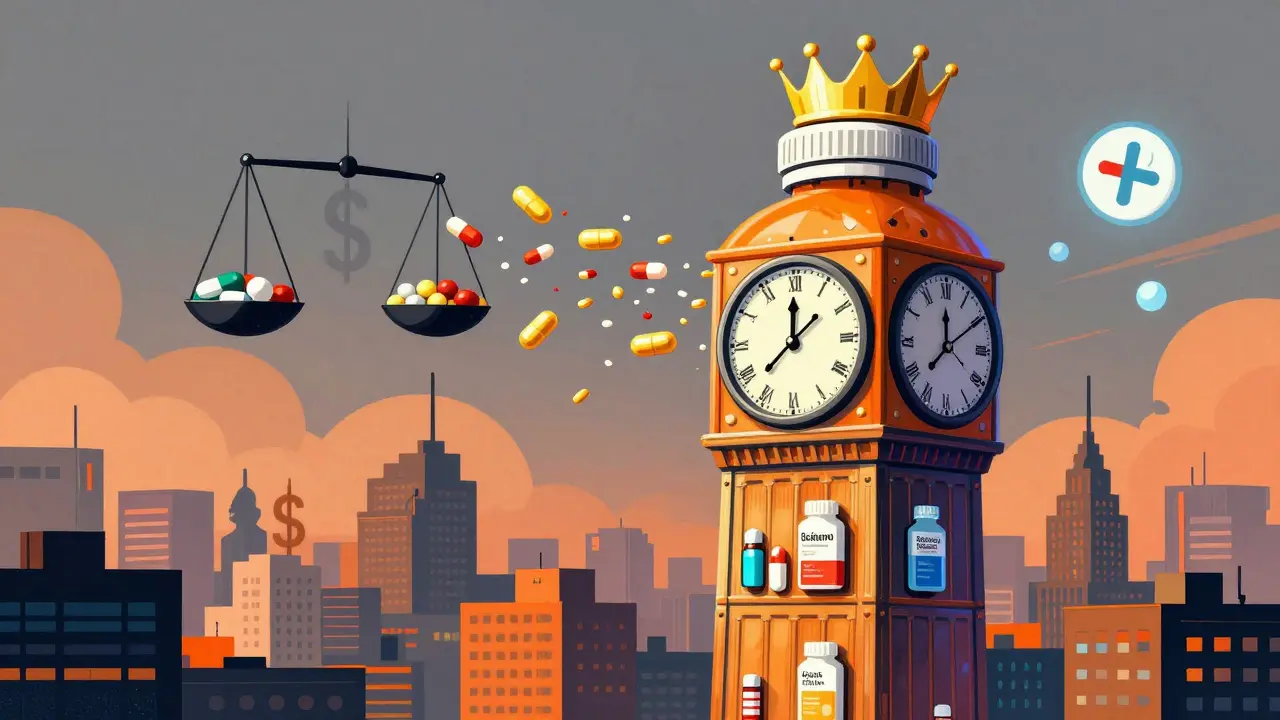
Every year, the FDA approves hundreds of generic drugs. These aren’t just copies of brand-name pills-they’re the reason millions of Americans pay less for prescriptions. The real impact? Billions in savings. But those numbers don’t stay flat. They spike, drop, and shift depending on which drugs lose patent protection. If you’ve ever wondered why your insulin or blood pressure med suddenly dropped in price, it’s because of these approvals-and the year-by-year savings they create.
What the FDA Actually Tracks
The FDA doesn’t just count how many generics get approved. It tracks how much money those approvals save the system in the first year after they hit the market. This is called first-generic savings. It’s not about all generics in use-it’s about the moment a brand-name drug loses its monopoly. That’s when prices crash.
Take 2019. That was a record year. Seven major brand drugs lost exclusivity, and their generic versions flooded the market. The result? $7.1 billion in savings in just 12 months. That’s more than the entire annual budget of some U.S. states. In 2020, the number dropped to $1.1 billion. Why? No blockbuster drugs expired that year. The savings weren’t gone-they just hadn’t kicked in yet.
The pattern is clear: savings aren’t steady. They’re tied to patent cliffs. When a top-selling drug like Humira or EpiPen loses protection, savings jump. When there’s a quiet year with no big-name drugs expiring, the number looks small. That’s why 2022 bounced back to $5.2 billion-five major drugs, including ones for high cholesterol and diabetes, went generic all at once.
Total Savings: It’s Not Just New Approvals
But the FDA’s number only tells part of the story. The Association for Accessible Medicines (AAM) looks at the whole picture: every generic drug sold in a year, no matter when it was approved. That’s where the real scale shows up.
In 2023, generics saved the U.S. healthcare system $445 billion. That’s not a typo. That’s more than the GDP of many countries. And it’s not just about one year. Since 2014, generics have saved Americans over $3.1 trillion. Think about that: nearly $1 billion saved every single day for the last decade.
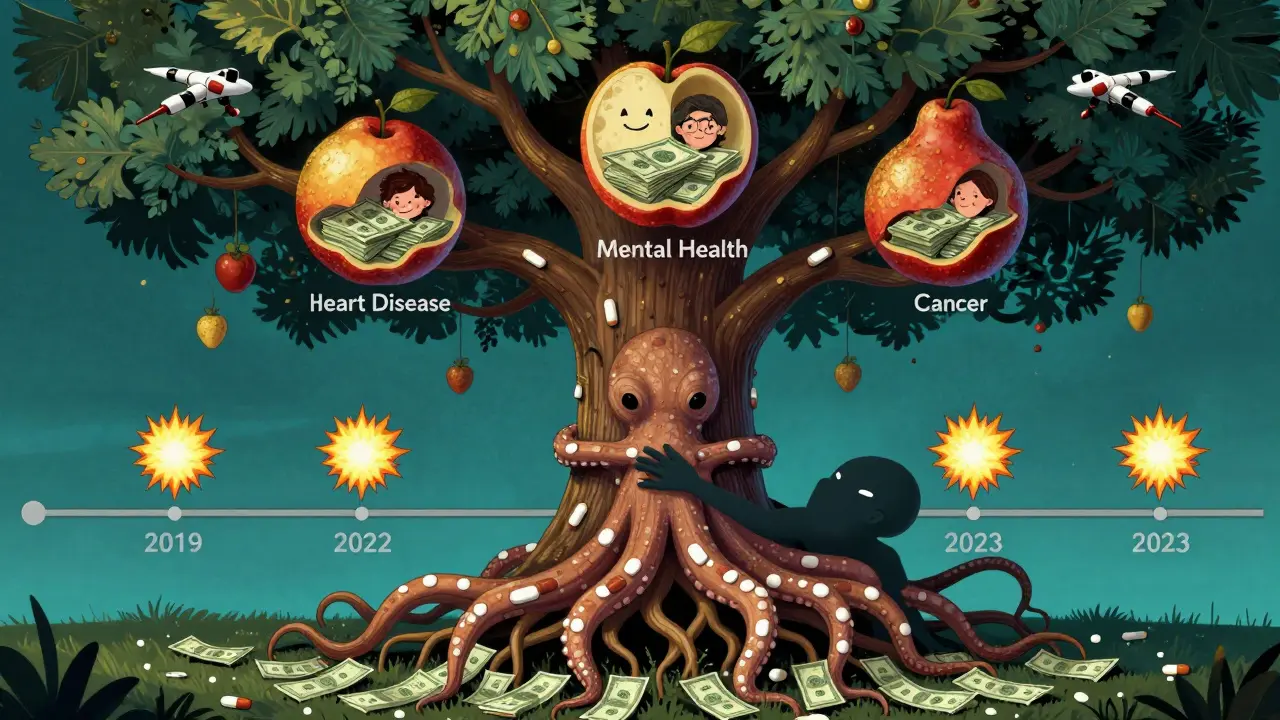
How does that break down? Medicare saved $137 billion in 2023-$2,672 per beneficiary. Commercial insurers saved $206 billion. Medicaid saved the rest. The biggest winners? People with heart disease ($118 billion saved), mental health conditions ($76 billion), and cancer ($25 billion). These aren’t theoretical numbers. They’re what someone pays-or doesn’t pay-at the pharmacy counter.
Why Prices Drop So Fast
When a brand-name drug goes generic, prices don’t just dip-they collapse. On average, the first generic enters at 30% of the brand price. Within a year, with more competitors joining, prices fall to less than 10%. Some drugs drop over 95%.
For example, when the generic version of the cholesterol drug Lipitor hit the market, the brand price of $120 per month dropped to $4. That’s the kind of swing that turns a monthly expense into a $2 copay. The FDA found that in 2021, the average generic copay was just $6.97. About 92% of generic prescriptions cost $20 or less.
But here’s the catch: not all those savings reach the patient. Pharmacy benefit managers (PBMs) often keep a big chunk of the discount through rebates. A 2023 Senate investigation found only 50-70% of the savings actually lower what you pay out of pocket. The rest goes to middlemen. Still, even with that leakage, generics cut costs dramatically.
Who Benefits the Most?
It’s not just individuals. States save billions too. California’s Medicaid program, Medi-Cal, saved $23.4 billion in a single year. Alaska, with a much smaller population, saved $354 million. That’s the power of scale.
Generics now make up 90% of all prescriptions filled in the U.S. But they cost only 13.1% of what brand drugs do. That means for every dollar spent on prescriptions, just over 13 cents goes to generics. The rest? That’s all brand-name drugs. And yet, without generics, that 13 cents would be $90 cents.
That’s why states, insurers, and even the federal government push for faster generic approvals. The FDA’s review time has dropped from 30 months to under 10 months for standard applications thanks to the Generic Drug User Fee Amendments (GDUFA). Faster approvals mean faster savings.
The Volatility Factor
One thing you’ll notice: the savings numbers jump around. Why? Because it’s a lottery. The biggest savings come from drugs that make billions for their makers. When a drug like Humira-once the world’s top-selling medication-goes generic, the savings are massive. But if the only drug that expires that year is a niche treatment for a rare condition, the savings might be under $100 million.
In 2021, just five first generics accounted for half of the $1.7 billion in first-generic savings. And 21 new molecular entity (NME) generics made up nearly $1.4 billion of that total. That’s concentration. One approval can move the needle. The next year, nothing happens. That’s why you can’t assume savings grow every year. It depends on what patents expire.
That’s also why 2020’s low number ($1.1 billion) wasn’t a failure-it was just a quiet year. The next year, 2021, jumped to $1.37 billion. Then 2022 hit $5.2 billion. The system isn’t broken. It’s just unpredictable.
What’s Coming Next?
The pipeline is full. More than 200 brand drugs are set to lose patent protection by 2030. That includes drugs for Alzheimer’s, rheumatoid arthritis, and severe asthma. Each one could mean billions in savings.
Biosimilars-generic versions of biologic drugs-are starting to make a dent. As of August 2024, the FDA had approved 59 biosimilars. They’re more complex and slower to adopt than small-molecule generics, but their savings are growing. In 2023, biosimilars saved an estimated $1.5 billion. That number is expected to climb to $20 billion annually by 2030.
But challenges remain. Some brand companies use legal tricks-like patent thickets, REMS restrictions, and pay-for-delay deals-to delay generics. The FDA’s 2023 Drug Competition Action Plan is trying to crack down on those tactics. If successful, savings could climb even higher.
What This Means for You
If you take a prescription, especially for a chronic condition, you’re already benefiting. You might not realize it, but the $5 you paid for your generic metformin? That’s because someone else fought for approval years ago. The $10 for your lisinopril? That’s because the FDA approved a generic version in 2021.
And it’s not just about cost. Generics make treatment accessible. A patient who can’t afford a $500 brand-name drug can now take a $4 generic. That’s not a policy win-it’s a life change.
Every time you fill a generic prescription, you’re part of a system that saves the country billions. You’re not just saving money-you’re helping the whole system work better.
How much do generic drugs save Americans each year?
In 2023, generic and biosimilar drugs saved the U.S. healthcare system $445 billion, according to the Association for Accessible Medicines. This includes savings across Medicare, Medicaid, and private insurance. The FDA also reports that new generic approvals in a single year can generate billions in savings-$5.2 billion in 2022 alone from first-time generic entries.
Why do generic drug savings vary so much from year to year?
Savings spike when high-revenue brand drugs lose patent protection. For example, 2019 saw $7.1 billion in savings because several blockbuster drugs went generic. In 2020, only low-cost niche drugs expired, so savings dropped to $1.1 billion. It’s not about how many generics are approved-it’s about which ones. A single drug like Humira or Lipitor can account for billions in savings.
What’s the difference between FDA and AAM savings numbers?
The FDA measures savings from drugs approved in a given year during their first 12 months on the market. The AAM measures total savings from all generics sold in a calendar year, regardless of when they were approved. So the FDA number shows the impact of new competition, while the AAM number shows the full, cumulative effect of generics in the market.
Do patients actually see these savings at the pharmacy?
Often, yes-but not always. The average generic copay is around $7, and 92% of generics cost $20 or less. However, pharmacy benefit managers (PBMs) sometimes keep part of the discount through rebates. Studies show only 50-70% of the savings from generics reach patients directly. Still, even with that leakage, generics are far cheaper than brand drugs.
Which therapeutic areas save the most money with generics?
In 2023, heart disease treatments saved $118.1 billion, mental health medications saved $76.4 billion, and cancer drugs saved $25.5 billion. These are high-cost, long-term conditions where patients take medication daily. Switching to generics cuts monthly expenses from hundreds to just a few dollars.
Are biosimilars as cost-effective as traditional generics?
Not yet, but they’re catching up. Traditional generics are simple chemical copies and often drop prices by 90%. Biosimilars, which copy complex biologic drugs, are harder to make and cost more. As of 2024, 59 biosimilars have been approved by the FDA. They saved about $1.5 billion in 2023, but that number is expected to hit $20 billion annually by 2030 as more biologics lose exclusivity.
How many generic drugs does the FDA approve each year?
The FDA approved 742 generic drug applications in 2022 and 633 in 2021. Not all are first-time generics-many are additional versions of drugs already on the market. First-generic approvals vary yearly: 48 in 2021, 51 in 2022. The number depends on patent expirations, not just regulatory speed.
What’s driving the growth of generic drug savings?
Three main factors: more brand drugs losing patents, an aging population needing more medications, and payers pushing for lower-cost alternatives. By 2030, over 200 brand drugs are expected to go generic. The FDA is also speeding up reviews-95% of standard applications are now approved within 10 months-helping savings kick in faster.
Do generic drugs work the same as brand-name drugs?
Yes. The FDA requires generics to have the same active ingredient, strength, dosage form, and route of administration as the brand drug. They must also meet the same strict standards for quality, safety, and effectiveness. The only differences are in inactive ingredients (like fillers) and packaging. Generics are not inferior-they’re identical in effect.
How can I make sure I’m getting the generic version of my drug?
Ask your pharmacist. Most states allow pharmacists to substitute a generic unless the doctor says "dispense as written" on the prescription. You can also check your prescription label-it will say the generic name in smaller text below the brand name. If you’re paying more than $20 for a drug that has a generic, ask if a cheaper version is available.
Kathryn Weymouth
It’s wild how much of a difference generics make - I didn’t realize my $5 metformin was part of a $445 billion system. The FDA’s first-generic data is fascinating, but the AAM’s total savings number is what really hits home. This isn’t just policy - it’s survival for people choosing between insulin and groceries.
And the fact that 92% of generics cost under $20? That’s the quiet revolution no one talks about.
Julie Chavassieux
So much noise. So little real change.
Candy Cotton
It is imperative to note, with the utmost clarity, that the United States of America leads the world in pharmaceutical innovation and regulatory efficiency. The FDA's rigorous standards ensure that generic drugs, while economically advantageous, maintain uncompromising quality. The $445 billion in savings is a testament not to the decline of brand-name pharmaceuticals, but to the brilliance of American enterprise and oversight. No other nation can replicate this model - and frankly, they shouldn't try.
Sam Black
Man, I never thought about how the math works - one drug going generic can drop a $120 monthly pill to $4. That’s not a discount, that’s a miracle. And yet, we still let PBMs pocket half the savings? We’re letting middlemen turn healthcare into a casino.
Imagine if that 50-70% leak went straight to patients. No one would have to choose between meds and rent. We’re not broken - we’re just being robbed politely.
Cara Hritz
did you know that the fda approves like 700 generic drugs a year?? and most of em cost less then 10 bucks?? i think this is like the most important thing ever and no one talks about it??
Jamison Kissh
There’s something deeply poetic about this: a molecule, identical in every measurable way, becomes a lifeline simply because the patent clock ran out. We’ve built a system where access to health is tied to corporate monopolies - and the only thing that breaks those monopolies is time.
Generics don’t just lower prices. They restore dignity. They say: you are not a balance sheet. You are a person who needs to live.
Art Van Gelder
Okay, let’s take a breath and look at the big picture - because this isn’t just about pills and prices. This is about the soul of American healthcare.
Think about it: a guy in rural Ohio with diabetes pays $4 for metformin instead of $500. He doesn’t miss work. His kid doesn’t have to go without. His wife doesn’t cry at the kitchen table. That’s not a statistic - that’s a family staying intact.
And then you’ve got the biosimilars coming in - complex, expensive, slow to catch on, but when they do? They’ll be the next wave of salvation. Imagine a $10,000 cancer drug dropping to $1,000. That’s not just savings - that’s hope.
But here’s the ugly truth: the system’s rigged. Patent thickets? Pay-for-delay? Those aren’t loopholes - they’re legal theft. And the FDA’s 2023 action plan? It’s a start. But we need more than plans. We need people screaming in Congress until someone listens.
And yeah, I know - it’s boring. It’s numbers and regulations. But every time you swipe your card at the pharmacy and pay $6 for a drug that should’ve cost $200? That’s a victory. A quiet, uncelebrated, life-saving victory.
So next time you see a generic label? Don’t just take it. Honor it. Because someone fought for that price. And someone’s still fighting.
Kiranjit Kaur
OMG this is so important!! 💖 I just got my generic blood pressure med for $3 and I cried 😭 thank you FDA and all the scientists who made this possible!! 🙏🇺🇸🇮🇳 #GenericsSaveLives
Sai Keerthan Reddy Proddatoori
Generic drugs? More like government-approved fake medicine. Brand-name drugs are tested for decades. Generics? They copy the formula and cut corners. You think your $4 pill is the same? Think again. The FDA is in bed with big pharma and China. This whole system is a scam to weaken American health. You're being poisoned with cheap imports.
Johnnie R. Bailey
One thing people miss: the real hero here isn’t the FDA - it’s the generic manufacturers who take the risk. They invest millions to reverse-engineer a drug, navigate regulatory hell, and then sell it for pennies.
And when the first generic hits? The market doesn’t just drop prices - it obliterates them. That’s capitalism working the way it should: competition kills monopolies.
The problem isn’t generics. It’s that we let PBMs, insurers, and pharmacy chains turn savings into profit. The fix? Transparency. Force them to disclose rebate structures. Let patients see the real discount.
Also - yes, generics are identical. I’ve worked in pharmacy for 20 years. I’ve seen patients switch from brand to generic and not notice a difference. Not one. Not ever. The science is rock solid.
Herman Rousseau
Just wanted to say - if you’re reading this and you’re on a generic med? You’re doing something powerful. You’re not just saving yourself - you’re lowering costs for everyone else. That’s the ripple effect.
And if you’re still paying full price for a drug that has a generic? Ask your doctor. Ask your pharmacist. Don’t be shy. That $200 bill? It doesn’t have to be yours.
Keep fighting. Keep asking. Keep choosing the cheaper option. You’re not being cheap - you’re being smart. And you’re helping fix a broken system.
👏